Showing posts with label aikido. Show all posts

Monday, 6 June 2022

I'm still here.

I haven't written for a while. There is a reason for this, I have started a podcast. It felt like a natural progression from writing blogs. I still have to put a script together but I can also have conversations with others! 

My podcast is called Musha Shugyo: A Warrior's Journey. On this podcast I investigate the mindset of warriors both past and present. This involves me talking about some of my own ideas, having conversations with interesting people and doing the odd book review here or there. I am enjoying the process immensely. The podcast community appears to be a cool group of people as well. I have made contact with other podcast hosts and have shared ideas and conversations about topics that interest us. The podcast has been going since the start of the year and has received over 500 downloads. 

So does this mean I stop blogging? No. This space is for my own thoughts on my martial journey with both Aikido and TSYR. Think of it as a martial arts diary. The podcast has a different focus.

Okay, where are things at for me right now? Well, so far, this year has been a strange one. Due to Covid restrictions, my work has been rather stressful. Unfortunately, this impacted my health for some time and I found I couldn't train without problems. It turned out I had some issues with my nervous system which seems to be under control with medication. The good news is that blood work has come back negative for anything nasty. The medication has allowed me to get back on the mat and I am both teaching Aikido and training in TSYR at my full capacity again. 

On the up-side, I made contact with my Aikido sensei and he has managed to get my dan certificates organised, these are now up on my wall at my dojo. Its nice to show the parents of my students that I actually have credentials. 

My shodan and nidan certificates.

My student numbers dropped over the last two years due to Covid-19 restrictions. It has always been a small group with the biggest class being 5 children. However, my youngest daughter and a boy from the local community keep on training and as of last week a third student is on board. I have found the biggest challenge to keeping students where I live is high school. The kids grow up and go off to high school, find some new opportunities and drop aikido. 

Still on aikido, my podcasting took me to the Coromandel where I had the opportunity to interview a pioneer of aikido in New Zealand. David Lynch started the first New Zealand aikido dojo in 1965!  It was great to talk to a man in his eighties who still values his aikido training. 

So I am keeping busy around work and family. Hopefully, I will still blog but probably not as often as I used to, as podcasting shares some of my time now.


Train safe!


Friday, 1 January 2021

Hello 2021

Well! Where to begin? Little did any of us know what 2020 would bring and even now many people in the Northern Hemisphere are still locked down at home as their countries deal with the pandemic. I count myself very lucky. New Zealand (thus far) has escaped the worst of it. We have suffered a total of 25 deaths and of the 2,162 people that had cases, 2,082 have recovered. Currently we have no restrictions in place other than our borders being closed. Life goes on as normal for the most part. 
I thought I would look back at my first post of 2020 and see if any of my predictions came true. I started last year's blog discussing the number of aikido students I had (two) and growing this. During 2020 I taught four students regularly so I doubled my numbers! As I have said before I don't advertise, it is just by word of mouth that children end up training with me and four is a good number for now. As it was, Covid restrictions created a fairly strange year and training was on and off as the country moved through different alert levels. 
As for teaching TSYR? Well, the Auckland study group were hit hard by Covid-19. Not only did they go into lockdown when the rest of the country did, later in the year, their region was hit again and although the restrictions the second time around were not as bad, it halted training for that group and people weren't allowed to travel to Auckland unless they were essential workers. So I think I managed two trips to Auckland last year and that was it. My own training continued unabated. We have a core group of about six of us that routinely train at the Hamilton Dojo and the group trains three days a week. I try to make two of those training sessions but sometimes it is only one if family commitments call me away. I also can train by myself at my dojo to make up for this. This evening one of the Auckland guys is driving down to stay the night and then he and I will have the first training session of 2021 at my dojo in the morning. 
As for my hopes for 2021? Well, I am very conservative this time around. I don't see New Zealand opening its borders until the pandemic is under control, this means no visits from Threadgill Sensei. As a group, the Hamilton branch must simply keep training to the best of our ability. Aikido will start up when the school term starts in February and I hope to get enough training in to grade some of the students at the end of the year but again, who knows? All it takes is one person to be irresponsible and Covid could be among us again. So, I will take each week as it comes. 
My post is sounding a bit bleak but to be honest, personally, I have had a very good year. My family has stayed in good health. Professionally, both my wife and I have had a successful year, and our daughters are also achieving very well in their pursuits. So there is plenty to be happy about.

I hope this year brings health and happiness to everyone. Train safe! 
Dean.

Sunday, 6 September 2020

Ironing out the kinks and removing the slack.

I thought I would just write a short post this time. 

Winter is a tough time for me as I don't get in as much training time as I would like. My Saturday morning training sessions are hijacked by my obligation to take my daughter to her football (soccer) games instead.  Now, don't get me wrong, I really enjoy watching her play but I miss a key training session each week. As weeks go by I find my body tightens up and old injuries start hurting. 

Jack having a bad day.

Saturdays at the Hamilton dojo usually focus around taijutsu and bodywork stuff. It is the foundation a lot of the other things hinge around. By the end of the football season I am really noticing the reduced training. During the week during our kenjutsu class, I really felt by body fighting me. Quality sword work really suffers if your body is not aligned correctly and it physically hurt to adjust habits I was forming from working on a computer and driving the 40 minutes to and from work everyday. Certain muscles had tightened up and it took fifteen minutes or so to get everything working correctly again. By the end of that session my body had limbered up and I was feeling better but I was discouraged how one less training session a week was hampering my progress. My lovely wife opted to take our daughter to training yesterday so I could get a Saturday session in. During the training we covered chokes, vital points for striking and body throws. I could feel tendons and muscles clicking and crackling back into place as I trained and walked out the the dojo feeling much, much better. 

As I get older I appreciate more and more the need to stay mobile for good health. Stuck in a chair for long periods or stooped over a computer increase my chances of getting injured as muscles stiffen and tighten. I have known this for a while now, mobility is the key to physical health in my humble opinion but sometimes as work and family keep me busy it is easy to get lost along the way.

As I write this I am reminded of a quote from Morihei Ueshiaba, the founder of Aikido:

The purpose of training is to tighten up the slack, toughen the body, and polish the spirit.

I certainly feel like I am in need of some serious slack-tightening! It feels to me like O'sensei must have had days like mine for him to say such things. 


Train safe, everyone!


Monday, 13 January 2020

Learning to use/abuse power.


This post was inspired by an article written by Ellis Amdur, titled Ballet Boy. I suggest you read it before following the rest of what I write. I'm not going to pretend I know what Ellis is getting at in that article but this is what hit me.  The boy in the story gets beat up and bullied, then he eventually retaliates and finds that he is stronger than he thought he was. He then systematically hunts down and deals with each of his bullies. This didn't sit well with me. Maybe I'm too much of a romantic, maybe I am being unrealistic but the fact that the boy suddenly realises he has power and then uses it to harm others bothers me. Yes, I know that they got him first and it was payback. I don't think that makes it right. For years I have wondered why I keep learning how to use violence to control or hurt people as a pastime. I came to the conclusion that I wish to know how to use violence to protect others rather than to have power over others or bully people. It's a big deal for me. 

I live in a pretty safe country and in an even safer community so I may never need to use this stuff but I do have one story to illustrate my point. 

A few years back I was training at the Hamilton dojo (the Yoshin Wadokan) with my fellow TSYR deshi. It was a freestyle training session. So we just had on gi pants and T-shirts, not our full keikogi and hakama. We had just got onto the mat when one of the women who turned up a little late said, "Did you see that couple out on the field?" Next to the dojo is a large green sports field. As we opened the doors to look out upon this field we could see a man standing over a woman who had obviously fallen to the ground. It was obvious that they were having an argument and it had got physical. My sensei immediately jogs towards the couple yelling "What do you think you are doing?" Right behind him are myself and two other deshi. Upon seeing us approach the man straightens up and steps away from the woman on the ground. His demeanour changes very quickly from aggression to appeasement as he sees he has been busted abusing his partner. The female deshi helps the woman up and starts to lead her away asking if she is alright and has she somewhere she can go? I stay and talk to the male, who is calling me sensei at this point (eye-rolling moment) he even offers me a can of Bourbon and cola that had fallen out of his back pocket during his scuffle with the woman. I decline. I can see that he has scars on his face from old scratch marks that he received, no doubt from the woman he was standing over. I suspect this couple have been in a culture of violence for a while. 
This man is probably a threat to nobody except his partner and looks to get as much as he gives. Eventually everyone is talked down and the man and woman move off in different directions. We go back to keiko. I'm pretty sure those two would be back together in no time and smacking each other around again. 

Here is an example where my dojo mates and I could use our power for the right reasons. We didn't need to rough-house the guy or threaten him but simply let him know that what he was doing was wrong and we wouldn't stand for it.

Good Jack or Bad Jack?
There are many instances both in and out of the dojo where power is used to abuse others. Ellis Amdur does a very good job of discussing this in Chapter 10 of his book, Dueling with O-sensei. It is a great read and I highly recommend it for any martial artist not just those practising Aikido. To quote Amdur, "The dojo is a laboratory in which we can embody some of the most horrifying potentials of humanity, with the aim of mastering and controlling them. It must, therefore, be a place of trust and honorable behaviour." Amdur acknowledges that we are learning how to be good at violence. In doing so we must surround ourselves with a culture of safety and care. This is very important to the mental state of all involved. 

When I was an enthusiastic 5th or 4th kyu in Aikido I bought into the harmonious and healing nature of Aikido. I thought Aikido could change people and bring peace to everyone's lives. The dojo could be a sanctuary for strays and the down-trodden. The problem with this thought, as good-intentioned as it was, is that when you bring people into a space, they bring their values and ideas with them. They are not hollow vessels waiting to be filled. So I was naive to think that people who may train once or twice a week with us would change radically from the person they were. Sure, there are instances where Aikido has helped people improve their lives, but they have to want to change and other factors are at play here as well, like good friends or agencies supporting them, not just the dojo. 

I remember one fellow that joined us at the dojo. He had obviously had a rough time in his life and although he tried to fit in at the dojo, some of his habits of distrust and anger were too ingrained that he compromised the safe,caring nature of the dojo. After he had been spoken to on many occasions about some of his behaviour he slowly disappeared and we never saw him again. Last I heard he was training at another Aikido dojo in town.

When I speak of learning to use power, I don't only mean physical power. The culture of a dojo can lend itself to abusing people psychologically and emotionally as well. We have all seen those movies where the young apprentice wants to learn the martial arts from the master. We then join the local dojo and think "teach me, sensei." at any cost. This requires a high level of trust and some people exploit that trust. Then there are the kids' classes. Those little people are put in your hands by their parents and they are trusting you to look after their sons and daughters and keep them safe in a potentially dangerous environment. The allure is strong here. As a teacher/instructor/sensei you have absolute power in that context.

The Budo Kensho (Budo Charter) released by the Nippon Budo Kyogikai (Japanese Budo Association) in 2009 states that through physical and mental training exponents seek to build their character, enhance their sense of judgement, and become disciplined individuals capable of making contributions to society at large. That is just article one. There are six articles that speak of things like teachers being role models, everyone showing respect and emphasis on more than just gaining technical skill. Lofty ideals but the document makes it clear what is expected of any budoka. The irony is I have seen these things exhibited better in my current koryu practice than in any gendai budo dojo I have stepped into.

The longer I train the more I see the mental/psychological aspects of my training becoming more important and that of the quality of a person's character. Some people just enjoy hurting others. I don't want to be the one that gives them more tools to do so. I find myself in a privileged position of teaching Aikido to children. I have a chance to influence how they view and use power in their lives as they grow. 

So these days, as I teach my own Aikido class and train in TSYR I am more comfortable with training with people that fit the mindset of the budo I practice rather than the other way around. Good people make good budoka. Lets give the power to those who already have the morals and values to wield it graciously, with honour and integrity.

Train safe!

Thursday, 3 October 2019

Influences, scholars and good reads.

As time has gone by I have been contacted occasionally by those of you who actually read this blog. I can not take all the credit for some of the ideas I write about. A lot of what I write about is my own experiences in budo. However, some of my posts are also inspired by something I have read. This post is about those influential authors and I hope some of you will delve deeper into what these people have to offer.
Disclaimer: Many of the profiles written below have come from Koryu.com.

Ellis Amdur
Ellis Amdur

I have all three of Ellis' books on the martial arts. I really enjoy his writing style and he has a lot of knowledge to share on koryu bujutsu and aikido. 

Ellis began his martial arts training in 1968. He spent 13 years in Japan, and currently holds instructor licenses in Araki-ryu Torite Kogusoku and Toda-ha Buko-ryu naginatajutsu. He teaches these two martial traditions in Seattle. He began aikido training in 1973 with Terry Dobson in New York City, and continued his training in Japan with an number of instructors, most notably Yasunori Kuwamori and Yoshio Kuroiwa. He is the founder of Edgework, which offers training and consultation to law enforcement and social service personnel for the de-escalation and management of the behaviour of emotionally disturbed individuals. He has his own budo website you can view here. Many chapters in his books inspired me to write my own feelings and ideas about my martial arts practice. The first piece of writing I read from Ellis Amdur was called "Hiding in the Shadows of the Warrior." and I discovered it as an article on the Koryu.com website (see below). The experience Ellis was writing about was so raw and honest that I was hooked on his writing from then on. I looked everywhere online for his writings and eventually bought his books. My TSYR instructor and another member of my dojo were in Seattle this year for karate training and met Mr Amdur. They said he was a very interesting guy and had a discussion with him on generating internal power.


Meik and Diane Skoss
It was the website Koryu.com that was my gateway into the world of koryu bujutsu. Living in New Zealand means I live in a remote area of the world so the internet is my main source of quick and free information. I stumbled upon this website while trying to decide if training in a classical Japanese martial art was right for me. In fact, many of the authors I write about in this post are mentioned at Koryu.com and that is the first place I read about them. 
Diane Skoss founded Koryu Books in 1996, and is the creator of Koryu.com. Prior to moving to Tokyo in 1987, she earned a Masters of Library Science and an MA in English. She was Managing Editor of Aiki News/Aikido Journal for six years, beginning in 1990, and was in charge of producing most of the books published by Aiki News between 1990 and 1996. In late 1997, she returned to the U.S. where she and her husband (Meik) run a dojo in New Jersey. Her own training began with Tomiki aikido in 1982 at Indiana University, and she now holds a 4th dan, Jiyushinkai, and 4th dan, JAA. Started training in jukendo (bayonet) and tankendo (short sword) in 1990 under All-Japan Jukendo Federation instructor Wakimoto Yasuharu, hanshi 8th dan; she is currently 5th dan in jukendo and 3rd dan in tankendo. Began training in Shinto Muso-ryu jo under menkyo kaiden Phil Relnick in 1991; she is now menkyo kaiden and also holds Zen Nihon Kendo Renmei jodo 3rd dan, and Jodo Federation of the U.S. 2nd dan. Entered the Toda-ha Buko-ryu under Soke Nitta Suzuyo in 1993, and holds the okuden license. Has also trained in atarashii naginata and judo. She is the editor of Koryu Bujutsu, Sword & Spirit, and Keiko Shokon, the "Classical Warrior Traditions of Japan" series (of which I have the first and hope to buy the other two in the future).

Meik Skoss began training in martial arts in 1966 in Los Angeles. In 1973 he went to Japan to continue his training in aikido. After moving to Tokyo in 1976, Skoss started studying Shinto Muso-ryu jo under Shimizu Takaji, Toda-ha Buko-ryu naginatajutsu with Muto Mitsu, and Tendo-ryu naginatajutsu under Sawada Hanae. It was also at this time that he began to work with Donn F. Draeger and accompanied the master hoplologist on several field trips to Southeast Asia. In 1979 he began his study of Yagyu Shinkage-ryu heiho/kenjutsu and Yagyu Seigo-ryu battojutsu under the 21st generation lineal headmaster, Yagyu Nobuharu Toshimichi. He has also practiced judo, t'ai chi ch'uan, Goju-ryu karatedo and is currently training in jukendo and atarashii naginata. An MS in Physical Education, Skoss holds the ranks of 5th dan Zen Nihon Kendo Renmei jodo, 5th dan jukendo, 4th dan aikido (Aikikai), 3rd dan tankendo, 2nd dan atarashii naginata, the okuden mokuroku and shihan licenses in Toda-ha Buko-ryu, and menkyo in Shinto Muso-ryu jojutsu. Fluent in Japanese, and the owner of a substantial library of martial arts books in both English and Japanese, Skoss is one of several hoplologists continuing the work of Donn F. Draeger. He has travelled throughout Japan visiting various koryu and modern budo dojo and collecting information on the Japanese martial arts. Now resident in New Jersey, he and his wife (Diane) run a dojo there. Meik is quite active on certain facebook groups and online forums concerning koryu bujutsu. 


Stanley Pranin
Passed away in 2017 leaving behind his legacy: Aikido Journal (formerly Aiki News). Stanley shattered many myths about Aikido and its history while still being a strong promoter of the martial art. As a beginning Aikido student I would read many articles that Stanley put out, including an interview with Takamura sensei. I immersed myself in the information I found on Stanley's website.
Aikido Journal continues under the supervision of Josh Gold.


Wayne Muromoto
I came across Muromoto's writing much later than the other authors. He is the publisher of Furyu: the Budo Journal (appears to be out of print) and Furyu Online (no longer active). He began his martial arts training some twenty-five years ago, and has spent several years studying Urasenke chanoyu (tea ceremony) and various martial arts in Japan. He is a direct student of Ono Yotaro, headmaster of Bitchu-den Takeuchi-ryu and holds the rank of yondan (shihandai or official representative instructor under the old system) as well as the chu-mokuroku in that school. He is also a student of Ohmori Maso in Muso Jikiden Eishin-ryu iaijutsu. Muromoto has experience in a wide variety of martial arts including judo, aikido, karatedo, t'ai chi ch'uan, jodo, and kendo, and holds the rank of sandan from the Zen Nihon Kendo Federation in iaido. What I value the most is Mr Muromoto's writings on his blog, The Classic Budoka. Last count he had 111 posts up there. I still have much to read of his works. 


Dave Lowry
Dave Lowry has been involved in the study of traditional Japanese martial arts and Ways since 1968 and has written about them for more than twenty years. His articles have appeared in magazines in the US, Japan, and the UK, including work as a long-time columnist for Black Belt magazine. I have several of Dave Lowry's books in digital form. My favourite are his two books on his experiences learning Yagyu Shinkage Ryu, Autumn Lightning and Persimmon Wind. He has many others if these don't suit you. 

Threadgill sensei with my own instructor (Photo taken in New Zealand)
Toby Threadgill
Yes, of course my TSYR sensei is on this list.
In 1985 Toby Threadgill initiated training under Takamura Yukiyoshi, headmaster of Takamura-ha Shindo Yoshin ryu. In 1992 he founded the Soryushin Dojo and in 1994 was appointed a branch director of the Takamura-ha Shindo Yoshin Kai. In 1999, he was one of three people to be awarded a menkyo kaiden in Takamura-ha Shindo Yoshin-ryu. Following the passing of Takamura Yukiyoshi in 2000, he was asked by the other TSYR branch directors to accept the position of administrative head (kaicho) of the Takamura-ha Shindo Yoshin Kai. He currently oversees instruction at the Shindo Yoshin Kai Hombu Dojo in Colorado and maintains a busy international teaching schedule.
Threadgill sensei has written the student handbook for the kai and some of his articles can be found online. For more information go here.

These people have been invaluable in giving me access to Japanese ideas and experiences about budo that I would otherwise not get in English. They are the reason myself and so many others can now enjoy koryu bujutsu in the West.


Saturday, 20 October 2018

Aikido: the next generation.

For those of you that have been following my blog for a while you know that I have a private, 12 mat dojo on my property. This is a space used for my own TSYR training but for over two years I have also taught aikido to children in this space.

Recently my daughter and another local girl graded for their 6th kyu (yellow belt). I invited my own aikido teacher, Clyde,  to be on the grading panel. This was a proud moment for me as I have not spoken to Clyde, face-to-face for a long time. TSYR has become my focus these past years and although aikido is dear to my heart, I don't have the time to practise both martial arts. However, by teaching aikido once a week in my own dojo it is keeping my aikido waza fresh and I feel like I am passing on what my own teacher has taught me and in this way, aikido moves on to the next generation.

The girls were nervous on the day but so was I!
How the girls performed was also a reflection of my own teaching and I didn't want to let my own aikido sensei down. As it turned out, both girls passed their test and Clyde had some positive things to say about their performance. 

My proud yellow belts and Clyde Sutton sensei


One of the things he mentioned was how both girls moved from their feet. What he was saying was that the girls had good posture and moved strongly using the ground rather than focusing on their arms and shoulders which beginners often do. I was very proud of this comment because I have tried to instil solid principles into the girls' training and not only do I want them to know the appropriate waza for the grading I want to know that principles are being internalised. The fact my sensei could see this was a great achievement. 

I also asked sensei for critique and areas we could work on. This became the focus of my next scheduled training session with the girls. Each girl had a point to consider. My own daughter moves very well and this would mostly be from her ballet training (I can't take all the credit for that one) but sensei asked for a more martial approach, ensuring kuzushi at first contact and making her waza more positive. The other girl naturally rounds her shoulders forward, and although she has worked on this she was advised to keep thinking chest up and forward during her practice. 

What I really liked was how focused our next normal training session was. The grading had re-set their minds and cemented what they were doing well. The girls moved strongly across the mat with good posture and positive technique. 

Now considering these girls are only 11 and 12 years of age, I have the opportunity to turn them into magnificent martial artists provided they keep at it for the next few years. 

Saturday, 13 January 2018

A surprise training session.

So a couple of days ago I was asked by the mother of the girl I am training aikido if I would run a session through the holidays. We decided upon a Thursday morning at 9am before the day got too hot. My daughter joined me and we had our first aikido class for 2018. After giving the mats a good clean we finished up for the day. Or so I thought.

That afternoon I am enjoying some family time when there is a knock at the door. In walks my friend from Auckland, Jules. With him is another TSYR member from Auckland and Marco Pinto from Portugal!

Now, I knew Marco was in the country as Jules had invited him over for a seminar this weekend. I was not able to make the seminar and although Jules and I discussed Marco coming to my dojo I assumed that it was not going to happen. I was wrong.

So it goes without saying that I jumped up and grabbed my training gear and headed for the dojo.
We trained for two hours going over the idori kata. It was humid, stinking hot and fun. I always enjoy Marco's instruction, he moves precisely, totally dominates the mat and has a friendly banter.

There were four of us on the mats and I could see we could perhaps have up to six people total at a push.

After training they were going to go into Hamilton to run a karate session so my wife and I invited them in for an early dinner to fuel them up for the next stage of their journey.

My daughters enjoyed the visitors as well. Board games were played while dinner was being prepared.

All in all it was a great day of training for both aikido and TSYR.


Sunday, 30 April 2017

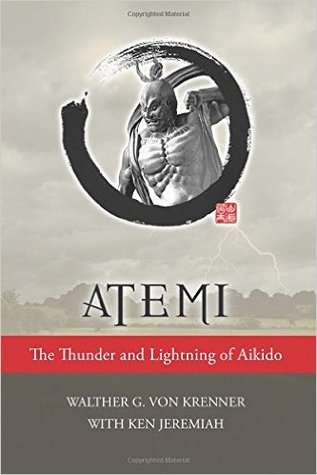
Atemi: The Thunder and Lightning of Aikido - Book Review

This book is written by Walther G. Von Krenner with Ken Jeremiah. Walther has been studying Aikido since the 1960s and runs a dojo in Montana, USA. According to his bio found here he is Hachi-dan in aikido and has studied with Morihei Ueshiba, Kisshomaru Ueshiba and Kochei Tohei.


I will review the book based on the sections it is split into so you can decide if it is something you may read for yourself. I bought the ebook version from Kindle.

The book is split into three parts; Shodan (basic), Chudan (intermediate) and Jodan (advanced). Each part is a section with its own chapters.

Section 1 focuses on striking both from the uke's (attacker) and nage's (defender) viewpoint. The author writes about striking well and with intent. For uke's role he looks at the three stylised attacks often found in aikido dojo; shomen uchi, yokomen uchi and tsuki. He also talks about the grabbing attacks and initiative. For nage's benefit he looks at the first four pinning techniques often practised; Ikkyo, Nikkyo, Sankyo and Yonkyo. He discusses where and why atemi (strikes) are used at the beginning, during or the end of a technique. Chapter Three of this section looks at striking during aikido throws. Kaiten-nage, Shihonage and Sumi-Otoshi are discussed. The final part of section 1 looks at "Putting it all together." The author gives examples of how strikes can be applied to specific examples of attack and defence using pictures. Throughout this section the author references the founder of Aikido, Morihei Ueshiba and attempts to relate sword arts to empty hand strikes. Although the whole section is really about striking correctly as an attacker and knowing when and where to strike during a pinning or throwing technique as a defender, the author offers more than this. He speaks about principles of movement. Such phrases as "The shoulders should never rise while striking.", "Always feel as though you are extending energy from the finger tips and even the elbow joint." and "The basics of stability and correct body movements are the key to performing more advanced techniques." are gems hidden within the text.

Section 2 assumes the Aikidoka has a good understanding of basic striking and moving. The principle of irimi is discussed and defined according to the author. He calls upon principles of Ona-ha Itto Ryu to help describe his concept of irimi. Of course it is only logical that a discussion of irimi leads into a discussion about irimi-nage and that is exactly what happens in this book. Irimi is discussed as a way to dominate an opponent. Keeping this in mind, the author explores aiki and kiai. I'll leave you to read the book to see what is discussed here.

Section 3 delves into the esoteric power of Aikido. Of course there are endless stories of Morihei Ueshiba's power and strength. What the author tries to do is to break down the illusion of mysticism around the founder of Aikido and suggests that there is a definite method of learning and improving this skill. Here the book explores the power of Takeda of Daito-Ryu Aikijujutsu fame and one of his best students, Sagawa Yukiyoshi. Aiki is described as a skill that develops immovability and unstoppable force and not simply "the flow of ki". Tohei's four basic principles are introduced here as a method to develop aiki. Each of the four principles are explained in detail: Keep one point, Relax completely, Keep weight underside, and Extend ki. O-sensei's solo training exercises are also mentioned, especially funakogi-undo and ikkyo-undo. The author stresses the importance of these two exercises in the development of aiki. He takes the point further by adding that having people push on you while doing these exercises will improve your skill substantially. He ends this section with the quote, "The true source of power in Aikido is not within the varied techniques, but rather in the internal training exercises that have been overlooked by many practitioners." 

Conclusion. Finally, the author gives a short conclusion summarizing his main points throughout the book. It is a very good synopsis of what is written and I would actually recommend reading this first and go to the appropriate chapter to read further if key points interest you. 


So my thoughts overall?  I found the book really interesting to read. Having a background in Aikido and what I believe to be some understanding of internal training I liked what I read. However, I am a naturally skeptical man and I have heard some of these terms thrown about (excuse the pun) by Aikido instructors before. Those same instructors didn't really demonstrate any of these principles on the mat (not at least to the level we are talking about here). The author didn't give me enough to be fully convinced he had cracked the internal power thing. I had a search of him on YouTube and there are videos. As is often the case with this stuff it is hard to really know what is going on from just watching someone perform techniques. His martial application of aikido strikes and concepts surrounding this, I agree with. Putting section 3 aside for a moment, the other two sections give plenty for an Aikidoka to work with to ensure they are practising a martially viable version of the art.  
If you are serious about your Aikido then I would recommend this book. At the very least it will give you another perspective from which to view the art. 

Friday, 30 September 2016

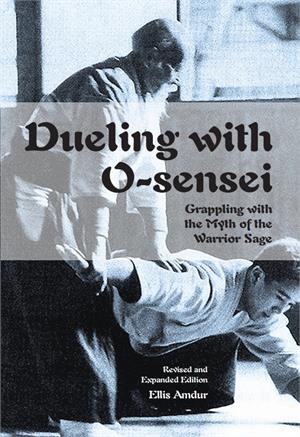
Dueling with O-sensei: Book Review

I was first introduced to Ellis Amdur's writing many years ago when I read the article "Hiding in the Shadows of the Warrior" that had been put up on Koryu.com. That article had a profound affect on me and fueled my interest in koryu budo. I scanned the Internet reading anything I could of Amdur's concerning martial arts. In time I read reviews about his first edition of Dueling with O-sensei: Grappling with the Myth of the Warrior Sage but never got the opportunity to read it myself. Just recently I have finished reading his revised and expanded edition.


It is a book made up of essays that are grouped into chapters following a particular theme. There is so much in this book that I'm not even sure how I'm going to tackle it.

I will start by giving my overall impression of the book. This is one of the best books I have read on the Japanese martial arts. Amdur writes honestly and with conviction, not only about his experiences with martial arts but on the human condition as well. What makes the book so compelling are the personal accounts from the author and how he links them to Japanese concepts. Amdur doesn't shy away from showing peoples' faults including his own and I think it is this quality that helps the reader  reflect on one's own actions and motivations for being in and around the martial arts. 

As with Old School, I will break the book down into chapters and try to cover main themes. There are 23 chapters in the book so at times I may combine some of them simply due to the amount of content that the book contains. 

Chapter 1: The Knights of the Mouldy Rope. 
Amdur talks about his introduction to Aikido and Terry Dobson. The majority of this chapter is about Terry and who he was as a man and his profound influence he had on the author. It is a great piece of writing and I thoroughly enjoyed it. 

Chapter 2: Ukemi from the Ground Up.
This chapter discusses ukemi (receiving body) by taking us through the role of two people training and how these roles have changed over time. He discusses taking ukemi in the context of classical budo and then how that changed in Kano's Judo. He discusses Daito-Ryu and Aikido and how the roles in the training have changed again. Overall Amdur appears to be saying that Ukemi is different things in different contexts. 

Chapter 3: My First Days at the Headquarters Dojo. and Chapter 4: The Best of Their Time.
Here Amdur tells his experiences at Aikido's Hombu Dojo. He writes about his experiences meeting the Doshu of the time, Ueshiba Kisshomaru and his son, Ueshiba Moriteru. The fourth chapter gives Amdur's perspective on a number of high level practitioners of the time; Osawa Kisaburo, Arikawa Sadateru, Tada Hiroshi, Yamaguchi Seigo, and Nishio Shoji. The author gives the reader a personal insight into the character of these men. 

Chapter 5: Forever Young.
This chapter centres around Kuroiwa Yoshio. A man Amdur obviously has a lot of respect for based on his writing. 

Chapter 6: A Conversation with Daito-ryu's Other Child. 
Here we read about Hapkido and its relationship with Daito-ryu and Aikido. 

Chapter 7: Atemi: Striking to the Heart of the Matter.
Amdur writes a small chapter defining atemi, what it is and what it means for aikido practice. 

Chapter 8: Did You Ever Meet O-sensei? O-sensei Who?
O-sensei, defined as great teacher does not always mean Ueshiba Morihei, founder of Aikido. Amdur gives some great examples of people that could be referred to as 'great teacher'.

Chapter 9: Tenchi: Head in the Clouds and Feet in the Muck.
This is a fascinating chapter where Ambur attempts to debunk the Myth of the Warrior-sage, Ueshiba Morihei and tell the man's story as it really was. It is a large chapter but well worth the read. Anyone who practises Aikido should read this chapter. It is eye-opening and makes a lot of sense. Earlier publications by other authors paint Ueshiba as almost god-like. This chapter treats him like a normal man who finds himself in extraordinary situations at times. 

Chapter 10: Toward Simple Morality - Or How Come Something So Fine Sometimes Turns So Ugly.
Here Amdur tackles the topic of abuse in the martial arts. Sexual abuse of children, physical abuse of students of any age and abuse of trust. Aikido in particular lends itself to physical abuse due to the junior-senior relationship set up in the dojo. Amdur's expertise in dealing with this issue is obvious in his writing. It is a tough chapter to read through and sickening in places as the author mentions cases where such abuse has occurred. Despite the content, Amdur's honest writing makes the reader think and reflect on their own practise. One line stands out for me in particular, "Be careful with whom you choose to study. You will become who they are, and if you haven't chosen wisely, you'll suffer and other people will, too." 

Chapter 11: Otoko (Manhood)
This chapter discusses what it means to become a man, in the Japanese context. It is perhaps a way to understand why some interactions in the dojo are set up they way they are and why it can be confusing for Westerners to understand. Amdur compares the Japanese and Western mindset and settles somewhere between the two. 

Chapter 12: Anyone Can Be O-sensei In One's Own Movie. 
This is a personal account of the author trying to be the hero of his samurai movies and discovering that he should stick to fighting his own battles. 

Chapter 13: The Ring is Where You Draw It. 
I'm not completely sure of Amdur's theme in this chapter. The collection of essays appear to be about taking the martial arts out of context. The essays are interesting and remind the reader that the lessons you may learn (or not) in martial arts can be applied outside the dojo. 

Chapter 14: So How Tough Do You Want to Be When You Grow Up? 
This chapter discusses that old chestnut - which martial art is better? Amdur writes about how every martial art makes assumptions that fit into their particular training paradigm. This means practitioners learn how to fight within those parameters and get very good...in those parameters. So what does Aikido promise?

Chapter 15: Setsuninto-Katsujinken.
This chapter is a hard-hitting tale of making hard choices and living with the consequences. Setsuninto (the sword that takes life) and katsujinken (the sword that gives life) are ideas representing the use of the sword for malicious ends opposed to its use for protection of others. Amdur gives the reader a scenario that ends tragically and he had a say in the outcome. Not for the light-hearted.

Chapter 16: Hiding in the Shadows of the Warrior.
I have so many good things to say about this chapter. As I said earlier, this essay was the first piece of writing I had read of Ellis Amdur's and it encouraged me to continue to search for a koryu to train in. War and fighting is ugly, decisions must be made and ultimately you are left dealing with your own demons. It is a fine balance and often there are no perfect answers. 

Chapter 17: Aiki: A State of the Union. 
For me, Aiki is such a loaded  term and here we find Amdur trying to define it. Aiki has been interpreted in many ways over the years and Amdur's take on it comes from a second-hand quote from Ueshiba, "Aiki is a means of achieving harmony with another person so that you can make them do what you want." Another chapter I believe all aikidoka should read. 

Chapter 18: Aiki is Not Always Pretty.
This chapter is a personal account of the author's when dealing with an angry man with a gun. How does one de-escalate the situation so that the least amount of harm occurs?

Chapter 19: Cutting the Circle.
Amdur writes about irimi and tenkan and then, as he likes to do, adds a personal account to emphasize his points. 

Chapters 20, 21 and 22
In these short chapters Amdur looks at three Japanese terms; Musubi (tying together), Bushi no Nasake (warrior's compassion) and Kamae (stance). 

Chapter 23: Oniisan (Elder Brother).
This chapter discusses the author's earlier times in Japan while training and living with Kuwamori Yasunori. It is a tribute, really, to a man Amdur regarded with respect, in his own words he says, "I reflect how much finer a man he was than many of the pirates and rogues that I admired so much," 

At the back of the book is a comprehensive glossary of Japanese terms. 

As you can see, the book covers a lot of ground and although Aikido is much the focus of this book, it is the tales of people that bring it alive. 

To date, this has been the best book I have ever read on budo and especially, Aikido. Highly recommended. 


Sunday, 26 June 2016

The Training (and Posting) Continues!

I must be feeling inspired at the moment. I am churning out the posts!

After many years, I began teaching aikido again this week. I am teaching a 10 year old boy along with my daughter at my private dojo. It's great to be thinking about aikido techniques again. With this young fellow I have to teach dojo etiquette as well because he has never practiced any martial art before. It brings me back to my early aikido days. The first session went very well. My daughter loves the fact that she can be involved in an activity with her dad and the young boy is diligent and keen. As I took them through the most basic of aikido exercises, I can see already that the body mechanics I have learned in TSYR are already having an impact on my movement and how I teach movement to the students. As I journey through aikido with these young people, I suspect I will be able to piece together how I will apply my aikido with my new TSYR 'engine'. It will be interesting. 

I looked back at some of my old posts and came across this one:

In this post from 2012 I say:
"As my young family gets older and if time allows, I may drift back into aikido training along side TSYR training once more. Time will tell."

Well, here I am in 2016 and I HAVE drifted back into aikido along side my TSYR training! My girls are growing up fast, my youngest is 5 and turns 6 in October. Things are certainly easier with two school children and a private dojo to train in. I also have a VERY understanding wife that knows how important budo is to me. 

TSYR training this week was once again, awesome!  On Thursday we worked through both sets of kumitanto kata. These sets we know well so it was all about refinement. 

On Saturday we spent a lot of time on nairiki no gyo and kunren then we got into kansetsu waza. Lots of fun. I am feeling really happy with my progress in these kata. The last few weeks I have felt that my training has been consistent and solid. Threadgill Sensei is out in September so I'm looking forward to seeing what he thinks of our progress at this stage. Bring it on!

Saturday, 25 June 2016

Ritual and respect.

Budo is an odd beast at times. 


One area where this really shows is in reigi (manner, etiquette). One thing a western student will notice very quickly when entering a dojo is the amount of bowing that goes on. When I started aikido I understood that bowing had to do with respect and when bowing to another person it was explained to me that it was like a handshake. Both parties had made an agreement of respect towards one another. When we bow we are saying, "I respect you and I will look after you as we train."  
This worked for me (and still does). But of course we also bowed towards the picture of Morihei Ueshiba, the founder of aikido. To some this seems stranger still. Bowing to the a picture of a dead guy? What?  One woman who trained with us for a while came from a Christian background. She made peace with the idea of bowing to "false idols" while in the dojo. However, her husband discovered that this ritual was part of aikido practice and encouraged her to quit. It was unfortunate. 
So why do budo students often bow to pictures of people who founded the martial art they practice?

I follow Dan Djurdjevic's blog and his recent post answers this question. 


To sum up, he says that it is important to acknowledge your teachers and the knowledge they have given you. Even if you have gone separate ways, you are the martial artist you are now because of your past teachers, and their teachers before them.

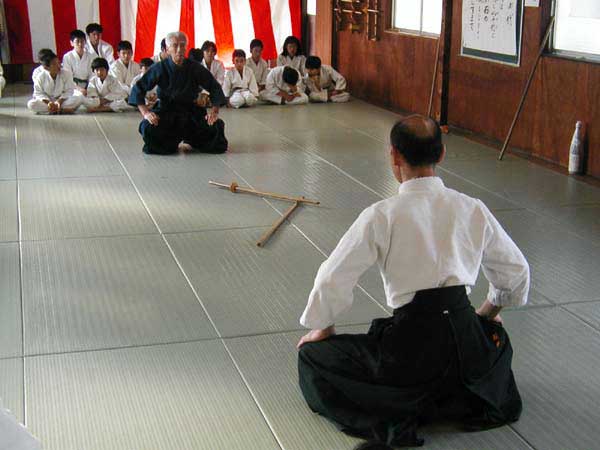
In budo, one way past teachers are acknowledged is by having their picture on the shomen (front wall/place of respect). The students bow towards the shomen before and after training. In this way the past teachers continue to be remembered for their contribution to the martial art. This is certainly the case in the aikido, judo and karate dojo I have visited or trained in. 

Bowing is based on the Shinto belief system. In Japan people can be found bowing at shrines to show respect to the kami (spirits/gods) that reside there. 

Yukiyoshi Takamura (the founder of Takamura-ha Shindo Yoshin Ryu) was a man committed to Shinto ideals and customs. In fact it is considered very important to be familiar with Shinto to understand the mindset and training methodology behind TSYR. Takamura is quoted as saying,

"Acceptance or rejection of proper dojo etiquette can expose a student's dedication or shortcomings to a sensei. The student who refuses to embrace reigi is not suitable for continued training because he ultimately views his own opinions and desires as superior to the aims of the ryu."

So as you can see, he took this very seriously. 

This aspect of budo I believe can separate traditional martial arts from the more competitive versions out there. Consider karate, aikido and judo for a moment. Then compare mixed martial arts or kick boxing gyms. Obviously karate and judo have a competitive element to them but reigi is still practiced in these dojo as well. 

Some people might say the traditional martial arts allow an individual to develop a sense of humility due to the values of respect that are involved in practice. Whereas, the athletes of mma and boxing, although very proficient physically may not develop as much respect for others. In fact the intense competition of mma and boxing may develop people with very large egos. To be the very best, you have to think you are the very best, don't you?  

I would say that the environment of the traditional dojo can be both good and bad. I have seen and heard of examples in a traditional dojo where reigi is used to establish power by either an amoral teacher or senior students. Often passive aggression can be rife in some of these dojo. This is reigi gone bad.  It is tainted. Also students come to the dojo with their own values established by their up-bringing. Some students can learn from technically sound "bad people" without being corrupted. Of course, the reverse can occur. A teacher of high morals can attempt to teach and perhaps influence a student with a bad background, but might just end up giving that person more tools to cause harm with. 

When all is said and done, reigi requires sincerity. Hollow bows and over-the-top praise for your sempai or sensei looks and sounds nice but is merely acting. Truly respectful students show respect in subtle ways. Sure, they follow the rituals but they are done with intent. They will quietly carry out duties no one else can be bothered with. They will see that the dojo stays clean, they will help a junior when they are struggling and listen carefully to the advice given to them by their seniors. 

A student who is sincere in their reigi is open to what is being taught to them and may in time be transformed by their practice. A student that does reigi mere lip-service will not change their ways. 

My 10 cents.

Dean.


Sunday, 19 June 2016

The next steps!

Training is going well. 

Good session on Thursday with kumitanto. Refining the techniques. Slice and dice!

Saturday was great with good numbers. A couple of members showed up that we hadn't seen on the mat for a while. Sensei took us through the nairiki no gyo then some kunren. After that it was into the katate set of the tachiai kansetsu waza. (Standing joint locking).

I really enjoy this set. It was the first set of unarmed kata I was introduced to when I first started TSYR. Externally they look a bit like aikido techniques such as ikkyo, nikyo and sankyo. However, as some of you may know, they are far more complicated than that. They are considered betsuden, which means they are applications of TSYR principles and are not part of the classical syllabus. My understanding is that Takamura Sensei added these kata in order to cater to the change of the times. They contain an assortment of strikes, different joint locks and take downs. In other words, lots of fun!

One of the guys I train with likes to increase the intensity and when we pair up we do a few slowly then get into it. Often this results in quick decisive movements that slams the other chap into the mats. I get a buzz off this kind of training because I can gauge my progress. If the elements of the technique are not internalised then things get messy pretty quick and the other guy lets me know about it. There is something exciting about executing a technique cleanly at speed.

We spent most of the session on these kata. In the last 5 or 10 minutes we looked at the tachiai tai nage (body throws). There are five and we do them most Saturdays so we know them well. Although there is always plenty to work on. I'm very happy with my progress in this area because my exposure to body throws was limited to koshi nage and seio nage in aikido and even then I did not execute them very well. I am tall and lean so you can imagine my difficulty in getting my hips low enough with correct technique to pull them off. Nowadays, I think I'm getting the hang of these throws.

So overall it was a great session.

On the aikido front, I caught up with my old teacher after 4 years!  He still trains in the same place at the same time so I popped in before training to chat with him. It was great to see him and the other seniors who are still training. I went to ask him about getting certification for my dan grade in aikido. Since I stopped training in aikido he had affiliated with a larger organisation. As I am starting to teach aikido again I thought it prudent to be under the umbrella of this organisation as well. I was asking for his endorsement. He was more than happy to do this. So the cogs are turning and in due time I will have certification of my grade through this organisation. I think it is important for my credibility when dealing with the public.
Next week I begin training a boy in aikido at my personal dojo and I am excited about delving back into my original martial art. I will head back to my original aikido dojo as well from time to time to knock off any 'rust' in my techniques as well. 

Exciting times ahead.


Sunday, 20 December 2015

The next step...

I find myself at an interesting time in my martial arts journey. Tomorrow, I begin building my private dojo at my home. In April this year my wife and two girls moved into a new house. This property has a 90 metre square shed as well. At about the same time as the move, my father-in-law passed away. It was a difficult time for us but 7 months on we are settled and moving on with our lives. My marvelous wife donated a proportion of her father's inheritance to allow me to build a dojo in part of the large shed. She also has a cousin who is a builder and after having a discussion with him he was happy to help with the build. He arrives tomorrow to begin on the sprung floor. 


A view from the Japanese Contemplation garden in Hamilton.


I am documenting every step of the build and will blog about the details in future posts. 

When people heard I was building a private dojo some started to ask if I would begin teaching Aikido again. I have agreed to teach one boy and his friend once the dojo is functional. I will see how this goes but at this stage I do not want to commit to scheduled classes as I have to balance my work and family as well as my own training. Although the small amount of money I get from teaching I will put into pursuing my own training. 

This brings me to my next point. My Aikido training and credentials. When I passed my Nidan grading I did not receive a certificate. I have no documentation to say what I have achieved and I feel that those who wish to have tuition from me are owed at least that. So, I will be talking with my Aikido teacher over the next month or so and re-establishing ties and working out what I need to do to consolidate my Aikido rank. It may mean re-grading or joining an organisation for credibility in the eyes of the public. I certainly believe I am a better martial artist since my transition to TSYR. The 'engine' has been refined and is ready to power Aikido techniques. However, the public do not know this, so time to get some documentation. 

Having a private dojo also allows other training opportunities. I will be welcoming any TSYR member to come and train. There is a loft area for bedding so staying over is not a problem. I can also train more often without compromising time with my family. I can simply walk out of my house and into my dojo for an hour of solo training whenever it fits with family life. Now, that is exciting!

So in the meantime I have an exciting project that will change the direction of my training for good.


Tuesday, 20 January 2015

Aiki in Aikido

I do not actively practise aikido right now. However, it is still in my heart and I wish to return to it in the near future. Circumstances may allow this to happen soon.


I left aikido to pursue TSYR. I had to decide between the two martial arts as my time was at a premium with a young family. Now, with my girls getting older, very soon, hopefully I will return to aikido training once more.

So I find it timely that I stumbled upon this article by Ellis Amdur.

This article resonated with me for a couple of reasons. First and foremost, I have always believed the founder of Aikido was a man of remarkable skill and ability as a martial artist. Like many founders of martial arts he had a certain presence and the backing of important people that allowed him to be successful but ultimately it was his martial prowess that won many people over. However, over the generations, we are not seeing students of aikido emerging with similar skills. Why not? In my opinion, Morihei Ueshiba had developed a different way of powering his techniques that most of his students simply didn't pick up. Ellis Amdur states this much more eloquently in his book, "Hidden in Plain Sight" so I won't even attempt to articulate further.

So it was that I went on the search for a martial art that could teach me how to develop internal strength. I found TSYR.

Secondly, the article talks about incorporating internal strength into aikido practice and this is something I have been thinking about for some time. I am very interested in studying this further and I have dabbled with moving with a connected body using the shapes of aikido techniques. It will take some time but inspired by the article I think there is value in pursuing it. 

So the irony is, my TSYR training may end up informing my aikido practice. Isn't that interesting?


Saturday, 7 December 2013

TSYR and aikido cross paths.

In the week just been my Sensei took Toby Threadgill and the other visitors from abroad to an amazing dojo found in the Coromandel, New Zealand. Three members from our branch also went. The Koru dojo was designed by an aikido practitioner called David Lynch and as far as I know there is nothing like it in the world.

Toby Threadgill Sensei with members of TSYR.
The dojo is surrounded by native New Zealand bush and has a unique roof. Over four nights this was their home. David and his wife made the kobudo group very welcome and the setting and hospitality impressed so much that it is likely the branch will visit there again. 

Battojutsu


Needless to say, I am extremely happy to see the two arts that I practice combining in the name of budo. It is times like these I realise just how lucky New Zealand is to have such quality in budo locations and practitioners. Despite being on the bottom of the world. 

Thursday, 5 December 2013

What's wrong with aikido?

For years now, people have rubbished aikido by saying it isn't a practical martial art. I can see their point. But I think the Founder's aikido was very practical. So what has happened?

In this article:
http://www.aikidojournal.com/article?articleID=519
Todd Jones says the following about students of O'Sensei, "Yes, so they understood these things fundamentally. He didn't have to waste time teaching basics… they were either qualified to step into his dojo or, “Sorry, we don’t have time.” I think, partly because of that, aikido — the way it’s taught today - is built on an expectancy of those fundamentals; those basic skills should already be there. I see aikido as a high level, or graduate school, martial art. If you've done ten years of judo, or if you've done ten years of karate, or if you've done ten years of kendo… it’s very easy to step in and say, “Oh yes, I see.” This just makes training all that much easier, all that more efficient, all that much better."


Let's look at the implications of this. If aikido was originally taught to students who had come from other martial arts backgrounds we can assume they were already taught how to strike, use timing and understood ma-ai. 
Morihei Ueshibi then advanced them further with aikido. 

Now move forward to contemporary aikido and untrained people are walking off the street into that kind of training paradigm. Here, I believe the problems begin. 

Aikido as a set of principles and techniques is a solid martial art in my opinion. However, the training paradigm is wrong. 
I can speak from personal experience around this. I now study a kobudo with others trained in another martial art, most people on the mat are Dan-ranked in a gendai budo. The training is intense as every practitioner is competent in their ability to move their body around. Of course we have our strengths and weaknesses. The karateka strike well but have had to learn how roll and breakfall. I can roll about all day (coming from an aikido background), but must learn to strike correctly. Those trained in Judo find the body throws a piece of cake. 

If I was to take this experience and retrofit it to an aikido dojo, I'm sure the training would be very satisfying. Imagine a group of Judoka, karateka and kendo practitioners working through aikido techniques. Alas, this is simply not the case now. 

I think this would solve problems of colluision between uke and nage. It would stop problems around poor attacks and it would turn aikido back into a serious martial art once more. 


Thursday, 14 February 2013

Comparisons


Comparisons - I wrote this near the end of the 2012 year and forgot to post it earlier. My apologies. It is not a positive post and I wasn't going to place it here, but it is what I felt at the time and therefore my historical point of view. I don't name anyone or any club so take it how you like. 


It is nearing the end of the year and tomorrow will be my last training session of TSYR for 2012. I happened to attend the last training session of my aikido club as well, earlier in the week. The teenage daughter of an old work colleague of mine was grading to 4th kyu and I was interested in seeing her progress and seeing what I could still remember of aikido. All people on the mat participate in a grading at this dojo. So even though I was not grading I was pairing up with people and doing the techniques asked by the grading panel just like everyone else there. As it turns out the young woman had a solid grading and I hadn't forgotten any of the kihon waza asked at this level. I discussed this with my aikido sensei afterwards. How is it that I could still perform the techniques crisply and without hesitation after being away from training for many months? Well, the first thing that happens to any athlete that ceases training is that their body loses condition. Of course this is not the case with me because I am still in fact training in the martial arts, just not aikido. I know of many examples where people have ceased training and then returned to find that their mind is willing but their body is not. After nine years of aikido, the techniques were still locked away ready to be used and the fact that I was in the familiar setting of the dojo I learnt the art in and going through the rituals of a formal grading, it was easy to fit right in. Also of importance was the calibre of the grading, it was 4th kyu, not very high up the ranks and the test was pretty limited as to what was asked. However, at that level all techniques that I consider kihon were asked for. From katatetor; ikkyo through to yonkyo and shihonage. From shomenuchi; iriminage, ikkyo and nikkyo and from yokomenuchi, any two techniques. There were other combinations as well as the grading panel pushed the young girl to her limits. Kotegaeshi from munetsuki, tenchinage from a two handed grab, sumi otoshi from katate tori and so on.
As a nidan in aikido none of those techniques posed a problem for me. But here’s the snag. I like the people I train with at aikido, they are genuinely, nice people. However, after training elsewhere in what I consider a potentially more dangerous art, I had concerns for my safety at the grading. Why? The emphasis appears to be on making the technique work, come what may. As I have trained in TSYR and my body alignment and structure has improved, I don’t lose my centre as easily and I have become more sensitive to the balance of my training partner. Most of the people at TSYR are even better at this than me so when a technique doesn't work, they don’t think “push harder” they think “what have I done wrong, where have I lost the connection?” So they stop adjust and dump me cleanly on my backside. I had one experience during the aikido grading where my partner was attempting ikkyo on me and he swung my arm in the appropriate manner but simply didn't move me from my base at all, I wasn't resisting, in fact I was quite relaxed (thank goodness) and because I didn't move as expected he proceeded to try and force me down by putting his knee into my arm as well. Now, I still didn't move as the pressure was still being applied in the same way, but now with his knee. However, seeing where it was going I moved appropriately and he pinned me. As I got up he said “Man, that didn't really work, even when I put my knee in.” I'm thinking, what is wrong with the training methodology here that an aikido practitioner of a reasonable rank would think like that? Of course I am/was a product of the very same dojo and I know my TSYR instructor has ironed out a few kinks in my thinking since then. Another incident occurred when we were asked to perform any techniques we wished from yokomenuchi. At one point I looked across to the pair training next to me and my partner. A young black belt had a complete novice in a dangerous technique that included a head lock with the uke’s back arched. The poor girl didn't realise she needed to tap her leg to signal submission and she was going red in the face while this young show-off applied the lock. Needless to say I quietly but very firmly told him to let go and to take into account the abilities of the training partner.
I had mixed emotions about the night. I was happy for the girl grading as she had done a great job. I was happy that I slotted back into the aikido dojo without any of my techniques showing any ‘rust’ and I enjoyed catching up with people I hadn't trained with for a while. However, I was disappointed at how no one I trained with that night showed any evidence of good internal body structure, and during a formal occasion when things are often at their safest, I saw/experienced some practises that were very dangerous.
This leaves me thinking. Was the dojo always like that when I was a consistent practitioner? I certainly know that my posture and general body alignment was rubbish before I trained in TSYR. The grading was set up so that only dan grades trained with kyu grades to allow most experienced to work with least experienced. So I never got my hands on the other black belts that night. However, all but three were my junior so I have a good idea of what they are capable of. I honestly believe I can now see a contrast in the training methodology of each of the two dojos I have trained in. It was not as apparent while I was still training in both vigorously. Now that I have been away from the aikido dojo for a while, my eyes have been opened to the differences.
A part of me wants to be involved in changing things at the aikido dojo but it is not my place. It is my sensei’s dojo, not mine. I can simply choose to train elsewhere and go back from time to time to keep the bonds of friendship with the people in aikido, ignoring the aspects of training that bother me. As the saying goes, when in Rome…