Showing posts with label training. Show all posts

Thursday, 11 January 2024

Hatsugeiko

Hatsugeiko, which is closely tied to Kagami Biraki (鏡開き), is the first training session of a chosen art in the New Year and sets the tone for the remainder of the year. Thus, one will perform to the best of one’s ability taking this first performance of the year very seriously. It will define who one is, if one has mastered his art, or where one is on the road to mastery. It is also a signal to others and yourself that you wish to carry on how you started for the new year - training sincerely.

A budo dojo can do special hatsugeiko (first practice of the year) as part of the kagami biraki, perhaps doing 100 front kicks or 100 punches, or 1,000 something or others. Or you could do an embu (demonstration) for each other, not tested, ranked or rated. It would be just a demo so that everyone can give each other and the gods an offering of their techniques in thanks for what they have learned in the past, and with hope that they will keep on being healthy and happy in the future. Again, what makes the training special isn’t particularly what you do, it is just that it is the first practice of the year, and it’s symbolically an offering to the dojo’s spirit and one’s own religious/spiritual deities as thanks for having helped you to survive the old year, and hopes that the new year will bring good luck, health and happiness.

In the two dojo I have been part of, there has been no big fanfare for the first training session. It is merely a continuation of the training from the year before. However, those that show up for the first training of the year are often the serious students, those who see their martial arts journey as more than a simple hobby. This is not to devalue those who don't make the training session. January in New Zealand is peak summer holiday season so many people are still away with family and family is important.

At the Yoshin Wadokan (my TSYR dojo) we started the year slowly. Sensei simply put out an email saying we are training on Monday and Wednesday of this week, for "those who can make it". I made it to the Wednesday session (which was last night). There were four of us. Wednesday is sword work night. We bow in with our swords and start our battojutsu practice. There is an atmosphere of quiet intensity as we work through our kata at our own pace, with the occasional correction from sensei. Is is a subdued, sincere practice, and this is normal for a Wednesday night. Then, we put down our swords, pick up our bokken and begin partner practice. Now the dojo is filled with the sound of kiai and wood cracking on wood as we forge ourselves with the kata. It is hot in New Zealand, and humid, so we are sweating in no time. Sensei often uses these small classes to impart some important concept he is working on and gets us to try it. Always refining, always working on the edge of our limits. Incrementally improving. After an hour and a half, we put down our bokken, pick up our swords and formally bow out. We get changed and then clean down the mat space.

I woke up this morning feeling very flat. My body is not sore, but tired. TSYR requires a certain type of internal mechanics that can be demanding on bone and sinew when not practiced often. It is hard to describe, but it is like my tendons and ligaments are tired. I am happy though, always happy to get another training session in. Happy to be consistent in my practice.

The first training of the year is always a chance to knock out the cobwebs and make a promise to myself, that this will continue into the year - this practice.


Saturday, 29 October 2022

Kata training is hard.

No matter how long I work at kata, I still come away from the dojo feeling like a beginner. It happened again just the other night. Lately, I have been working on Chuden (middle curriculum) kata. Some of these are new to me, others I may have done a few times before but I don't know them as well as the Shoden kata. So I found myself struggling away, trying to perform the correct movements while maintaining certain TSYR principles of body mechanics and posture. As you would expect, I was failing at both. 

Samurai Jack dueling with the Scotsman.

Just to be clear, kata training in koryu bujutsu is usually a two person affair. One-on one. This is different to the solo forms you might see in another martial art, such as karate. This means you are always working with another person who may be stronger, faster, shorter or taller than you. 

Look around the internet long enough and you find people talking trash about kata. In my opinion, this is often from a place of ignorance. There is a place for this kind of kata training. There is certainly room for other types of pressure testing and competition but there is also room for kata training. 

In its current form, the Takamura-ha Shindo Yoshin Ryu curriculum involves 346 forms. 346 different kata to learn. Kata hold the riai, or underlying principles at the heart of combat. These principles reveal themselves in layers. In TSYR, the kata are divided into omote, ura and henka. Omote function as the orthodox teaching form. These set the foundation of a student's skills and principles. Ura allow a student to delve deeper into the principles of the forms. Finally, henka represent application of kata principles. This stage should only be developed once the omote and ura have been thoroughly explored.

It is a frustrating experience. But it is suppose to be. My kaicho, Tobin Threadgill sensei, says that kata are not so much fighting techniques but rather a set of principles we are trying to internalise. Kata molds you from the outside in, both in body and mind. 

What does this mean for day-to-day training? Well, just when you think you get the hang of even some of the most simple kata, something changes. It may be that your sensei now wants you doing the movements with better internal dynamics. It may mean it is time I performed the movement under more pressure from uchitachi. This could be an increase in speed, or power or both. Perhaps uchitachi changes the tempo or timing of some of the movements. Can I still match them? Perhaps uchitachi comes in using his best coordinated attack, with good structure and near perfect alignment. Does my technique still stand up to that? Can I still take their balance? Can I still move efficiently around my own spine when the pressure is on. Can I still remain calm under the changing dynamics? 

Ultimately, kata training teaches resilience in the student. The fact that it may seem like you are not making progress or feeling a lack of achievement must be overcome if you are to continue training. 

The old masters had it sorted. They were looking to train the student's mind as much as the body. 

So whether this kata training is something you do or not, hopefully you get an idea about where one koryu bujutsu student is in his journey.


Train safe! 


Monday, 6 June 2022

I'm still here.

I haven't written for a while. There is a reason for this, I have started a podcast. It felt like a natural progression from writing blogs. I still have to put a script together but I can also have conversations with others! 

My podcast is called Musha Shugyo: A Warrior's Journey. On this podcast I investigate the mindset of warriors both past and present. This involves me talking about some of my own ideas, having conversations with interesting people and doing the odd book review here or there. I am enjoying the process immensely. The podcast community appears to be a cool group of people as well. I have made contact with other podcast hosts and have shared ideas and conversations about topics that interest us. The podcast has been going since the start of the year and has received over 500 downloads. 

So does this mean I stop blogging? No. This space is for my own thoughts on my martial journey with both Aikido and TSYR. Think of it as a martial arts diary. The podcast has a different focus.

Okay, where are things at for me right now? Well, so far, this year has been a strange one. Due to Covid restrictions, my work has been rather stressful. Unfortunately, this impacted my health for some time and I found I couldn't train without problems. It turned out I had some issues with my nervous system which seems to be under control with medication. The good news is that blood work has come back negative for anything nasty. The medication has allowed me to get back on the mat and I am both teaching Aikido and training in TSYR at my full capacity again. 

On the up-side, I made contact with my Aikido sensei and he has managed to get my dan certificates organised, these are now up on my wall at my dojo. Its nice to show the parents of my students that I actually have credentials. 

My shodan and nidan certificates.

My student numbers dropped over the last two years due to Covid-19 restrictions. It has always been a small group with the biggest class being 5 children. However, my youngest daughter and a boy from the local community keep on training and as of last week a third student is on board. I have found the biggest challenge to keeping students where I live is high school. The kids grow up and go off to high school, find some new opportunities and drop aikido. 

Still on aikido, my podcasting took me to the Coromandel where I had the opportunity to interview a pioneer of aikido in New Zealand. David Lynch started the first New Zealand aikido dojo in 1965!  It was great to talk to a man in his eighties who still values his aikido training. 

So I am keeping busy around work and family. Hopefully, I will still blog but probably not as often as I used to, as podcasting shares some of my time now.


Train safe!


Sunday, 6 September 2020

Ironing out the kinks and removing the slack.

I thought I would just write a short post this time. 

Winter is a tough time for me as I don't get in as much training time as I would like. My Saturday morning training sessions are hijacked by my obligation to take my daughter to her football (soccer) games instead.  Now, don't get me wrong, I really enjoy watching her play but I miss a key training session each week. As weeks go by I find my body tightens up and old injuries start hurting. 

Jack having a bad day.

Saturdays at the Hamilton dojo usually focus around taijutsu and bodywork stuff. It is the foundation a lot of the other things hinge around. By the end of the football season I am really noticing the reduced training. During the week during our kenjutsu class, I really felt by body fighting me. Quality sword work really suffers if your body is not aligned correctly and it physically hurt to adjust habits I was forming from working on a computer and driving the 40 minutes to and from work everyday. Certain muscles had tightened up and it took fifteen minutes or so to get everything working correctly again. By the end of that session my body had limbered up and I was feeling better but I was discouraged how one less training session a week was hampering my progress. My lovely wife opted to take our daughter to training yesterday so I could get a Saturday session in. During the training we covered chokes, vital points for striking and body throws. I could feel tendons and muscles clicking and crackling back into place as I trained and walked out the the dojo feeling much, much better. 

As I get older I appreciate more and more the need to stay mobile for good health. Stuck in a chair for long periods or stooped over a computer increase my chances of getting injured as muscles stiffen and tighten. I have known this for a while now, mobility is the key to physical health in my humble opinion but sometimes as work and family keep me busy it is easy to get lost along the way.

As I write this I am reminded of a quote from Morihei Ueshiaba, the founder of Aikido:

The purpose of training is to tighten up the slack, toughen the body, and polish the spirit.

I certainly feel like I am in need of some serious slack-tightening! It feels to me like O'sensei must have had days like mine for him to say such things. 


Train safe, everyone!


Wednesday, 1 April 2020

Developing a Budo Body Part V

I have wanted to go into a deeper discussion on developing a type of body that can generate relaxed power for a while now. However, I am very aware that I am still learning and have a lot more to learn in this field. Due to this, I will be relying heavily on two books to help me clarify my thoughts along with my own experiences. Ellis Amdur's "Hidden in Plain Sight" and T. Threadgill and S. Ohgami's "Shindo Yoshin Ryu: History and Technique" are written by men that know much more than I and are where any quotes I use come from.

Takamura Yukiyoshi sensei called the type of body that had these esoteric skills, a budo body. I intentionally used this term back in April 2011 with my first Budo Body post. I had only been training in TSYR for a number of months but even then it was made clear to me that my body was getting conditioned for a certain skill set.

So what is this type of power I am training for? The term most often used is internal power or internal strength. Amdur summarises internal strength as managing the intersection of the ground and gravity forces within you and then directing these forces in the most powerful way possible. I think this is a good place to start. There is a fundamental exercise that I was taught very early on in my training called Ten chi jin. This is where a person stands with feet side by side, shoulder-width apart, arms slightly bent and extended forwards in front of the shoulders. The legs are slightly bent, the feet facing forward and the head up-right. Now imagine another person applying a lateral force through the first person's arms in an attempt to topple them backwards. As the force enters the first person, he or she splits the incoming force, half directed towards the ground and the other half upwards into the heavens. This exercise is teaching you to redirect forces acting on your body.

Now, if we go back to Amdur's definition of internal strength you can see that is exactly what this exercise is training. I have been practising that exercise for nine years, week in and week out. It is now becoming easy to absorb and redirect that lateral force no matter who is pushing on me. What is more interesting is that it takes little effort to do. This is important. This exercise to accomplished through coordinating bone and muscle so it is aligned in such a way that the force naturally flows where you want it to go. It does not take excessive muscular tension to do. I am 186 cm (6 ft 1 inch) and only 75 kg (165 lbs) so imagine a tall stick. I am actually very easy to knock over in most situations. The fact I can have people heavier than me lean on me and not topple me is a testament to this type of training.

As I said above, this is a fundamental exercise we have been learning for a while. It is not the only exercise and there are other skills we need to learn that require a different approach. Any application of internal power/strength also requires a heightened sense of body sensitivity. Threadgill sensei writes about four dimensions that provide this sensitivity: Skeletal-Postural, External/Tactile Sense, Internal/Proprioceptive Sense and Dynamic-Kinesthetic. I will touch on these very briefly, if you want to know more, buy the book.

The Skeletal-Postural dimension has already been discussed above. The skeleton should be aligned in such a way that it takes minimal amount of muscle to stand upright. Without a decent instructor it is very difficult to know exactly what this looks or feels like. Tactile sensitivity identifies subtle pressure changes during body contact that allows practitioners to evaluate and respond to threats. Paired exercises are required to develop this. Proprioception is the awareness of knowing where your body is in space without using visual cues. Dancers and gymnasts have enhanced this ability as well as martial artists. With proper dynamic training, the final dimension can be honed. This is done by replacing inefficient movement patterns with more efficient and budo-appropriate ones. This results in the relaxed power I wrote about at the beginning of this post. Together these four overlapping dimensions allow a TSYR practitioner to consistently monitor the physiological state of their own bodies.

SAMURAI reJACKed: Episode VII – Jack and the Three Blind Archers ...
Samurai Jack training his proprioception.

Once an awareness of one's own body has begun to develop, five key skills can be practised. Again, I will not go into detail here (read Threadgill and Ohgami's book). The first is to have a connected body, a body that is flexible but strong and works in a unified fashion. The practitioner is able to act in a fully coordinated manner recruiting muscle, bone and fascia to deliver power. The next skill is that of having a subtle touch/feel so that your hands can detect tactile feedback. The touch must be light, only as much is required. The third skill is the cultivation of a precise grip. Flexible, yet firm and devoid of tension. Extremely important in this weapon-based art. The fourth skill is called Dragon Capturing and involves projecting force into an adversary when you grab them. Not in a linear fashion but with a subtle spiral. Finally, breathing methods are utilised to enhance internal strength.

I would like to talk about fascia for a moment. This connective tissue plays an important part in internal power. Recent research hints that fascia is more than just a passive tissue enveloping muscles and organs. It can be conditioned, toughened and used to direct and assign force. Many of the metaphors in internal martial arts appear to be linked to using the fascia network within one's body. I remember talking to the late Robbie Smith sensei before our usual Saturday morning practice. I said that my body felt more robust and springy than prior to training with him but I couldn't put my finger on why. Thinking about it now, I believe the exercises we were doing were developing my fascia along with the coordination of the muscles to created a more unified body. Even now, when I train I can turn on a 'tone' in my body. I'm not sure what this is but I can speculate and say it is a combination of key muscle groups and fascia. If that makes sense? I know that without that tone, I am more susceptible to having my centre taken.

In his book, Amdur has this to say, "With internal expressions of force, the mind directs muscles, ligaments, tendons, fascia AND one's body mass as a whole, organized primarily to exert actions upon oneself, which affect the other in the process." This is a fascinating statement and a great explanation, in my opinion, on how a budo body is created. What Amdur is saying, is that until you have control over your own body, you can't control your opponent using internal power. In my own experience, I find this to be true. Most of my training in internal power has been around me being aware of tension in my body, how I power movements efficiently and monitoring my body alignment. As Threadgill sensei says, once this budo body is developed, the very act of an adversary touching the practitioner results in the attacker being stripped of any structural support. The opponent loses their advantage on contact.

Now that we have established that the practitioner requires an element of sensitivity and an awareness of their own body mechanics the final, crucial element is intent. Threadgill sensei talks about intent often when giving instruction. For a person of his calibre to be talking about the same concept over and over again indicates to me that I should listen carefully. If he thinks it is important then so should I. Internal power ultimately requires a well-integrated mind/body connection. In a moment of conflict, I can't think sequentially through my checkpoints to make sure I am moving appropriately while someone tries to strangle me. My movements must become instinctual. Therefore I must get to the point where my intent drives my actions and I trust that the training I have in place allows for my body to produce the appropriate response. 

A great analogy for this is driving a car. When we first learn to drive a car it can be overwhelming (especially if you learned in a car with manual transmission). However, over the years it becomes second nature to drive to and from work everyday, pass other vehicles and assess threats as you drive. This is what must occur for internal power to be practical. Think about how many hours you have spent behind the wheel of a car. Then think how often you train. Scary thought, huh?

It is well documented that athletes use visualisation to help them succeed in their physical endeavours. When you visualise yourself doing something, but not actually doing it, the same neural pathways fire that would normally activate those muscles that help you perform the activity. The mind is a powerful tool. I think of intent in the same way. If you have grabbed me I might put my intent behind you to make you topple in that direction. I think, "over there" and my conditioned, coordinated body does what is required to put you there. We can practice intent when attempting Ten Chi Jin exercises. Once we can redirect the incoming force we can start to try other things within this set up. I can move the other person around as they try and push me over. By thinking "move that way" my opponent gets moved. I can also place my intent into parts of my opponent's body. This is complex to explain in this post. Having face-to-face instruction is key to learning such concepts. 

So a budo body is not complete without the intent of the practitioner. Amdur says, "intent is the ability to use the forces of gravity and ground to your advantage, and to organize your body in such a way that, moment-by-moment, you shift to make another's power your own." It is the final puzzle piece in internal power training. 

Internal power training comes with a warning from Threadgill and Ohgami in their book, "Not all budo practitioners can internalize or master nairiki (internal power) skills. Nairiki training requires a significant investment in time and physical dedication." Further more, "Considerable mental patience and resolve are needed. Repeated failure and thousands of hours of repetitive training must be endured to acquire these skills, with no guarantee of success." 

Jack in snow | Samurai Jack | Know Your Meme
Even after training for years, you may not get it.

Sobering words.

I have found a certain level of competence in this area but have a long way to go before mastery. I see it being many years until I can claim that, if at all. 

Train safe out there everyone!

Tuesday, 31 March 2020

Universal truths of budo and body mechanics

The title of this post has been taken from a quote from a martial arts friend of mine. He was discussing the cross-over he saw in internal Chinese martial arts and internal power trained in Japanese martial arts.

At the TSYR dojo where I train, we have karateka, aikidoka, judoka and gendai jujitsu folk training together. We all bring something different to the training based on our previous disciplines (in many cases people still train in that discipline). We often talk about how certain principles overlap in many of the martial arts.

A human being has a finite way of moving efficiently. By this logic, a martial artist has only a finite way to strike, apply locks or throw someone effectively. What we are noticing as we train is that we are conditioning our bodies to move more and more efficiently and as we look at the principles behind many of the techniques we see overlap in other martial arts.

Jigoro Kano and Kyuzo Mifune

Here are some of the 'universal truths' I have discovered, please note that some of these concepts are hard to explain with words alone and some have to be experienced to get the full meaning of what I am trying to say. Also I am sure I will change my mind about some of these ideas as I refine my understanding. So, a disclaimer - this is how I understand things as of now, in no particular order of importance, and they are all up for discussion.

POINT OF IMBALANCE (the third point)
Humans stand on two feet. Although this has its advantages, the major drawback is that we are not very stable compared to our four-legged counterparts. Good martial arts exploit this fact. If we trace a line between the two feet and then another line perpendicular to that one (forming a T), the end point of that line is where a person will lose balance if we put their centre of gravity there. Put very simply we have two such points, one at the front and one at the back. If you ask a friend to stand square on to you in a relaxed manner and then lightly pulled their shirt from the chest, they would tilt forward and have to step or fall over. You can move them by pushing them backwards gently as well. It doesn't matter what stance they take, there are always two points of imbalance waiting to be exploited. This concept can be found in aikido, judo, TSYR and I'm sure many other martial arts. How this is achieved depends on the martial art.

DOUBLE LOADING
So you take someones balance, so what? They will just step or readjust their weight won't they? Of course they will. To maintain an advantage the martial artist must stop this happening. Double loading/weighting is just one expression used to describe an opponent's weight being trapped in both feet so they cannot step without falling. This is hard to explain only with words. Imagine you are at that point where you are about to fall but you are so extended or compressed that if you should lift either foot, you will collapse on the ground. This is double loading/weighted. A martial artist will try and set an opponent up in this position so that they can then dictate where or how the opponent will move next. This might result in a strike, throw or joint lock. Double loading takes away an opponent's options. Without a secure base they cannot counterattack and therefore are severely compromised.

HAVING A SOLID BASE
It is important in any martial art to move from a position of power. To maintain your own balance and be 'strong'. It is no good executing a technique while your own balance is compromised. This goes for transitioning from one movement to another as well. Should you not be in a position of balance as you move, your opponent can take advantage of this. I have heard dancers comment on the importance of 'finding the ground' with your feet at all times. They too know the importance of a solid base. 


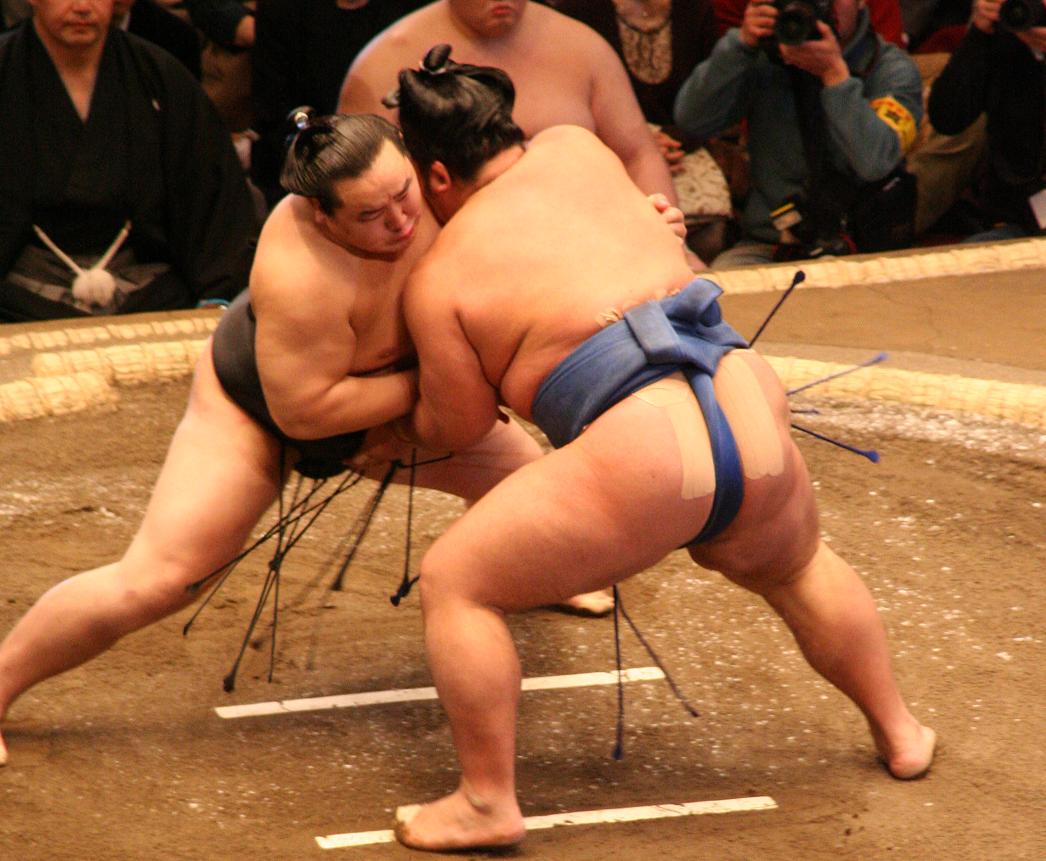
This may mean lowering your centre of gravity by bending your legs (like the sumo practitioners above). It may mean having your feet flat on the ground or it might mean making sure you have your weight directly over your feet, or one of your feet at all times. 

MOVE FROM CENTRE
This usually refers to the use of the legs and lowerback/pelvis/core to support and move the body about. To correctly move from centre the practitioner is not using extra muscles to complete the movement. I find this simple idea to be one of the most challenging to achieve in practice. Through my life I have generated certain body/movement habits. As I train myself to move from centre I am discovering these habits and am challenged to change them into new ways of moving. If you are moving from your centre correctly, your upper body is stacked on the bowl of your pelvis and will move where your centre moves. This is written too simplistically but hopefully gets my point across.

CONNECTING TO ONE'S OPPONENT
This is an extremely difficult one to explain but I will try. By making contact with another person, the practitioner can feel into their opponent's centre and take their balance. It requires a great deal of sensitivity and we spend some time every training session on this at the dojo. Ellis Amdur calls this the Listening Skill. I believe all martial arts that have elements of prolonged contact are ultimately trying to develop this. You can see this in the BJJ of the Gracies, the interplay between two fencers and the subtle Judo of Kyuzo Mifune. Once you can feel where an opponent's balance is, you can move it, take it away and ultimately control their actions.

POSTURE
Maintaining a good posture as you move is fundamental to Japanese Martial Arts. Even when a person bends at the waist they do so with a straight back. Does this mean you can't bend? No. However, where you bend from is important. Many people bend from the lower back or round their shoulders to get lower to the ground. What is better, is to bend at the hips or bend your knees. In this way you keep your centre engaged, your upper body stacked upon the pelvic bowl to tap into the power of your waist, hips and lower back. I have had both my instructor and a ballet teacher talk about 'moving around your spine'. Essentially this is the same idea. You shouldn't be twisting your spine or rounding it in a way that takes strength away from your structure. If you can spin or turn on the spot without your head moving, then you are moving around your spine and maintaining good posture. 
Throwing with good posture.
STRUCTURE
This term refers to body structure - the alignment of bones and muscle to remain stable and strong. Misalignment of the bones will cause certain muscle groups to contract to maintain stability, when this happens, an adversary can exploit this moment of increased tension. Unifying the structure of your body with sophisticated joint articulation, muscle coordination and controlled breathing leads to internal power. This is the ability to use maximum power with little effort. Threadgill sensei discusses this in depth in his book Shindo Yoshin Ryu: History and Technique. 

I believe all of the above concepts apply to good martial arts mechanics. If I see someone applying these principles, no matter what their background or training history then I know I am looking at a proficient martial artist. 

Train safe.


Tuesday, 24 March 2020

What are your win conditions?

When we bow onto the mat, whether it is judo, aikido, kendo or some older budo, we engage in controlled violence where there are set rules, limitations and boundaries. No matter how hard I train I know that I will still be getting in my car afterwards and driving home, healthy and happy.
That is a good thing. I want to reuse my training partners from week to week and we all need each other fit and healthy. Unfortunately, this mentality doesn't lead to good self defence psychology.

I have been re-reading Rory Miller's book, Meditations on Violence: A Comparison of Martial Arts Training & Real World Violence. I also have been listening to an Australian podcast called Managing Violence by Joe Saunders and another podcast called Walking with the Tengu by Matthew Kreuger. These three men have left me with many thoughts about my own martial arts training.

Joe Saunders has created the Violence Survival Pyramid. He talks about four factors that go into increasing your chances in a violent encounter. From the most important at the base of the pyramid to the least important at the top. If you have a look you will notice that he puts physical techniques at the top (the least important factor). Rory Miller writes about dealing with sudden, violent encounters. Although he wrote a whole book on the subject, most of his writing is not on physical techniques, why? Finally, many Walking with the Tengu episodes mention win conditions. Despite the different topics this podcast host explores, he often returns to win conditions. 

These thoughts and ideas have been percolating in my mind. I keep coming back to win conditions. What have you decided is your goal for any given confrontation, whether it is verbal or physical? In sport karate it is scoring a clean touch on a designated area. In MMA it is getting the tap or the knock out. In kendo it is getting a clean strike on a designated target area while showing strong spirit. As a high school teacher managing challenging student behavior, it is deescalating the situation to a point that allows learning to continue. For a police officer it may mean the restraint of a person with handcuffs. To a soldier it may mean killing the enemy. 

All these win conditions set up very different training regimes for the people above. It makes no sense for a karateka training for his next tournament to learn the verbal deescalation techniques of a teacher. The teacher does not need to learn how to fire a rifle to get the focus of students in a classroom and teaching an MMA fighter how to strike with a kendoka's shinai is not going to help him much in the cage. This may seem obvious but people still have arguments over 'the best martial art' or 'the best technique' when what they should think about is the win conditions assumed with each of those statements.

If I am put in a self-defence situation where my life is threatened and I may be able to escape,  my win condition is to get away. Everything I do in that moment is to try to make that a reality. Any actions I might perform that aren't helping me achieve this goal are pointless and in this case, potentially deadly. 

If you are practicing a martial art I hope you have thought about the win conditions that have created the training paradigm you are involved with. Is this what you thought you were training for? Is it not clear what you are training for? I started aikido in 2002, I joined because a workmate of mine had been practicing a long time, he was a black belt and because he was a nice guy. I thought the dojo must be pretty good to churn out a guy like that. I went into it with the thought that I would do it as long as life didn't get in the way. Little did I know that martial arts training would become part of my life. However, my reasons for training in aikido changed over the years and so did my assumptions about its practice. You could say that my interpretations of what the win conditions were changed. At first I considered the win conditions to be the resolution of conflict through superior technique. An aikidoka could skillfully use his opponent's force against him and the adversary would see the error of his ways. The more I trained, the more I found this difficult to believe. So I started to doubt my practice and the purpose of my training. That was a confusing time for me. Because the win condition was not clear, it was hard to decide which elements of my training I should focus on and which parts I should forget. Then I decided the win condition of aikido was still about conflict resolution but through deescalation and we were practicing a physical metaphor. It was more about training a mindset that was open to resolving conflict through deescalation be it verbal or physical. The physical training kept me fit and flexible and wasn't that practical. For me, this was particularly true of aikiken, the wooden sword training. At this point I had started as a high school teacher in a co-ed state school and the mental skills I had learned in aikido practice paid off. I could see a link between my training and my profession. My training found renewed purpose. I could also blow off steam on the mat. 

I still had my doubts about all the sword swinging I was doing. That didn't seem to fit into my deescalation paradigm very well. In 2011, I was introduced to Takamura-ha Shindo Yoshin Ryu. This is a classical Japanese sword school. Everything I thought I knew about using a Japanese sword was wrong in this training paradigm. The win condition in TSYR is very clear. Kill the other guy. However, do this in the context of medieval Japan. The mindset is different. Deescalation is not important. You have to have the mind of a predator in this martial art. Everything I learn and train for in TSYR is to gain advantage over an adversary to kill him. This makes training so much clearer and straight forward. If I perform a movement that gives an advantage to the other person or is done in an inefficient manner I am 'dead'. There is something very pure about this type of training. 

The funny thing is, I still practice some aikido. I teach it to children. My TSYR training has clarified the win condition of my aikido practice. It most certainly is not the desire of my aikido training to kill the other guy. That, I am very sure of. So what is it? 
 I believe it is beneficial to learn to be strong of mind but willing to deescalate a situation. That is the win condition I have for my students. Do what is needed to deescalate and no more. That is a valuable skill I can give them to take into the world. 

So I go back to Joe Saunder's "Surviving Violence Pyramid". We see mindset is the very foundation of this diagram. As he says, "get your head straight" and everything else falls into place.  Rory Miller discusses the psychology of both attackers and victims in his book. He understands that the mindset of a person is key. Know what your win conditions are and train hard to ensure you can achieve them. Your win conditions will decide your mindset, your mindset will decide your training parameters. Then you can train with sincerity and purpose, without distraction and without the 'fluff'. 

When I step onto the mat I will be one of two people in that moment. If I am practicing TSYR, then I am the predator, seeking an opportunity to kill. If I am practicing aikido then I am the mediator, seeking to find a solution through deescalation but not devaluing myself in the process. As my mindset shifts, so too does my training. This gives me a sense of clarity.

So, what are your win conditions?

Train safe.

Monday, 25 November 2019

Assassins!

So I recently finished playing a game of assassins at my workplace. If you don't know what this game is then check this link here.Staff are given the option to opt out before the game begins, otherwise it is assumed you are playing. You arrive on a Monday morning with a note telling you who your 'mark' is. Along with one clothes peg. This is your weapon. Should you succeed in getting this peg on your mark, they are out of the game and must tell you who they are hunting down, this continues until the end of the week. At that point prizes are given for those still 'alive' and those with the most 'kills'.
I didn't play last year as I helped plan the game so this year was my debut. I am happy to say I survived until the last day and got into the final four alive. Unfortunately, I let my guard down in the last fifteen minutes of the game to be taken out. 

Four kills!

Why am I writing about this on my budo blog? Well, interesting thing. In the past I have suffered from anxiety and anger management problems. Due to the paranoia the game creates, my colleague asked how my anxiety was going while the game was running. I had nothing! I was wired, excited and loving every minute!  So why wasn't I feeling the panic and paranoia that some of the others were?

I have had counselling for both anger issues and anxiety and what I have discovered is that I have a reactive personality. So I respond to perceived threats quickly. Now, in the everyday life of work and family these threats are really just perceived. Not actual life threatening situations. They are also over a long period of time (chronic) and my physiology is trying to respond to these threats and anxiety is often the result. While the game was running, the threats were real. I had to watch my back or I would get 'pegged'. I also had to be vigilant and scheme to get my targets. I had to take moments when I saw vulnerability and commit fully in that moment. Three out of my four 'kills' involved acting in a moment of my target's weakness. Opportunistic almost. All my normal nervous energy was given purpose. I had never felt so stable and mentally sharp. My colleague (the one that asked about my anxiety) made an observation. She said that there must obviously be a genetic component to anxiety, depression etc. and that it must have been useful to have this 'reactivity' (let's call it that) in times of war and disaster. The problem is when the real threats go away generations later, those born with this reactivity don't function well in peaceful times. She knows of one family that has had both sons of that family attempt suicide, one succeeded and the other one did just enough damage (hanging) to starve his brain of oxygen and he now needs full care to get by. This is an example of it being 'in the family'.

But here is the kicker. All of a sudden her observation made me feel normal. I want you to understand what that means. I hated myself for when I had anger management problems. I was confused as to why I would have anxiety attacks over things when under chronic stress. Now, this make more sense. I could forgive myself a little. For that week of assassins, I was totally in my element!  I enjoyed the hyper vigilance and the fact every action during the day mattered. All my energy was being channelled into purposeful behaviour and I felt great!

Two things I can take away from the game that relate to budo. 
1. The predator mindset was invaluable to being successful in this game. The constant pressing of your target until they made a mistake was very important. 
2. The reason I choose to practice budo other than other physical pursuits is because it gives me a small experience of consequences really mattering. Move wrong and you could get hit in the head with a bokken. Lose focus and you can stab yourself with your habikito. My physiology needs this to function at a normal level or weird things happen (like anxiety attacks). 

Keep training!


Saturday, 16 November 2019

TSYR Australasia unites!

Marco Pinto sensei has arrived in New Zealand for a weekend seminar on the 1st November 2019. On Friday night we had jiyu keiko (free training) for a couple of hours. Hamilton deshi as well as two early visitors from Auckland were able to make it. Eight people were given advice from Pinto sensei on kata from empty hand through to battojutsu and kumitachi. It was an atmosphere of study and focus as bokken and habikito were being used next to people being joint locked or thrown.

Pinto sensei in action.
On Saturday we had representatives of the entire Australasian TSYR membership attending. Sixteen people in total including four deshi from Australia. This is the first time these people have been on the same mat together since Robbie Smith sensei passed away many years ago. We spent the morning session working on the te hodoki with variations and tips. The afternoon session was focused on the haru set of the kumitachi. Pinto sensei emphasised uchitachi responding correctly to the techniques to allow counter attacks if needs be and to keep safe during practice.

That night we went out for dinner and there was plenty of conversation and laughter. One Auckland member and an Australian bunked down at my house as the Hamilton group spread the visitors amongst their homes. This allowed for more discussion that evening and morning over breakfast. As all the Australians were members of the Armed Forces, my visitor had interesting work stories. 

Sunday morning was all about the kuzushi no kata. Unfortunately I couldn't attend the Sunday afternoon session but some batto and disarms were covered as far as I am aware. 

When I got home my muscles felt like they had been stretched and were aching. It was good to push myself and work with many great people. The aching was not muscle soreness but more a feeling of being overstretched and the next day my body felt fine. I honestly believe the aching of the day before was a reaction from my nervous system from taking ukemi from Pinto sensei and having to respond rapidly to his movements. 

Pinto sensei was amazing. He moves with such speed and power that at times when I was receiving technique from him I felt like my brain was rattling around in my skull. In one technique he lifted both my feet off the ground - twice!  He said to those watching that one can simply step out of the technique when receiving it. I argue that to step out of the technique, you actually have to have at least one foot on the ground!

TSYR seminar attendees.
The vibe on the mat was fantastic. Everyone was working hard and very demanding of themselves. It was an excellent experience.


Sunday, 6 October 2019

Whole curriculum in two hours!

My instructor is away on holiday. So training always falls to those of us left behind. 
One of my fellow deshi lives in Cambridge which is only 15 minutes away from my house. I asked him to come out and train at my dojo for the weekly Saturday training session. We decided that we would attempt to work through the entire shoden curriculum (60 Omote Kata, 24 Goshinjutsu Waza) in the two hours we had available. 

Vigorous training!

We decided to do just one kata each before moving on to the next. The challenge was to remember the kata and not to be too concerned with the quality (although we would do our best on the one take). I have done this before with another training partner and it gives an insight into what is actually memorised and what needs more work. 

Very early on we were making good time and we actually got through all shoden kata including Tachiai Te Hodoki, Idori Te Hodoki and Tachiai Tedori Kuzushi. We also covered all weapons kata such as kumitano and kumitachi. The only kata we decided to leave out was batto as we do these often and don't need a training partner for these movements. 

We bowed off with 10 minutes to spare. 

It is now the next day and my body is stiff from the practice. This is good. It feels like I have ironed out some kinks. I don't recommend this kind of practice very often. This is about the third time in eight years I have done this. Training in this manner does not endorse quality of movement. It is merely a 'check in' to see what we can remember and what our bodies can put up with. It really is a full body work out!

Happy training out there!


Sunday, 22 September 2019

Budo Body Part IV

Yesterday, at training, I had an epiphany. As most of you will be aware, in martial arts you might be told how to do something but do not fully realise what the instructor means until years later. This was one of these moments. In TSYR we are often told to pull with the front leg. This in itself was not enough for me. I realised that what I actually had to do was pull down and forwards with the front leg so my weight sat in the middle of that foot. This creates an angle that wedges down into my opponent. It also creates tone in that ankle. As I am tall and therefore often taller than my training partners I have to bend the knee and ankle joints far more than I thought I needed too. 

Creating a budo body in the TSYR sense requires stacking and coordinating of the joints in such a way to gain the most stability and power at the same time. This is not easy. Learning to adjust ankle, knee and hips joints is a start but then think about all the joints in a spine!  Then the shoulders, elbows and wrists. That is a lot of variables to consider. This is one reason why I think developing subtle internal power takes a long time. Once you have skeletal alignment you still have to adjust muscle tension. Which muscles should be on, which should be relaxed? What we experienced in training yesterday was that the smallest amount of incorrect muscular tension can result in feedback to your opponent and they have something to fight you with. Finally, but by no means the least, is having intent. This mental aspect connects mind to body and is very important. Threadgill sensei mentions this often. 
Even if you manage to get all these things right while standing still, how do you achieve this state while moving? While on your knees?  With a weapon in your hands? It starts to make sense why this discipline is life-long.

Jack's Budo Body.

Usually with one of these "Budo Body" posts I speak about my own anatomy. One thing that has progressed for me is joint mobility and a more stable midsection. My ankles, especially are stronger and more mobile due not only to idori practice but also with the above mentioned, knee bend. What I battle with is joint stability. My joints are naturally flexible, I have been called "Noodle Man" by my fellow deshi a few times. However, this can lead to my joints not holding their position when I need them to. This is most problematic around my midsection. The transmission of power from lower body to upper body must come through the midsection. If this is soft and yielding then the power is lost. I have had to work hard to develop a strong core/hara. This is different to having strong abdominal muscles. I came from an aikido background where I had at one point routinely done 100 sit ups in one session. The muscles I talk about here are deep ones, around the spine and pelvic bowl. These ones required conditioning. As I was not naturally stiff through the middle I had to train that area and now as I take a position on the mat I turn this area 'on'. When I hold a sword this area is 'on'. I guess this is what is traditionally called the hara or tanden. When this area is engaged, a slight movement in the legs will turn the upper body without muscular tension from the arms or shoulders. As the power is coming from "below", the opponent does not feel how or why they are being moved and taken off-balance. 

Once my structure is set I can try different things. Imaginary lines can be traced vertically down the body, horizontally across joints and even on diagonals. I am just beginning to manipulate and use these planes/lines of movement.

Keep training!


Sunday, 15 September 2019

Training is picking up!

I have to say that since beginning TSYR, this is the first year I have really dropped back on my training hours. I had a soft tissue injury that required some rest for 10 weeks around January and February, then my daughter's winter sports kept be away from the dojo through the middle of the year. However, I can safely say that things are looking up. 

The spring training session I had with the Hamilton deshi was the first Saturday I was freed up from winter sports. Then I got to my week night session as well.


I have just spent another busy Saturday training. I went to the scheduled Saturday training session at the Hamilton dojo then one of the deshi who lives in Auckland came out to my place in the afternoon for extra training. It was great to get my body "training warm". You know, that loose, warm feeling where all your muscles are well used from constant force and movement.  I am tired today but in a good way. 

We covered five of the idori te hodoki, then the set involving the two-hand grab from standing and later, knife disarms. 

We had good numbers too. With the Auckland guy down for the day, we had seven on the mat. 

Its good to be back in the training flow!

Tuesday, 10 September 2019

Spring Training

For the second year running, I invited members of the Hamilton TSYR dojo out to Te Miro for two hours of training on a Saturday morning. With the trees in full bloom and native bird chorus around us it is an opportunity to train in idyllic surroundings.

The Hamilton Dojo TSYR Deshi.

Chris lead us through idori te hodoki, the three kata of the uchite set and finished with nage waza. The sprung floor and judo tatami provide a good surface for this sort of training. It is only a twelve mat space, however, so we had to be aware of where everyone was moving and standing to avoid collisions.


There is not much to say about the session so I will let the pictures tell the story.


Saturday, 20 July 2019

Holiday training comes to an end.

This posts comes at the end of the school holidays. Another three days of training are behind me covering tanto, sword and idori. Good times.
We covered defences against sword disarms, tanto disarms and then the Shoden idori set. It was good to get back into the groove over the last two weeks knowing that when the next term starts family and work will reduce my training significantly, again. That is the balance of family and work life and my children will only be young once so I need to make the most of it. 

Saturday morning training.
We have a steady group at the Hamilton Dojo and usually have five to six on the mat most days. This is good for working with different body types and with people at different places in their training. Personally, it was good to knock the dust off some of the kata I hadn't trained in a while and sharpen up the others that I know well. I have been working on timing, structure and adding an edge to the movements. I like the expressions 'grind the stone' and 'polish the mirror'. To me, the first expression means to remove the rough edges of my movements, get the basic patterns memorised and performed adequately through constant practise. The second expression means to work on the small things, refine my movements in an attempt to improve the exactness of technique. To do this requires paying attention to the slightest nuances of structure, kuzushi and timing. I have had the opportunity over the last two weeks to do a bit of both. Polishing the mirror also refers to having the right attitude. When I bow in front of the kamidana my image is reflected back at me by the kagami (mirror). This is a time for reflection on my practice and spirit. 

There is not much more to add right now. So until next time, happy training!

Thursday, 11 July 2019

Holidays = budo!

It is the school holidays in NZ. For two weeks classes stop before the next term begins. As a school teacher, my time is more flexible (I still have work to do even though students are not attending) and my focus falls upon my training. I have started the school holidays with training three days in a row. TSYR training on Monday, teaching Aikido on Tuesday and then more TSYR training on Wednesday. Today I spent time on washing keikogi and sword maintenance.

Sword maintenance.

My focus on my training recently has been on keeping my shoulders rolled back and down. Also to keep my middle strong. Last night was one of those training sessions where I felt I have so much more to learn. It feels like the kata are getting harder and harder.

In my down time I am reading Musashi by Eiji Yoshikawa. I know, I know, I am a practitioner of Japanese martial arts and have never read this book. I tried once before but just couldn't get into it. The second time around I am finding it a better tale. I think going to Japan has helped me understand the book more and I can relate to it better. I have read Shogun by James Clavell years ago and enjoyed that immensely. However, that book was written by a British author with a Westerner's mindset. Musashi is written by a Japanese author with an Eastern mindset. This sets up a very different style of story telling.

I have also been listening to the Samurai Archives pod casts while driving to and from work. I highly recommend them for anyone wanting to know more about medieval Japan. The hosts are graduate students at the University of Hawaii and specialise in different aspects of Japanese history such as the Sengoku period, Edo period and so on.

Just for entertainment I have been watching episodes of Samurai Champloo as well. So you can say I am immersing myself in Japanese medieval culture these holidays.

Happy training!

Saturday, 21 July 2018

Training Day!

I have just finished a great training session with Pete and Chris. Pete had spoken for a while about working through all the waza in the Shoden Mokuroku, both weapons and empty-hand. So I invited Pete to my dojo for a Saturday morning training session. We bowed on sharply at 9 am and set my phone timer going. Then we proceeded to work through every kata one time each to see how long it would take. We managed to do all the kata in 1 hour, 16 minutes. This included idori, paired weapons sets, the works. It was great to pressure test ourselves to see what we really knew. We managed to remember all the kata even though for a few of them we had to stop and think or work out certain parts, but we got there. Not bad considering there is something like 90 or more kata to learn. It was great to get the heart pumping and my limbs warm. It is a mild winter's day here and it felt good to get to that magical 'training warm' feeling.

Kumitanto!


Not long after finishing the whole Shoden syllabus, Chris arrived. He had just flown into New Zealand early this morning and wanted to work out some of the swelling from a long flight. So he joined us on the mat as we slowed down and looked at some key points on the idori kata. 

Chris emphasised the right attitude in the techniques, an attitude that presses an opponent and takes the initiative immediately. It was just the right amount of fine tuning we needed after blasting through the techniques. 

Overall Pete and I were happy with our progress. Despite the speed at which we worked, the main points of each kata remained intact (despite the odd technique not being our best). It certainly showed us what we need to work on now for future training sessions.

Pete suggested we do the whole Shoden set some time again to see if we have improved overall. I know it will be a blast. 

Wednesday, 11 July 2018

Training through/around injury.

So I have injured myself.

I woke up one morning to intense pain and aching in my right hip. I had trained the night before but had not noticed any problems before I went to bed. As I got up I found my right leg wasn't weight bearing without pain. I knew I had landed hard on that hip a couple of times during training and assumed I had bruised some part of my hip. After gently pressing different parts of the problem area I discovered the pain was coming from a protrusion of my femur known as the Greater Trochanter. I think I had bruised it and the area had become inflamed overnight as I lay on it. I was pretty sure I had damaged some of the soft tissue around the area as well because certain lateral movements caused me pain as well. After a quick bit of research online and talking to my wife who teaches anatomy and physiology to nursing students, it was quite probable I had tendinitis of the medial glute as well. This made sense as the same day as I had training I had a therapeutic massage appointment. The massage therapist had worked on my medial glutes as they were quite sore.

So here is what I think happened.
Last week I participated in the staff Tug o War (I'm a high school teacher). Now, due to a busy schedule with work and family I have only been getting to training once a week and teaching aikido once a week. Therefore my mobility and activity had dropped considerably over the winter months. Then to suddenly participate in some pretty serious isometric movements (Tug o War) didn't do my body any good. I had also stopped seeing my massage therapist over this winter term due to being too busy. Last year I made sure to see her at least once a month. 

This week I finally got back to my massage therapist and my body was a wreck. She did her best to iron out muscular kinks but more still needs to be done. I had that massage at 10 am of the same morning I had training. I then went to training that evening. Here is where I think my problems started. I had a fairly vigourous training session and pushed myself physically. I got home tired but not really sore. However, the massage therapist would have stretched and loosened muscles around my hips which, I believe, reduced my stability leading up to the training. In fact I believe that having a deep tissue massage PRIOR to training was my down fall. Nothing I did at training was unusual or new, other than increasing the intensity. Therefore the only thing I did differently that day was have a deep tissue massage earlier on. Also, knowing that the therapist worked on my medial glutes and that is the very tendon that is inflamed now seems to support this idea. 

Its my second day with the sore hip and it is healing quickly. It is most painful when I lie down so I slept with a pillow between my legs which reduced the tension on my hip tendons. Plenty of Deep Heat (Menthol cream) has been applied and I did take Ibuprofen yesterday to help with reducing inflammation. I am annoyed with myself for getting injured. However, it is in these moments that I find myself reflecting on my practice and what I can improve on. I will still go to tonight's training session but I will train around the injury. I know what planes of movement I can do without pain and I will stick with those. 

It goes without saying, that I will not be getting a deep tissue massage before training in the future.