Saturday, 13 August 2016

German Instruction

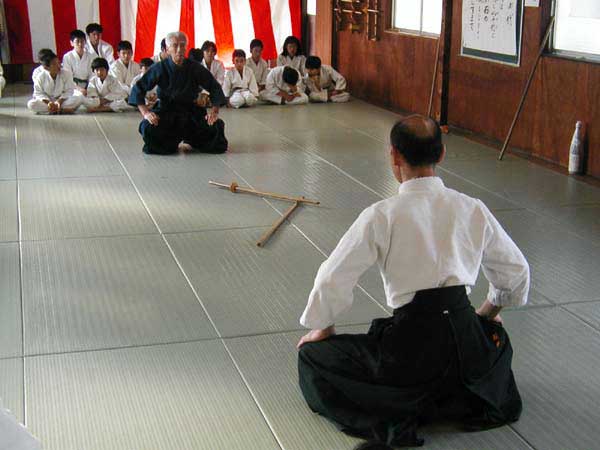
Today I had a fantastic training session. A member of the Takamura-ha Shindo Yoshin Kai, Jurgen Buchwald, was visiting from Germany. Jurgen is holidaying in New Zealand with his wife, Fusako and has managed to train at the Hamilton dojo for Wednesday's kenjutsu session and our Saturday taijutsu session in between sight-seeing. 

Jurgen in the dark blue.

I couldn't make the Wednesday training but witnessed his instruction and technique first-hand today (Saturday's training). First, let me say he is an incredibly nice guy. He is humble and polite with a ready smile. He started by saying he does not consider himself an expert by any means and what he was showing us today were simply his interpretations of the waza and underlying principles. Despite his humble introduction it was very clear we had plenty to learn from him. Jurgen has Shoden menkyo and has about 14 students in his own dojo but oversees other German TSYR groups as well. This makes him the senior most member of the Kai in Germany. With these credentials it was obvious to see why he was a great teacher and comfortable working with all body types on the mat. His waza is strong and clean. He concentrated on taking the 'slack' out of limbs to create the desired connection with uchitachi. His presence in the dojo was timely as he was able to affirm where we were going well in our training and correct mistakes. Threadgill Sensei arrives in three weeks and this was a nice way to check progress before his arrival. 

Two members from the Auckland study group had traveled down to train and had requested that they work through the katate set of the Tachiai Kansetsu Waza. It was great to see Jurgen's interpretations of these waza. His movement was precise and powerful. He patiently explained key concepts he thought were important to each kata and made corrections where necessary. The training during the session was positive and at a good pace. It was clear to see he was another level above our own training, his movements flowed through each stage of the kata and he mentioned that at any point shitachi should have control and have uchitachi at a disadvantage. In other words the first movement of the kata could finish the encounter if you wanted it too. 

After the session we went out for lunch before Jurgen and Fusako left for Rotorua. It was a privilege to have had the opportunity to meet another member of the Kai and take some points away from training today. 

Wednesday, 27 July 2016

A Cautionary Tale.

I was diligently training in my dojo recently. I had worked through all the battojutsu that I knew and I decided to spend some time working on a movement from one of the kumitachi. I had been told prior, that this particular movement can be practiced near a doorway or similar because it is important to move the sword precisely ninety degrees during the movement. So I lined up a section of wall in my dojo that borders where people would enter to step onto the mats. I tried the movement a few times until I was happy that I was moving the sword ninety degrees. The second movement of this technique requires the blade to snap up from a horizontal position to a vertical position. I looked to the low beam that ran across the entrance to the mat and thought, "Will my sword hit that, I guess I will find out."  In the next instance the tip of my sword is embedded in the wood of the beam. My first thought is "My poor sword!" my next thought is "The beam!."

After checking the sword for damage (there was none I could see) I then admired the fine line I had produced in the wood of the beam. It reminded me that despite the fact I am training with a habikito (dull blade), the metal point at the end of the sword is still quite dangerous. It had punched into the wood very well despite a lack of effort on my part.

The cut in the wood reminds me of a group of fine lines over some of the mats at the Hamilton dojo. These lines occurred when Robbie Smith sensei used to train by himself at the dojo. Sometimes he would get the angle of his cuts wrong and hit the mat. Just another reminder that these dull blades are still large metal knives that must be handled with respect.

Takamura sensei had plenty to say on the matter of swords. My understanding is that he was a strong believer in swords taking on the spirit of their owners, or at least being imprinted with past events where they were used. He a list of do's and don'ts when handling swords in the dojo as well. Some of them are Shinto related, others simply there to ensure safety. 

Of course it is a natural progression to think of the implications of training with a shinken (live blade). Imagine the danger of making a mistake with a three foot razor blade!

After a quick search on YouTube under the key terms "sword accident" shows just what can happen.


A lesson to be learned there, for sure!  

There are plenty of other videos you can watch, but you get the point (pun intended).

Train safe, folks!

Sunday, 26 June 2016

The Training (and Posting) Continues!

I must be feeling inspired at the moment. I am churning out the posts!

After many years, I began teaching aikido again this week. I am teaching a 10 year old boy along with my daughter at my private dojo. It's great to be thinking about aikido techniques again. With this young fellow I have to teach dojo etiquette as well because he has never practiced any martial art before. It brings me back to my early aikido days. The first session went very well. My daughter loves the fact that she can be involved in an activity with her dad and the young boy is diligent and keen. As I took them through the most basic of aikido exercises, I can see already that the body mechanics I have learned in TSYR are already having an impact on my movement and how I teach movement to the students. As I journey through aikido with these young people, I suspect I will be able to piece together how I will apply my aikido with my new TSYR 'engine'. It will be interesting. 

I looked back at some of my old posts and came across this one:

In this post from 2012 I say:
"As my young family gets older and if time allows, I may drift back into aikido training along side TSYR training once more. Time will tell."

Well, here I am in 2016 and I HAVE drifted back into aikido along side my TSYR training! My girls are growing up fast, my youngest is 5 and turns 6 in October. Things are certainly easier with two school children and a private dojo to train in. I also have a VERY understanding wife that knows how important budo is to me. 

TSYR training this week was once again, awesome!  On Thursday we worked through both sets of kumitanto kata. These sets we know well so it was all about refinement. 

On Saturday we spent a lot of time on nairiki no gyo and kunren then we got into kansetsu waza. Lots of fun. I am feeling really happy with my progress in these kata. The last few weeks I have felt that my training has been consistent and solid. Threadgill Sensei is out in September so I'm looking forward to seeing what he thinks of our progress at this stage. Bring it on!

Saturday, 25 June 2016

Ritual and respect.

Budo is an odd beast at times. 


One area where this really shows is in reigi (manner, etiquette). One thing a western student will notice very quickly when entering a dojo is the amount of bowing that goes on. When I started aikido I understood that bowing had to do with respect and when bowing to another person it was explained to me that it was like a handshake. Both parties had made an agreement of respect towards one another. When we bow we are saying, "I respect you and I will look after you as we train."  
This worked for me (and still does). But of course we also bowed towards the picture of Morihei Ueshiba, the founder of aikido. To some this seems stranger still. Bowing to the a picture of a dead guy? What?  One woman who trained with us for a while came from a Christian background. She made peace with the idea of bowing to "false idols" while in the dojo. However, her husband discovered that this ritual was part of aikido practice and encouraged her to quit. It was unfortunate. 
So why do budo students often bow to pictures of people who founded the martial art they practice?

I follow Dan Djurdjevic's blog and his recent post answers this question. 


To sum up, he says that it is important to acknowledge your teachers and the knowledge they have given you. Even if you have gone separate ways, you are the martial artist you are now because of your past teachers, and their teachers before them.

In budo, one way past teachers are acknowledged is by having their picture on the shomen (front wall/place of respect). The students bow towards the shomen before and after training. In this way the past teachers continue to be remembered for their contribution to the martial art. This is certainly the case in the aikido, judo and karate dojo I have visited or trained in. 

Bowing is based on the Shinto belief system. In Japan people can be found bowing at shrines to show respect to the kami (spirits/gods) that reside there. 

Yukiyoshi Takamura (the founder of Takamura-ha Shindo Yoshin Ryu) was a man committed to Shinto ideals and customs. In fact it is considered very important to be familiar with Shinto to understand the mindset and training methodology behind TSYR. Takamura is quoted as saying,

"Acceptance or rejection of proper dojo etiquette can expose a student's dedication or shortcomings to a sensei. The student who refuses to embrace reigi is not suitable for continued training because he ultimately views his own opinions and desires as superior to the aims of the ryu."

So as you can see, he took this very seriously. 

This aspect of budo I believe can separate traditional martial arts from the more competitive versions out there. Consider karate, aikido and judo for a moment. Then compare mixed martial arts or kick boxing gyms. Obviously karate and judo have a competitive element to them but reigi is still practiced in these dojo as well. 

Some people might say the traditional martial arts allow an individual to develop a sense of humility due to the values of respect that are involved in practice. Whereas, the athletes of mma and boxing, although very proficient physically may not develop as much respect for others. In fact the intense competition of mma and boxing may develop people with very large egos. To be the very best, you have to think you are the very best, don't you?  

I would say that the environment of the traditional dojo can be both good and bad. I have seen and heard of examples in a traditional dojo where reigi is used to establish power by either an amoral teacher or senior students. Often passive aggression can be rife in some of these dojo. This is reigi gone bad.  It is tainted. Also students come to the dojo with their own values established by their up-bringing. Some students can learn from technically sound "bad people" without being corrupted. Of course, the reverse can occur. A teacher of high morals can attempt to teach and perhaps influence a student with a bad background, but might just end up giving that person more tools to cause harm with. 

When all is said and done, reigi requires sincerity. Hollow bows and over-the-top praise for your sempai or sensei looks and sounds nice but is merely acting. Truly respectful students show respect in subtle ways. Sure, they follow the rituals but they are done with intent. They will quietly carry out duties no one else can be bothered with. They will see that the dojo stays clean, they will help a junior when they are struggling and listen carefully to the advice given to them by their seniors. 

A student who is sincere in their reigi is open to what is being taught to them and may in time be transformed by their practice. A student that does reigi mere lip-service will not change their ways. 

My 10 cents.

Dean.


Sunday, 19 June 2016

The next steps!

Training is going well. 

Good session on Thursday with kumitanto. Refining the techniques. Slice and dice!

Saturday was great with good numbers. A couple of members showed up that we hadn't seen on the mat for a while. Sensei took us through the nairiki no gyo then some kunren. After that it was into the katate set of the tachiai kansetsu waza. (Standing joint locking).

I really enjoy this set. It was the first set of unarmed kata I was introduced to when I first started TSYR. Externally they look a bit like aikido techniques such as ikkyo, nikyo and sankyo. However, as some of you may know, they are far more complicated than that. They are considered betsuden, which means they are applications of TSYR principles and are not part of the classical syllabus. My understanding is that Takamura Sensei added these kata in order to cater to the change of the times. They contain an assortment of strikes, different joint locks and take downs. In other words, lots of fun!

One of the guys I train with likes to increase the intensity and when we pair up we do a few slowly then get into it. Often this results in quick decisive movements that slams the other chap into the mats. I get a buzz off this kind of training because I can gauge my progress. If the elements of the technique are not internalised then things get messy pretty quick and the other guy lets me know about it. There is something exciting about executing a technique cleanly at speed.

We spent most of the session on these kata. In the last 5 or 10 minutes we looked at the tachiai tai nage (body throws). There are five and we do them most Saturdays so we know them well. Although there is always plenty to work on. I'm very happy with my progress in this area because my exposure to body throws was limited to koshi nage and seio nage in aikido and even then I did not execute them very well. I am tall and lean so you can imagine my difficulty in getting my hips low enough with correct technique to pull them off. Nowadays, I think I'm getting the hang of these throws.

So overall it was a great session.

On the aikido front, I caught up with my old teacher after 4 years!  He still trains in the same place at the same time so I popped in before training to chat with him. It was great to see him and the other seniors who are still training. I went to ask him about getting certification for my dan grade in aikido. Since I stopped training in aikido he had affiliated with a larger organisation. As I am starting to teach aikido again I thought it prudent to be under the umbrella of this organisation as well. I was asking for his endorsement. He was more than happy to do this. So the cogs are turning and in due time I will have certification of my grade through this organisation. I think it is important for my credibility when dealing with the public.
Next week I begin training a boy in aikido at my personal dojo and I am excited about delving back into my original martial art. I will head back to my original aikido dojo as well from time to time to knock off any 'rust' in my techniques as well. 

Exciting times ahead.


Saturday, 4 June 2016

Teaching and Learning

I've had a good week of training and teaching. 

On Wednesday evening I lead the class through all four battojutsu kata at the Hamilton Dojo. We spent the whole session on just those four. I figured that when our sensei came back from the instructor's seminar, he would have lots of new information for us so let's nail our basics. 

Drawing the sword. 

Starting with the first of the kata, I asked everyone to work very slowly but smoothly. While we did this I looked for one or two points each person might need to fix or refine. Sometimes everyone had the same problem so I would stop everyone and just clarify a point. Once everyone had slowly teased out some problems then we would speed up the kata to see how things looked.

We did this for each kata. 

The great thing about teaching is that I learn as well. When I take the time to consider how to explain a concept or share an analogy to help someone through a problem, it clarifies the movements of the technique in my mind also. It can be challenging to come up with a way of describing an idea that the other person understands. Some of the body dynamics we deal with in TSYR are quite subtle and require minute changes in body position or muscle tension. It can be a matter of millimeters between correct and incorrect sometimes. So coming up with a good way of describing movement is very important. Despite only covering four kata, everyone said they enjoyed the training. 

The Saturday morning session was held at my dojo as only one person could make it. It is a long weekend so many people are out and about making the most of the extra day off work. After warming up and going through the Nairiki No Gyo, we decided to quickly work on one of the Idori Te Hodoki that the other guy had not practised for a long time. We then worked through all of the Katate set from the Tachiai Kansetsu Waza (Standing joint locking techniques). 

Rather than just a teacher-student dynamic, here we gave each other feedback as to when we felt our balance was taken and when we didn't. This way we could tweak our techniques as we went. It was a good session with both of us making some progress. It also solidified what we were doing correctly. 

Next we looked at the Tachiai Tai Nage (Body throws). I'm really enjoying these throws at the moment. I had not done much of these sorts of techniques in aikido so I always struggled a bit with them. However, in the recent months something has clicked and I am much more confident in my ability. Just as before, we talked to each other and gave honest feedback to help the other person improve. 

To finish the session off we went back to idori and worked on gaining the centre of the other person while they held both wrists. I find this training fascinating because something like this occurs in aikido training and I knew it as suwari waza kokyu ho. With my TSYR perspective on the exercise I see the value of it much more. 

So that's it. My sensei is back next week and I go back to being the student. I have fulfilled my duty to the dojo by maintaining a training regime while the teacher is away but it will be nice to go back to simply being one of the crowd again. 

Until next time...

Dean.


Sunday, 29 May 2016

Masakatsu Agatsu

Lately, I have been thinking about a quote from Morihei Ueshiba, the founder of Aikido.
He once said, "masakatsu agatsu or "true victory is victory over oneself."


Like many of his quotes, this can be interpreted in many ways. I often find my self thinking about this quote in my own training.
During my aikido practice I often thought of the quote to mean if I had control of myself emotionally and had a calm approach to an assailant, then I could control the situation. In other words, if I had self-control then I could control others. This is of course true in a verbal confrontation, in fact I use this idea everyday in my job. I'm a high school teacher in a state-funded school and staying calm with teenagers is very important. Teenagers will often resort to verbal abuse like put-downs and swearing to disrupt your influence. Being able to use body language, precise wording and a calm demeanor is important.


I find one flaw in my own logic here. Even if I could be calm under a physical assault I would still have to be technically proficient to survive such a confrontation. Just because I could be calm under pressure does not guarantee success. 

When I began practicing Takamura-ha Shindo Yoshin Ryu an important aspect of the training focused on correct alignment of my body, 'structure' is the term we use often. The more I train, the more I realise that without proper structure I cannot possibly control others. If my structure is not correct, then it becomes more difficult for me to take control of my opponent. So on a simple, physical level masakatsu agatsu applies. 

While in the draft stages of this post I came upon this blog:


In this blog the author talks about how anyone who studies martial arts, studies violence. There is no other way to look at it. We can wrap it up in soft fluffy philosophy but at the end of the day, the definition of martial arts is forms of self-defence or attack. We learn how to use physical violence to get an end result. So the author then goes on to say, "How does this make us any different to bad guys?"  
It is an interesting point. People who rob, rape, assault or kill use violence or at least the threat of violence. How do we differ? The author's point? We use violence to protect while the bad guys use violence to prey on others.  He then goes on to say that in order to protect we must be better at violence than the bad guys. What a thought.

A quote from the blog:

"So it is imperative that GOOD people be skilled at violence.
What does that mean?For the most part it is helping good people give themselves permission to do what is necessary.
Unless they are competing for the same resources, it is rare for a predator to hunt another predator.
So protection can also be achieved by helping folks remember that they are also predators.  The confidence that brings can remove someone from some victim profiles.
"


The author continues to say that should you allow yourself permission to do what is necessary and be violent, then how much is too much? When do you turn the violence off? How do you turn the violence off? Masakatsu agatsu. True victory is victory over oneself. This mental level is something I have been chasing all of my martial arts journey. As I have trained I have pushed myself out of my comfort zone, then once that was comfortable I looked for more discomfort. The problem I had was if the people around me didn't want to amp things up like that I was left with no one to train with. When I started aikido, taking a physical risk might mean taking a high break fall or letting someone twist on my arm. As that fear disappeared, I wanted faster attacks and to dance more on the edge of what I was capable of. Unfortunately for most of my training partners, they weren't interested after a certain level of stress. 

Then I started TSYR. Here my training colleagues were more capable and used to higher levels of stress in the dojo. The training involved committed attacks often with wooden training weapons. I know at even higher levels of training, shinai and armour are used and permission is given to move away from kata and really try to make the hits land. Sensei has a systematic approach to amping up training and getting the adrenal dump to occur in the participants. I am not at this point and Threadgill Sensei has said that not everyone wants to go there. I want to go there. 

One of my TSYR buddies is an Air Force Medic. He had the opportunity to train with the Australian Special Forces at one point. Members of the Armed Forces were asked if they would play the part of terrorists on a Special Forces exercise. My friend put his hand up. One thing he noted when he meet these men is the absolute confidence they had in their abilities. It was a quiet confidence, no bravado what-so-ever. The exercise simulated a takeover of a bus. The Special Forces guys were to storm the bus and take down the 'terrorists'. My fiend said he had never experienced anything like it. The Special Forces guys went from quiet, confident men to aggressive, violent soldiers in a second. They moved with absolute precision, with calculated violence. My friend found himself taken to the ground with a knee on is chest in seconds. He said there was nothing gentle about how they dealt with the situation. He said these men carried  a presence that none of the other soldiers carried. One of utmost confidence in their abilities in moments of high stress. They had gained victory over themselves. Masakatsu agatsu.

I have read many articles by Ellis Amdur. He wrote this one:


How can I, a civilian studying martial arts ever get to the level of calm efficiency that the Special Forces guys get to? Should it even be a goal for me? A part of me wants to find out what I am capable of. What happens to me, psychologically if I really feel threatened? Ellis Amdur's article addresses his own training under stress and one of the outcomes for him. It is sobering reading. 

Part of me wants to go into this psychological space. To see where my breaking point is. To see what demons lurk within. And then quell them. 


Then, and only then do I think I will have achieved masakatsu agatsu.