Showing posts with label sword. Show all posts

Wednesday, 1 January 2020

Enter 2020.

This blog is about my experiences in both gendai and koryu budo. So looking ahead into 2020 I can see changes coming for both Aikido and TSYR. I have been teaching just two children Aikido over the past few years at my private dojo. However, through word-of-mouth I have been asked to take on a few more. This could move my numbers up to five students. To be honest, my small dojo could only handle a maximum of six children on the mat at once so five is good. I have never sought students but I enjoy passing my knowledge of Aikido onto others and will accept children that I think will make good students, I am a picky sensei. I don't apologise for that. My day job keeps me busy so if I am teaching after work I want to enjoy the experience as much as the kids I teach.

As some of you may already know, I have been awarded my Shoden teaching license. This means I can now teach people TSYR. I will be looking to teach in Auckland when I can to help that group increase their skill level. Of course, I will take on teaching responsibilities at the Hamlton Dojo when needed but to be honest that shouldn't be very often as I have a competent teacher there and another capable fellow deshi with a teaching license. 

I started the year as I always do, out in my dojo. This morning I worked on critiquing my batto, first by working on the omote forms and then performing the matching ura version of each kata. I am really enjoying the sword work at the moment. For years I always felt that the sword fought me and I would diligently work through the kata but felt frustrated at my lack of control. Of late, things seem to be clicking. I can make slight adjustments in my technique to get better at the kata and I am finding overlap in some movements which helps. I am enjoying the precision of the kata. 

I also hope to use the summer holidays to do some more renovations on the dojo, I have some work to do to finally tidy up the mat area and complete it properly. That should be possible over the next few weeks. 

So I am excited about what I may be able to achieve this year in my martial arts.
All the best for your own training!


Saturday, 16 November 2019

TSYR Australasia unites!

Marco Pinto sensei has arrived in New Zealand for a weekend seminar on the 1st November 2019. On Friday night we had jiyu keiko (free training) for a couple of hours. Hamilton deshi as well as two early visitors from Auckland were able to make it. Eight people were given advice from Pinto sensei on kata from empty hand through to battojutsu and kumitachi. It was an atmosphere of study and focus as bokken and habikito were being used next to people being joint locked or thrown.

Pinto sensei in action.
On Saturday we had representatives of the entire Australasian TSYR membership attending. Sixteen people in total including four deshi from Australia. This is the first time these people have been on the same mat together since Robbie Smith sensei passed away many years ago. We spent the morning session working on the te hodoki with variations and tips. The afternoon session was focused on the haru set of the kumitachi. Pinto sensei emphasised uchitachi responding correctly to the techniques to allow counter attacks if needs be and to keep safe during practice.

That night we went out for dinner and there was plenty of conversation and laughter. One Auckland member and an Australian bunked down at my house as the Hamilton group spread the visitors amongst their homes. This allowed for more discussion that evening and morning over breakfast. As all the Australians were members of the Armed Forces, my visitor had interesting work stories. 

Sunday morning was all about the kuzushi no kata. Unfortunately I couldn't attend the Sunday afternoon session but some batto and disarms were covered as far as I am aware. 

When I got home my muscles felt like they had been stretched and were aching. It was good to push myself and work with many great people. The aching was not muscle soreness but more a feeling of being overstretched and the next day my body felt fine. I honestly believe the aching of the day before was a reaction from my nervous system from taking ukemi from Pinto sensei and having to respond rapidly to his movements. 

Pinto sensei was amazing. He moves with such speed and power that at times when I was receiving technique from him I felt like my brain was rattling around in my skull. In one technique he lifted both my feet off the ground - twice!  He said to those watching that one can simply step out of the technique when receiving it. I argue that to step out of the technique, you actually have to have at least one foot on the ground!

TSYR seminar attendees.
The vibe on the mat was fantastic. Everyone was working hard and very demanding of themselves. It was an excellent experience.


Thursday, 19 January 2017

The Precision of the Sword

We recently had the privilege of having Marco Pinto out to New Zealand. Marco is one of only two people to hold a Chuden teaching license in Takamura-ha Shindo Yoshin Ryu. Unfortunately I couldn't make the seminar due to family commitments. However, last night at our regular kenjutsu training session my teacher, Chris, went over some of the points that Marco had made. 

It was one of those sessions where Chris picked apart our batto. I really enjoy these sessions because it is good to have someone look at my technique and point out things that might need correcting that I miss. 

Battojutsu is a very precise practice. For instance, during one movement Chris said I needed to move my sword about 1 cm forward at the end of my cut. That extension meant my blade stopped in the correct position. That 1 cm was the difference between the tip of my sword dipping or not. 

An upright posture is critical in sword work as well. If you cut with a lean either to the front or back, it requires more muscular strength to hold the sword as the person's centre of gravity has shifted past their feet, slightly unbalancing them. If you keep your shoulders over your hips then gravity is pulling you down into your feet and you remain stable. Now this is easy to understand if you are doing a straight cut from above your head and down. But some cuts are on the diagonal or horizontal planes and you still have to keep your posture. Easier said than done. 

One area I am working on (one of the many!) is 'noto' or returning the sword to the saya. I am trying to do this without any extra body movement and keeping my weight down the whole time. Noto is one of the few times you have the sharp end of the sword pointing towards yourself and often the time when you can cut yourself. 

After last night's class I had a moment of thinking, "wow, so much to learn in this one kata but the overall curriculum is so large!"

I will leave you with Kaicho Toby Threadgill, showing how its done.

Toby Threadgill Menkyo Kaiden.


Wednesday, 27 July 2016

A Cautionary Tale.

I was diligently training in my dojo recently. I had worked through all the battojutsu that I knew and I decided to spend some time working on a movement from one of the kumitachi. I had been told prior, that this particular movement can be practiced near a doorway or similar because it is important to move the sword precisely ninety degrees during the movement. So I lined up a section of wall in my dojo that borders where people would enter to step onto the mats. I tried the movement a few times until I was happy that I was moving the sword ninety degrees. The second movement of this technique requires the blade to snap up from a horizontal position to a vertical position. I looked to the low beam that ran across the entrance to the mat and thought, "Will my sword hit that, I guess I will find out."  In the next instance the tip of my sword is embedded in the wood of the beam. My first thought is "My poor sword!" my next thought is "The beam!."

After checking the sword for damage (there was none I could see) I then admired the fine line I had produced in the wood of the beam. It reminded me that despite the fact I am training with a habikito (dull blade), the metal point at the end of the sword is still quite dangerous. It had punched into the wood very well despite a lack of effort on my part.

The cut in the wood reminds me of a group of fine lines over some of the mats at the Hamilton dojo. These lines occurred when Robbie Smith sensei used to train by himself at the dojo. Sometimes he would get the angle of his cuts wrong and hit the mat. Just another reminder that these dull blades are still large metal knives that must be handled with respect.

Takamura sensei had plenty to say on the matter of swords. My understanding is that he was a strong believer in swords taking on the spirit of their owners, or at least being imprinted with past events where they were used. He a list of do's and don'ts when handling swords in the dojo as well. Some of them are Shinto related, others simply there to ensure safety. 

Of course it is a natural progression to think of the implications of training with a shinken (live blade). Imagine the danger of making a mistake with a three foot razor blade!

After a quick search on YouTube under the key terms "sword accident" shows just what can happen.


A lesson to be learned there, for sure!  

There are plenty of other videos you can watch, but you get the point (pun intended).

Train safe, folks!

Saturday, 19 April 2014

Sword Mechanic.

Recently training has focused on kenjutsu and battojutsu on Wednesday evenings. On Saturday mornings we have been working on taijutsu kata and idori. Things are really starting to click. I'm retaining more and more of the kata now and the new kata are easier to remember as the TSYR principles underlie all the techniques.
Recently we were split into two groups. One group worked on the Shoden kumitachi and another group worked on the first set of the Chuden kumitachi and then moved into the first few kata of the next set. There is so much to learn (I seem to be always thinking this). As always I must work on obtaining the correct mindset for TSYR sword work. The physical application of the kata is only the beginning, the intent and mental application is just as important.

As I have been training I have been delving deeper into the bits and pieces of a sword. For a while now I have been determined to remove the mekugi (bamboo pin) from the handle of my sword. Ever since I have had the sword the mekugi has been jammed in so hard I have not been able to get it out. Armed with a hammer and two blocks of wood, I took my sword outside and placed it across the blocks. Then using a modified roofing nail I hammered on the pin until it finally moved. It took many more strikes before it loosened and was knocked out. Before anyone growls at me, I didn't have a mekuginuki at the time and I was being careful.
I discovered that hole of the tang through which the pin went through had gouged into the pin jamming it in there. So I made a new mekugi out of a bamboo chopstick. I removed the handle and checked the tang. There was some corrosion where the tsuba had been rubbing against the metal so I sanded that back and put some sword oil on it. The tang is long and is almost the length of the tsuka, which is an indicator of a good sword, I believe.
I reassembled the handle and put the new pin in. Good as new!

Sunday, 29 December 2013

Wood and Steel

I finally purchased a Shindo Yoshin Ryu bokken from Tozando online. As you can see in the picture below it just so happens it is the same length as my custom made sword (which is quite long due to my height).


TSYR uses a sword with a longer tsuka (handle) and a deeper sori (curve), which in turn means the bokken must mimic this. In fact the dimensions of the blade determine how some of the kenjutsu techniques work.
Up until now I have been using a VERY old aikido bokken that was too short and had been taped in three places to prevent the blade splitting. Sensei has been kind enough to let me use a TSYR bokken that belongs to the dojo from time to time to allow me to improve my technique.
I'm looking forward to using the new bokken in 2014.

Saturday, 4 May 2013

Getting to know your sword


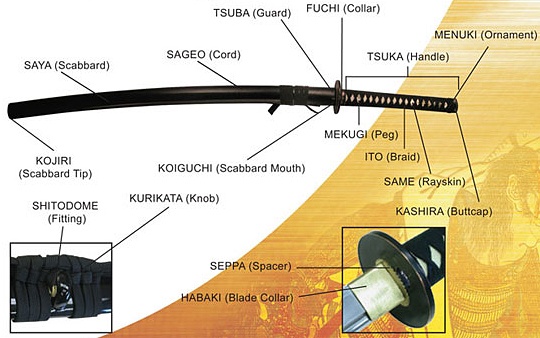
So, I now have my own, custom-made sword. It is Chinese made but was forged in the traditional manner. It is folded steel that has been differentially heated. I have made it a goal of mine to learn the Japanese terminology for the parts of the sword. I have found the whole experience fascinating. I have looked over numerous Youtube clips and other websites in my eagerness for knowledge.
So what do I know at this point (excuse the pun)?
Kissaski - the point of the sword.
Mune - the back of the blade.
Ha - the edge of the blade.
Hamon - the wavy line on the blade.
Tsuba - the guard.
Habaki - the brass piece that links blade to handle.
Seppa - the brass spacers.
Mekugi - peg that holds handle to tang.
Tsuka - the whole handle.
Same - ray skin wrap.
Saya - scabbard.
Sageo - scabbard cord.

This picture tells the story...

Of course knowing the parts of the sword allow me to look into sword disassembly and care but it is a tool for conflict and ultimately I do TSYR to learn how to use this weapon. 
First there is the practise of battojutsu, or sword drawing. It is a precise discipline and there is much to be gleaned in the four kata we learn at the basic level.
However, the real challenge is simple suburi, the repetition of simple movements such as men strikes. I can swing a bokken through 100 cuts but today, I cut with my sword for 50 cuts and found that swinging a piece of steel about requires conditioning. Something I do not have as of yet. I sit writing this with aching wrists, shoulders and back muscles (also an indication that my technique is poor).
I have a long journey ahead with my sword work, it is by far the weakest part of my practice. However, having my own blade and learning its balance, weight and length is enjoyable.

Now, back to training!  


Monday, 3 September 2012

Drawing a Sword


We have the headmaster of our school, Toby Threadgill visiting again. The Friday morning session was an informal training with the sword. Adam from Australia joined us as we went over the four sword draws in our shoden curriculum. Some points Toby covered were:
a)      When drawing the sword, the left hand pushes the saya out then as the right hands draws the sword, at the same time the left hand is withdrawing the saya. In this way you generate a fast draw.
b)      Keep the shoulders relaxed and make sure when you cut, the power is transferred to your base otherwise tight shoulders cause the person to lurch forward slightly and lose correct posture.
c)       Drop your weight through your step on the point of contact and not before. This generates power for the cut.
d)      Keep the speed of the cut constant throughout. Like a switch; power on, power off. This includes being tense only for the moment of the cut and staying relaxed before and after.
e)      Keep the sword between you and your imaginary opponent. Seems simple enough, right? Then why weren’t we doing that all the time?
f)       Always have a feeling of pressing your opponent. Keep an aggressive mind-set, never passive.
I have yet to purchase my own sword and so will look into this with Toby this time around. I shared the dojo sword today with two others and it is apparent how quickly I lose my technique when just using a bokken.

Thursday, 26 July 2012

Tools of the Trade.


Most people are aware of the two swords of the samurai, the long sword (katana) and the short sword (wakazashi). Up until now I had only ever trained with the bokken, in other words the wooden version of the long sword; first in aikido and now in TSYR. The way the bokken is used in my line of aikido is to enhance taijutsu technique by applying correct body alignment and positioning. The weapon work informs the empty hand waza. This could also be said to be true in TSYR except the attitude behind the sword work differs greatly. Aikido is about conflict resolution where both the attacker and defender are given the opportunity to reconcile their differences. In TSYR the philosophy is very basic – kill your opponent. These attitudes effect the kenjutsu. Aikido operates in large circles and attempts to place both the attacker and defender out of harm’s way. TSYR kenjutsu is far more direct and quick. The emphasis is on small deflections, direct strikes and one obvious loser. The thing is, TSYR technique is very circular or made up of spirals as well, but the movements are small, sometimes just a matter of millimetres. Now imagine the mental intensity this creates. After an hour of kenjutsu training in TSYR I get a good sweat going. Not because of the physical demand but because of the intense concentration that it requires. Attacks have to be strong and committed, deflections and counter attacks have to be timed well and precise.

Needless to say it has been a challenge switching mind-sets from one art to another for the sword work. Now our sensei has been exposed to some of the kata using other blades; the tanto (which we train with already), the O-tanto, and the wakazashi. With the introduction of these other weapons I get a feeling that we are really delving into an obscure, ancient tradition. Aikido has tanto practice, but nothing like the kata I’ve experienced in TSYR. I haven’t had the opportunity to see all the kata with these weapons but the rationale behind them appears to be that ultimately a warrior wants to fight with his long sword. However, there will be times when he has been disarmed or caught without his primary weapon and needs to know how to defend himself with the shorter blades.

The curriculum of TSYR appears to be vast, in fact it has some 135 kata, and things get complex. It is exciting to be venturing into this unique world where a person is assessed by their ability to maintain their posture and composure under ever-increasing physical and mental challenge.

Good fun!

Dean.

Monday, 20 June 2011

Stepping stones in my training.

Two significant things have occurred in my budo training recently. The first moment happened at the end of an aikido training session. We had just bowed out for the night when my sensei walked over to me and said most casually "I think you should grade for your nidan at the end of the year."
Now, grades or rank have never been a driving force for why I train. I see rank as a side-effect of training. So I never ask to be tested and am always surprised when I am asked. I have been a shodan for four years and was happy with my lot. However, sensei has decided it is time I go for it. I am excited and honoured to have been asked.

The second occassion was a Tuesday night training session with the TSYR group. We were asked to bring our swords (not bokken) and wear our hakama. This is unusual for a Tuesday night as this training session is only an hour long, straight after an adult karate class. As most of the group are karateka they simply stay in their karate dogi and pick up a bokken. I travel across town from my aikido training so my hakama is always with me. Tuesday training is usually paired bokken kata. So to ask the group to bring their real swords and dress in hakama means we are to do something else. I do not have a sword so I just thought I would use my bokken as I have done before with live sword work. Upon arrival at the dojo I am told that two of the group have received their swords from overseas and the spare club one was now available for me to use until I get the money together for my own. So for the time-being I now have a sword to train with. As I have said before, it is nothing like using a bokken so I am quite excited.

The TSYR sensei is overseas at the moment at an instructors seminar so the study group is on its own for training. That is OK, it gives us an opportunity to practice the basics well.

My focus will be now on polishing up my aikido for the end of the year and at the same time remembering to clean and polish the sword I have in my possession.

Wednesday, 30 March 2011

Substance.

I'm tired. On a Tuesday night I start a martial arts sojourn. At 4pm I teach teenagers aikido until 5:30pm. Then I drive to my own aikido training, 6pm - 7:30pm. I then throw down some high energy food and drink and drive to my final training location for the night. 8:30pm - 9:30pm Takamura-ha Shindo Yoshin Ryu training.
As my night progresses, the training gets more difficult as I get more tired.

The subtle nature of TSYR training is difficult to grasp in a tired state but I also realise I am learning something new every time I step into that dojo. Last night I was shown the first two kata of the second sword kata series.
I'm still trying to get the simple mechanics of the movements and the internal power is not happening. Due to this my movements have no substance. One of my training partners said he had to pull back on his tsuki as he could feel that he was going to thrust straight through my defence even though I was doing my best to defend myself. I know in time as my confidence builds, I will be paying more attention to how I am powering my movements. In the meantime I will continue to have no substance, like a shadow of myself on a martial sojourn, every Tuesday night.

Bring on Saturday!

Friday, 18 March 2011

Live sword!

The sword kata continue but I have had the opportunity to draw a live sword and strike with it!  Wow, there is nothing like a live blade to hone concentration. It is true what they say...putting the sword back into the saya (scabbard) is the hardest bit. I even managed to cut my finger with the steel point.

We continue to train with the paired sword kata and I now know the five kata from the first set. Knowing them, of course is one thing, knowing them well is another story.

In my own time I am practicing the internal strength exercises that will lead to a coordinated, strong body for budo. Some of the exercises are very challenging and I'm still trying to work out how to do them correctly.


It will take years before I feel I'm on top of this stuff.

Thursday, 10 March 2011

Sword work

I have been away from a computer for a short time so the experiences I write about today have occurred over more than one training session.

Last Saturday started with the internal strength exercises, which I am still very bad at. Then we returned to a few taijutsu techniques I had seen before and a couple of new ones. We also  practised some judo-type throws. The really new stuff was the kenjutsu training. Part of the kenjutsu training is the etiquette that goes along with using a sword, it is very new and fascinating for me. I am learning the first set of kata in the shoden curriculum. They are short kata but there is plenty to learn within these seemingly simple movements. Timing, posture, breathing, grounding are all important. By the end of the Saturday training I had learned the first two kata to a rudimentary level.

I then turned up to the Tuesday training. Prior to the TSYR training is my own aikido training. Sensei was looking at initiating movement before connecting with uke. This way uke is caught up in your momentum at the moment they make contact. One of the kyu grades thanked me for my help with his Irimi Nage at the end of class. The TSYR training is giving me insights into relaxed movement and opportunities to exploit openings and this is turn is aiding my ability to teach better aikido technique. We also practised randori and I was uke for a lot of that. Good for my fitness level.

Now, onto the TSYR training for that night...
More kenjutsu. This time training along side another guy who has just started. We added a third kata to our small repertoire. I really like the third kata. It involves a block then a strike that traps the attacker's arm with your own blade. There is a feeling of winding the body tight during the block and then unwinding into the second movement. Very cool.

Tuesday night was a contrast of training experiences. The aikido training is familiar and has many teenagers training which makes it feel more casual. Compare this to the TSYR experience of every adult on the mat fully focused and more experienced than myself. Although sensei did mention that I was catching on quick. I feel I need to so I don't slow the progress of the others down.