Showing posts with label budo. Show all posts

Monday, 6 April 2020

What is koryu bujutsu?

Once work colleagues or people outside my close circle of friends hear that I practice martial arts the next logical question from them is, "What martial arts do you practise?"

I have found this hard to answer. I used to say 'jujutsu' but this would lead to people thinking I did Brazilian Jujutsu and was rolling around on mats and choking or tapping people out. Irritatingly, this is what most people think jujutsu is. So I changed my answer to 'an old Japanese martial art with swords'. This tends to get people thinking in the right direction but they started to think I was a ninja or samurai (eye-rolling at this point).

Lately (in the last two years or so), I have revised my answer once again. This time to, "I practice a classical Japanese sword art."  I like this answer for a few reasons. First of all, the term 'classical' indicates something old. It's very definition is that of being traditional or long-established. This is very true of koryu bujutsu. Secondly, it is of Japanese origin. Martial arts have many cultural backgrounds, I want the people asking to know that my tradition is strictly Japanese. Finally, I mention the word 'sword' so that they don't automatically think about the many empty hand fighting arts that come to mind when thinking martial arts. Even though my school does train without weapons, that is not our focus, so this is my answer. It tends to satisfy the curious while keeping true to what I do. If they have further questions or want an actual name then I will tell them that I practice Takamura-ha Shindo Yoshin Ryu. This is usually more than enough!  Just uttering that phrase tends to blow their minds. 

This line of thought triggered this blog post. I would like to go a little deeper into what is koryu bujutsu? Now, I do not read or speak fluent Japanese and my understanding is simply my own based on conversations with and reading by those that know better than I do. So, I do not claim to be an expert on this subject. I am simply, as always, writing down my thoughts on the matter. 

Let's start with looking at the word 'koryu'. The characters that make up ko-ryu can be read as "old" and "flow". Essentially, this refers to styles or traditions of Japan of a particular past time such as flower arranging, tea making, dance and of course the fighting arts. Therefore, I can't simply say I practice a koryu. It is too broad. Therefore, I can add the word "bujutsu", meaning "martial arts". So you could translate koryu bujutsu as old school martial arts. Now, the words bujutsu and budo can be used interchangeably and have a fascinating history in English interpretation. There are some lines of thought that classify bujutsu as martial arts that focus on combat effectiveness while budo are martial "ways" that focus on self perfection and morals. I believe Donn Draeger was the first person to place a difference on these two words. However, others have said that most Japanese do not see a difference between the words at all. Some old school Japanese practitioners will say they study budo.
Ellis Amdur mentions in his writing that one of his own Japanese sensei didn't like the word kobudo (old martial way) as to him it meant something fixed and dead, like an antique. This sensei preferred, instead, to say koryu budo (old flow martial way) - an art that flows from the past to the present, still developing and relevant to the world. 
I tend to use the term budo for my general practise of TSYR and aikido but if I am specifically talking about TSYR I will refer to it as a koryu bujutsu. I never say koryu budo. It just doesn't sound right in my head. Each to their own.

Amdur writes that the koryu bujutsu were established as entities that used combative practice as a binding force. Their purpose to teach the practitioners how to function perfectly as a member of the samurai (warrior class) under the leadership of the daimyo (feudal lord) whom the bushi served. To the modern observer it may appear that training in these old schools simply comprises of mimicking a preset series of movements called kata. It is far more than this. If we look between the lines at what Amdur has written we can see that at its heart, studying koryu bujustu demands loyalty from its practitioners. The ryu flows through its members (remember the translation "old flow") and when you sign up to be participant in one of these archaic arts, your individual wants or needs in your practice become second to the maintenance of the ryu itself. You are loyal to the headmaster and loyal to keeping the practice going into the next generation. Threadgill sensei discusses loyalty in "Shindo Yoshin Ryu: History and Technique." He mentions that loyalty should not be trivialised in a society where individuality takes priority. In other words, western culture. One must not let ego get in the way of real loyalty. The type of loyalty he writes about is not that of a mindless drone. More that of a thinking person who has made a conscious choice to be loyal to the ryu. Amdur describes this type of group loyalty as similar to a wolf pack. At first glance, wolves might play and frolic about but as soon as the leader prepares to hunt or perceives a threat, the whole pack is on the alert. They are finely attuned to the alpha's moods. Such is the case with koryu members who may appear to joke around with each other or tell stories before training begins. However, as soon as the sensei kneels to bow in, without a word, the casual joviality stops and everyone lines up ready for class. Immediate focus and calm ensues. 

I have battled with the balance of loyalty between my training, family and work for years. I have written about it from time to time on this blog. However, I have settled on this working paradigm for now - my family is first, my work is second and then koryu bujustu fills in the remainder of my time. I study a martial art so I can learn to use physical power to protect my family and others (family first). I work to obtain money to support my family (family first) and my koryu practice, therefore work needs to be second. However, once I have satisfied my needs for family and work, koryu training must be my priority. Let me clarify this. Having a drink down at the local bar is not as important as training. Binge watching a television series is not as important as training. Thinking "I can't be bothered going out to the dojo today" is not good enough. If I have time, I should be training. Now, training not only includes going through the physical movements of kata. It could writing my blog, reading one of many books on the subject I have yet to get to or cleaning and maintaining my sword. I can be practical about this. 

Right now, my country is in lock-down as it comes to grips with COVID-19. I am fortunate in that I can work from home. My children are home with me and my wife can also work from home. My daily routine supports my priorities. First of all I keep my family safe, we follow the health suggestions by our government and stay in our 'bubble'. We wash our hands well and only my wife is going out for essentials - family first. Secondly, I am a high school teacher so I am working from a digital platform for now. I make sure I am up-to-date with my work commitments online. Once they are satisfied I go out to my dojo and train for 30 mins to an hour depending on what I am working on, every day except Mondays. I give myself Mondays off from physical training - today is Monday.
I also read books about martial arts and write these posts. My mind is never far from TSYR or budo in general. 

My relationship with other deshi in the kai is quite unique as well. I cover these in more detail in this post. It is a very unique situation where I am part of an international community. 

So, that is my thoughts on this crazy obsession of mine.

Train safe and wash your hands.


Wednesday, 1 April 2020

Developing a Budo Body Part V

I have wanted to go into a deeper discussion on developing a type of body that can generate relaxed power for a while now. However, I am very aware that I am still learning and have a lot more to learn in this field. Due to this, I will be relying heavily on two books to help me clarify my thoughts along with my own experiences. Ellis Amdur's "Hidden in Plain Sight" and T. Threadgill and S. Ohgami's "Shindo Yoshin Ryu: History and Technique" are written by men that know much more than I and are where any quotes I use come from.

Takamura Yukiyoshi sensei called the type of body that had these esoteric skills, a budo body. I intentionally used this term back in April 2011 with my first Budo Body post. I had only been training in TSYR for a number of months but even then it was made clear to me that my body was getting conditioned for a certain skill set.

So what is this type of power I am training for? The term most often used is internal power or internal strength. Amdur summarises internal strength as managing the intersection of the ground and gravity forces within you and then directing these forces in the most powerful way possible. I think this is a good place to start. There is a fundamental exercise that I was taught very early on in my training called Ten chi jin. This is where a person stands with feet side by side, shoulder-width apart, arms slightly bent and extended forwards in front of the shoulders. The legs are slightly bent, the feet facing forward and the head up-right. Now imagine another person applying a lateral force through the first person's arms in an attempt to topple them backwards. As the force enters the first person, he or she splits the incoming force, half directed towards the ground and the other half upwards into the heavens. This exercise is teaching you to redirect forces acting on your body.

Now, if we go back to Amdur's definition of internal strength you can see that is exactly what this exercise is training. I have been practising that exercise for nine years, week in and week out. It is now becoming easy to absorb and redirect that lateral force no matter who is pushing on me. What is more interesting is that it takes little effort to do. This is important. This exercise to accomplished through coordinating bone and muscle so it is aligned in such a way that the force naturally flows where you want it to go. It does not take excessive muscular tension to do. I am 186 cm (6 ft 1 inch) and only 75 kg (165 lbs) so imagine a tall stick. I am actually very easy to knock over in most situations. The fact I can have people heavier than me lean on me and not topple me is a testament to this type of training.

As I said above, this is a fundamental exercise we have been learning for a while. It is not the only exercise and there are other skills we need to learn that require a different approach. Any application of internal power/strength also requires a heightened sense of body sensitivity. Threadgill sensei writes about four dimensions that provide this sensitivity: Skeletal-Postural, External/Tactile Sense, Internal/Proprioceptive Sense and Dynamic-Kinesthetic. I will touch on these very briefly, if you want to know more, buy the book.

The Skeletal-Postural dimension has already been discussed above. The skeleton should be aligned in such a way that it takes minimal amount of muscle to stand upright. Without a decent instructor it is very difficult to know exactly what this looks or feels like. Tactile sensitivity identifies subtle pressure changes during body contact that allows practitioners to evaluate and respond to threats. Paired exercises are required to develop this. Proprioception is the awareness of knowing where your body is in space without using visual cues. Dancers and gymnasts have enhanced this ability as well as martial artists. With proper dynamic training, the final dimension can be honed. This is done by replacing inefficient movement patterns with more efficient and budo-appropriate ones. This results in the relaxed power I wrote about at the beginning of this post. Together these four overlapping dimensions allow a TSYR practitioner to consistently monitor the physiological state of their own bodies.

SAMURAI reJACKed: Episode VII – Jack and the Three Blind Archers ...
Samurai Jack training his proprioception.

Once an awareness of one's own body has begun to develop, five key skills can be practised. Again, I will not go into detail here (read Threadgill and Ohgami's book). The first is to have a connected body, a body that is flexible but strong and works in a unified fashion. The practitioner is able to act in a fully coordinated manner recruiting muscle, bone and fascia to deliver power. The next skill is that of having a subtle touch/feel so that your hands can detect tactile feedback. The touch must be light, only as much is required. The third skill is the cultivation of a precise grip. Flexible, yet firm and devoid of tension. Extremely important in this weapon-based art. The fourth skill is called Dragon Capturing and involves projecting force into an adversary when you grab them. Not in a linear fashion but with a subtle spiral. Finally, breathing methods are utilised to enhance internal strength.

I would like to talk about fascia for a moment. This connective tissue plays an important part in internal power. Recent research hints that fascia is more than just a passive tissue enveloping muscles and organs. It can be conditioned, toughened and used to direct and assign force. Many of the metaphors in internal martial arts appear to be linked to using the fascia network within one's body. I remember talking to the late Robbie Smith sensei before our usual Saturday morning practice. I said that my body felt more robust and springy than prior to training with him but I couldn't put my finger on why. Thinking about it now, I believe the exercises we were doing were developing my fascia along with the coordination of the muscles to created a more unified body. Even now, when I train I can turn on a 'tone' in my body. I'm not sure what this is but I can speculate and say it is a combination of key muscle groups and fascia. If that makes sense? I know that without that tone, I am more susceptible to having my centre taken.

In his book, Amdur has this to say, "With internal expressions of force, the mind directs muscles, ligaments, tendons, fascia AND one's body mass as a whole, organized primarily to exert actions upon oneself, which affect the other in the process." This is a fascinating statement and a great explanation, in my opinion, on how a budo body is created. What Amdur is saying, is that until you have control over your own body, you can't control your opponent using internal power. In my own experience, I find this to be true. Most of my training in internal power has been around me being aware of tension in my body, how I power movements efficiently and monitoring my body alignment. As Threadgill sensei says, once this budo body is developed, the very act of an adversary touching the practitioner results in the attacker being stripped of any structural support. The opponent loses their advantage on contact.

Now that we have established that the practitioner requires an element of sensitivity and an awareness of their own body mechanics the final, crucial element is intent. Threadgill sensei talks about intent often when giving instruction. For a person of his calibre to be talking about the same concept over and over again indicates to me that I should listen carefully. If he thinks it is important then so should I. Internal power ultimately requires a well-integrated mind/body connection. In a moment of conflict, I can't think sequentially through my checkpoints to make sure I am moving appropriately while someone tries to strangle me. My movements must become instinctual. Therefore I must get to the point where my intent drives my actions and I trust that the training I have in place allows for my body to produce the appropriate response. 

A great analogy for this is driving a car. When we first learn to drive a car it can be overwhelming (especially if you learned in a car with manual transmission). However, over the years it becomes second nature to drive to and from work everyday, pass other vehicles and assess threats as you drive. This is what must occur for internal power to be practical. Think about how many hours you have spent behind the wheel of a car. Then think how often you train. Scary thought, huh?

It is well documented that athletes use visualisation to help them succeed in their physical endeavours. When you visualise yourself doing something, but not actually doing it, the same neural pathways fire that would normally activate those muscles that help you perform the activity. The mind is a powerful tool. I think of intent in the same way. If you have grabbed me I might put my intent behind you to make you topple in that direction. I think, "over there" and my conditioned, coordinated body does what is required to put you there. We can practice intent when attempting Ten Chi Jin exercises. Once we can redirect the incoming force we can start to try other things within this set up. I can move the other person around as they try and push me over. By thinking "move that way" my opponent gets moved. I can also place my intent into parts of my opponent's body. This is complex to explain in this post. Having face-to-face instruction is key to learning such concepts. 

So a budo body is not complete without the intent of the practitioner. Amdur says, "intent is the ability to use the forces of gravity and ground to your advantage, and to organize your body in such a way that, moment-by-moment, you shift to make another's power your own." It is the final puzzle piece in internal power training. 

Internal power training comes with a warning from Threadgill and Ohgami in their book, "Not all budo practitioners can internalize or master nairiki (internal power) skills. Nairiki training requires a significant investment in time and physical dedication." Further more, "Considerable mental patience and resolve are needed. Repeated failure and thousands of hours of repetitive training must be endured to acquire these skills, with no guarantee of success." 

Jack in snow | Samurai Jack | Know Your Meme
Even after training for years, you may not get it.

Sobering words.

I have found a certain level of competence in this area but have a long way to go before mastery. I see it being many years until I can claim that, if at all. 

Train safe out there everyone!

Tuesday, 31 March 2020

Universal truths of budo and body mechanics

The title of this post has been taken from a quote from a martial arts friend of mine. He was discussing the cross-over he saw in internal Chinese martial arts and internal power trained in Japanese martial arts.

At the TSYR dojo where I train, we have karateka, aikidoka, judoka and gendai jujitsu folk training together. We all bring something different to the training based on our previous disciplines (in many cases people still train in that discipline). We often talk about how certain principles overlap in many of the martial arts.

A human being has a finite way of moving efficiently. By this logic, a martial artist has only a finite way to strike, apply locks or throw someone effectively. What we are noticing as we train is that we are conditioning our bodies to move more and more efficiently and as we look at the principles behind many of the techniques we see overlap in other martial arts.

Jigoro Kano and Kyuzo Mifune

Here are some of the 'universal truths' I have discovered, please note that some of these concepts are hard to explain with words alone and some have to be experienced to get the full meaning of what I am trying to say. Also I am sure I will change my mind about some of these ideas as I refine my understanding. So, a disclaimer - this is how I understand things as of now, in no particular order of importance, and they are all up for discussion.

POINT OF IMBALANCE (the third point)
Humans stand on two feet. Although this has its advantages, the major drawback is that we are not very stable compared to our four-legged counterparts. Good martial arts exploit this fact. If we trace a line between the two feet and then another line perpendicular to that one (forming a T), the end point of that line is where a person will lose balance if we put their centre of gravity there. Put very simply we have two such points, one at the front and one at the back. If you ask a friend to stand square on to you in a relaxed manner and then lightly pulled their shirt from the chest, they would tilt forward and have to step or fall over. You can move them by pushing them backwards gently as well. It doesn't matter what stance they take, there are always two points of imbalance waiting to be exploited. This concept can be found in aikido, judo, TSYR and I'm sure many other martial arts. How this is achieved depends on the martial art.

DOUBLE LOADING
So you take someones balance, so what? They will just step or readjust their weight won't they? Of course they will. To maintain an advantage the martial artist must stop this happening. Double loading/weighting is just one expression used to describe an opponent's weight being trapped in both feet so they cannot step without falling. This is hard to explain only with words. Imagine you are at that point where you are about to fall but you are so extended or compressed that if you should lift either foot, you will collapse on the ground. This is double loading/weighted. A martial artist will try and set an opponent up in this position so that they can then dictate where or how the opponent will move next. This might result in a strike, throw or joint lock. Double loading takes away an opponent's options. Without a secure base they cannot counterattack and therefore are severely compromised.

HAVING A SOLID BASE
It is important in any martial art to move from a position of power. To maintain your own balance and be 'strong'. It is no good executing a technique while your own balance is compromised. This goes for transitioning from one movement to another as well. Should you not be in a position of balance as you move, your opponent can take advantage of this. I have heard dancers comment on the importance of 'finding the ground' with your feet at all times. They too know the importance of a solid base. 


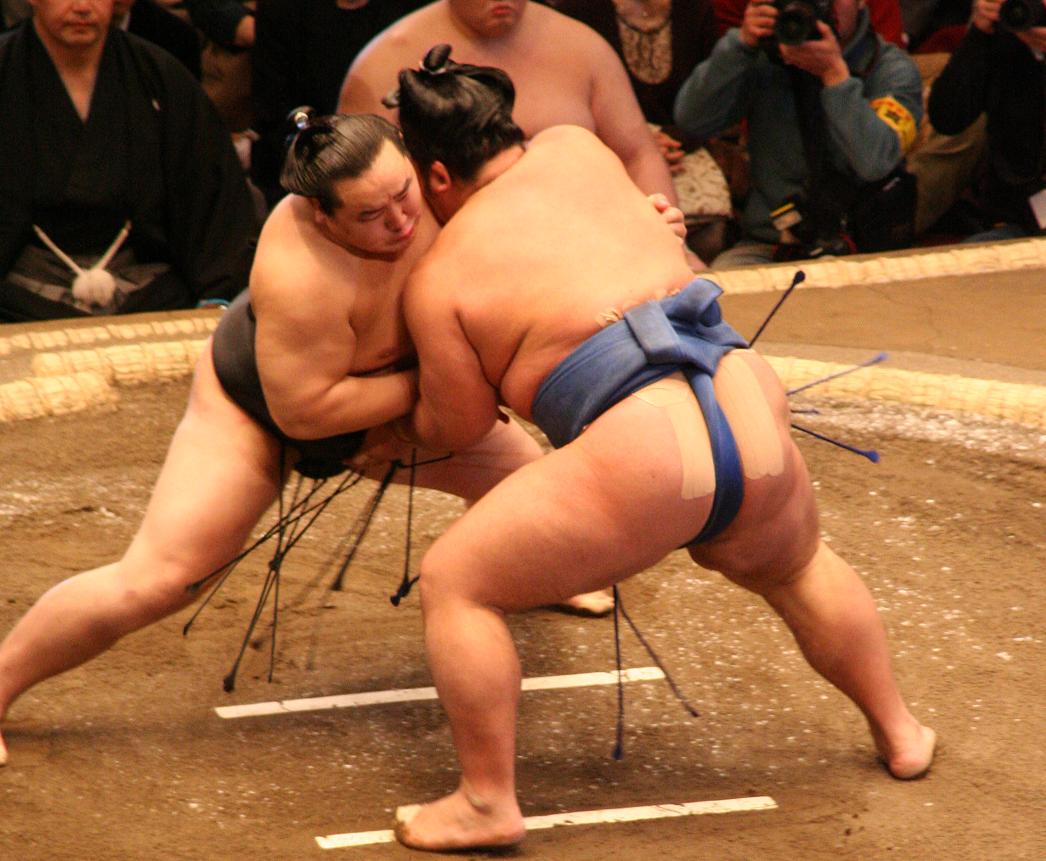
This may mean lowering your centre of gravity by bending your legs (like the sumo practitioners above). It may mean having your feet flat on the ground or it might mean making sure you have your weight directly over your feet, or one of your feet at all times. 

MOVE FROM CENTRE
This usually refers to the use of the legs and lowerback/pelvis/core to support and move the body about. To correctly move from centre the practitioner is not using extra muscles to complete the movement. I find this simple idea to be one of the most challenging to achieve in practice. Through my life I have generated certain body/movement habits. As I train myself to move from centre I am discovering these habits and am challenged to change them into new ways of moving. If you are moving from your centre correctly, your upper body is stacked on the bowl of your pelvis and will move where your centre moves. This is written too simplistically but hopefully gets my point across.

CONNECTING TO ONE'S OPPONENT
This is an extremely difficult one to explain but I will try. By making contact with another person, the practitioner can feel into their opponent's centre and take their balance. It requires a great deal of sensitivity and we spend some time every training session on this at the dojo. Ellis Amdur calls this the Listening Skill. I believe all martial arts that have elements of prolonged contact are ultimately trying to develop this. You can see this in the BJJ of the Gracies, the interplay between two fencers and the subtle Judo of Kyuzo Mifune. Once you can feel where an opponent's balance is, you can move it, take it away and ultimately control their actions.

POSTURE
Maintaining a good posture as you move is fundamental to Japanese Martial Arts. Even when a person bends at the waist they do so with a straight back. Does this mean you can't bend? No. However, where you bend from is important. Many people bend from the lower back or round their shoulders to get lower to the ground. What is better, is to bend at the hips or bend your knees. In this way you keep your centre engaged, your upper body stacked upon the pelvic bowl to tap into the power of your waist, hips and lower back. I have had both my instructor and a ballet teacher talk about 'moving around your spine'. Essentially this is the same idea. You shouldn't be twisting your spine or rounding it in a way that takes strength away from your structure. If you can spin or turn on the spot without your head moving, then you are moving around your spine and maintaining good posture. 
Throwing with good posture.
STRUCTURE
This term refers to body structure - the alignment of bones and muscle to remain stable and strong. Misalignment of the bones will cause certain muscle groups to contract to maintain stability, when this happens, an adversary can exploit this moment of increased tension. Unifying the structure of your body with sophisticated joint articulation, muscle coordination and controlled breathing leads to internal power. This is the ability to use maximum power with little effort. Threadgill sensei discusses this in depth in his book Shindo Yoshin Ryu: History and Technique. 

I believe all of the above concepts apply to good martial arts mechanics. If I see someone applying these principles, no matter what their background or training history then I know I am looking at a proficient martial artist. 

Train safe.


Wednesday, 25 April 2018

TSYR NZ in the paper!

The last time Threadgill sensei was out, our club took the opportunity to put an interest story in our community newspaper. The local paper known as the Hamilton Press sent a series of questions via email for sensei to answer then booked a time for a photo shoot down at the dojo. 


Chris McMahon and Threadgill Sensei.


You can look at the digital version of the article here.


It is a very light article but gets the point across. We are a Samurai-era historical preservation society in need of more members to preserve the teachings and techniques of Takamura-ha Shindo Yoshin Ryu. 

It is an obscure pastime that only a few people are interested in. This makes holding members difficult with a city of about 200,000 people. Martial arts such as karate, judo, aikido and mma dominate the community and of these people only a small portion may look into koryu. 

Our martial art also favours budo practitioners 20 + years who have already gained a dan grade in a Japanese martial art. So this narrows down future students even further. 

It is my hope that after the release of this article and increasing our digital profile with a new website, we may get one or two committed students to join our ranks. 

Wednesday, 4 January 2017

Tsune (Daily Habits)

I am currently reading Moving Towards Stillness: Lessons in Daily Life from the Martial Ways by Dave Lowry. One of the chapters that struck a note with me was about 'tsune'  which translates as the actions one does on a daily basis almost without thinking. Such activities as brushing one's teeth or putting out the rubbish are considered tsune. 

Lowry goes onto to talk about how the training process of a budoka reaches a point where it becomes part of his or her daily routine. This reminded me of something I said to myself when I first started aikido. When I first started to train I told myself that this is something I would do until life got in the way. Little did I know that training in budo would become part of my life!

I'm going to paraphrase the process a budoka goes through according to Lowry.
When a person begins practice, the new budoka's enthusiasm is high and he or she has a strong motivation to train. There is much to learn and to start with it is slow going. How to bow, simple stances and where to place one's hands and feet are the focus. This can be a tough time for the beginner but many push through this stage due to their enthusiasm.

Once the student has been exposed to the basics the learning curve shoots up. Every practice session adds something new and is fun. The budoka can't wait for the next class. Although this is an exciting time this period of rapid learning doesn't last. Sooner or later the learning levels off and the practitioner has been exposed to the main body of the martial art. 

Now is the time for polishing waza and perfecting what is already been taught. The budoka has a chance to compare himself with fellow practitioners and may notice others are doing the techniques better or with less effort. Frustration and disappointment may surface at this point. Progress in the art slows, the novelty has worn off and the training has become routine. It is tempting at this stage to find excuses for not training. "I have too much work to do." "I am feeling unwell." "I'll start again after the holidays." This period of a budoka's training is the most challenging. It is the moment when training will become part of his or her life or it will not. 

For those who persevere there is the realisation that tsune has begun to work its way into their training and so into their lives. Gradually, over time the budo has become part of the daily routine. At this point if the buodka were to miss a class, he or she may feel that something is not right, like forgetting to brush your teeth before bed. The budoka has embedded practice into the routine of his life.

 I find myself some years down the path having trained in aikido and now TSYR. When I started with the koryu bujutsu once I realised this was for me there was no question the training would become part of my life. It was integrated into my life just like aikido. 

Building my personal dojo is just another example of how much budo means to me. My wife met me as an aikidoka and knows that budo are part of who I am.

TSYR members at my dojo.

There will always be the tension between work, family and training but budo will ALWAYS be there provided my body keeps functioning as it should. I know this like I know I will brush my teeth tomorrow or that I will drive to work in the morning.

It feels so damn good writing this post and realising that tsune describes what training is for me, part of my daily routine. 

Thursday, 22 October 2015

One discipline or many?

How many styles?

What is the best? Training in one martial art or many? If more than one is of a benefit then how many more? In my opinion, there is not one good answer.


I train in TSYR and prior to that aikido. At one point I was doing both. I remember asking my aikido instructor what he thought of cross-training and he said that was fine as long as you have a foundation in one martial pursuit first.

I have met some people on that mat that have studied many martial arts through their lives but not necessarily at the same time.

What are the challenges? First there is the issue of available training time. If you have a family and a job then your time will be limited. You will have to work around those important commitments. You will need to find a club or dojo that fits in with your lifestyle. A club that trains on Saturdays is no good if you have to take your daughter to her soccer games on that day. 
If you are single with flexible working hours then things open up for you. So you have time? How do you use it? You will need to find clubs that train on alternate days so you can get to the training times. Perhaps an aikido dojo trains three times a week, on the alternate days you train in karate. 

Even if you have plenty of time to give to martial arts you have to have access to dojo or training halls nearby. Your time disappears quickly if you are travelling two or three hours to get to your training every time. It may mean moving to a larger town or city where more clubs are available. In New Zealand most towns have a Judo or Tae Kwon Do club but you need to move to a bigger place to get the variety of styles. 

Training in different martial arts certainly gives an insight into how each style trains and focuses on and you can quickly make a comparison but I'm not sure you progress as a quality martial artist as quickly. 

What is the advantage to training in one martial art? Well, if you spend all your available time on that martial art, you will get good at it sooner than a person who is spreading time across two or three martial arts (or do you?). Even here I find myself thinking of exceptions. Some people find different martial arts that compliment each other and training in one may help your technique in another. Sometimes people are just talented and pick up body mechanics and movement much easier than others so find training in more than one martial art easy.

For now let us assume we are doing one martial art and training as often as we can. What does this do for us? Firstly you are taught some fundamental skills in that martial art. Depending on that martial art you will be developing cardiovascular fitness, balance, timing and speed. As you progress you will become better and better at the different waza or kata. You will learn more waza and kata. Over time your training will take on new levels as you look more deeply into principles and ways your body has been trained to move. Hopefully you will internalise the movements that make up your martial art. They will become second nature and others will see you as being very good.
I trained in aikido for about 9 years and a large part of this training included taking ukemi. Without a doubt, that aspect of my training has been internalised and even though I train in another budo, the skills I learned before are well ingrained. There is certainly an advantage to sticking at one martial art for a long time.

What are the advantages to training across more than one martial art? Well, first of all you get to see the differences and similarities of two or more fighting systems. Maybe a technique common to both is applied differently. You get a lot of information in a shorter amount of time while you learn the basics of two or more disciplines.

The downside, and I see it as a major downside, is that this information overload can be conflicting or confusing for complete beginners. If you have never done martial arts before then you have no point of reference. You can start blurring techniques and trying things that are complete rubbish and not found in either art you are training in.

From my personal experience and from what others have told me, it would seem the safest route would be to get a grounding in one martial art first. Once you think you are at least competent in that martial art then start considering your next path.

When choosing another martial art you should either train in a complimentary art or one that has a completely different focus.

For example, Aikido is a Japanese martial art that focuses on joint locks and throws. Training in solid striking with hands and feet is not paramount. A complimentary martial art to take up would be a karate style. It is still a Japanese martial art so many terms are similar but there is a heavy focus on doing a good kick or punch. In this way you develop a more holistic approach to your training. Western Boxing would also develop good striking but due to its very different background could cause a student to develop the wrong body mechanics or mindset.

Most people I have met who have trained in more than one martial art appear to have progressed from one to another in a natural sequence. They have become better and better martial artists as they have transitioned, learning what each art had to offer. Many still have a core martial art they have their base movements in.

My current instructor trained for many years in Goju Ryu Karate. This style of karate has strong Okinawan influences and practices. He then moved into Wado Ryu karate which has Okinawan and Japanese influences. While still training in this style he began training in TSYR. This progression actually has a nice continuity about it. He started with a purely Okinawan martial art, then to a martial art with both Okinawan and the more subtle Japanese Jujutsu elements and finally to a classcial Jujutsu school. He now presents as a very proficient martial artist who can inform his current practice based on years of studying earlier arts.

Even my own less lofty journey makes sense in a way. Aikido training has elements of the more traditional jujutsu way of training and when I began training in TSYR I found some familiar elements within. I was familiar with joint locks and wearing a hakama and some of the Japanese terminology. There were certainly differences (sword work being one of them) but overall learning aikido certainly prepared me for training in TSYR.

Training for a long time in one martial art also teaches other things. One learns perseverance. To never give up and to move through frustration in yourself and your progress. You learn to trust that you will get better in time. When you take up another discipline you are familiar with starting again, learning basics and being patient with yourself and others. You also learn what your limits are in those early years. You learn to listen to your body and understand when to push through discomfort but not to push on to a point of harming yourself. Long time practitioners of the martial arts also learn how to teach themselves, how to use their time off the mat to further their training. It might be practicing sword cuts in your garage or going through rolling drills. In this way when you start a new discipline you know what it takes to progress quickly.

In conclusion, I would have to say that getting a strong foundation in one martial art and then trying others is my preferred way to train. In this way you can make better decisions in choosing your next path and making sure it is a logical progression in your martial arts journey. 


Monday, 8 December 2014

Socialising off the mat.

The budo world is a weird place. People from different races, religions and professions don traditional Japanese clothing and walk onto a matted space to practice antiquated martial techniques. We put our safety into each others' hands and then we bow, walk off the mat and continue with our lives as normal.

What happens when training is over?


At times I find it a surreal experience. We leave behind our contemporary world and enter one of etiquette, respect and controlled violence. What are we thinking?

In some dojo this is the extent of the relationship between the practitioners. However, another part of the culture can be the socialising that occurs between members at other times.

There are the seminar get-togethers. Usually a high ranking guest is in town and effort is put into booking a venue to gather after a day's training. This is often a restaurant close to the training venue. People get to talk to sensei off the mat, hear the budo stories and get to know one another a little better. It is an atmosphere that appears informal but due to the number of people quite often people are still reserved and respectful, despite the jokes being thrown around.

Then there are the talks after class. These often involve discussing organisational issues and making plans for upcoming events at the dojo. "We need to get that leak fixed." or "How do you think that new guy went today?" I will include in this events where members get together to clean the dojo or repair a part of the building. The relationships between people are more authentic than the seminar events. Usually everyone knows everyone else, at least by name and there is a feeling of camaraderie as the members work towards a common goal.

In some cases, the relationship with other members of the dojo become true friendships. They become people you can hang out with any time. The dojo may still be the focal point for many of your meetings and get-togethers but it is much more likely that you might go around to each other's house or end up getting to know each others children.

I have trained and been a member of dojo that had people mostly interact on the mat then leave. I have also been part of a dojo where each member will look out for you and catch up off the mat as well. Both were/are filled with good people.

People come to train at a dojo for many reasons. Some for fitness, some for self-defence and so on. They get out of it as much as they put in, including the relationships they form with other members. The three situations I described above allow different people to interact with others at different levels and in my opinion, that is a good thing.