Showing posts with label principles. Show all posts

Tuesday, 31 March 2020

Universal truths of budo and body mechanics

The title of this post has been taken from a quote from a martial arts friend of mine. He was discussing the cross-over he saw in internal Chinese martial arts and internal power trained in Japanese martial arts.

At the TSYR dojo where I train, we have karateka, aikidoka, judoka and gendai jujitsu folk training together. We all bring something different to the training based on our previous disciplines (in many cases people still train in that discipline). We often talk about how certain principles overlap in many of the martial arts.

A human being has a finite way of moving efficiently. By this logic, a martial artist has only a finite way to strike, apply locks or throw someone effectively. What we are noticing as we train is that we are conditioning our bodies to move more and more efficiently and as we look at the principles behind many of the techniques we see overlap in other martial arts.

Jigoro Kano and Kyuzo Mifune

Here are some of the 'universal truths' I have discovered, please note that some of these concepts are hard to explain with words alone and some have to be experienced to get the full meaning of what I am trying to say. Also I am sure I will change my mind about some of these ideas as I refine my understanding. So, a disclaimer - this is how I understand things as of now, in no particular order of importance, and they are all up for discussion.

POINT OF IMBALANCE (the third point)
Humans stand on two feet. Although this has its advantages, the major drawback is that we are not very stable compared to our four-legged counterparts. Good martial arts exploit this fact. If we trace a line between the two feet and then another line perpendicular to that one (forming a T), the end point of that line is where a person will lose balance if we put their centre of gravity there. Put very simply we have two such points, one at the front and one at the back. If you ask a friend to stand square on to you in a relaxed manner and then lightly pulled their shirt from the chest, they would tilt forward and have to step or fall over. You can move them by pushing them backwards gently as well. It doesn't matter what stance they take, there are always two points of imbalance waiting to be exploited. This concept can be found in aikido, judo, TSYR and I'm sure many other martial arts. How this is achieved depends on the martial art.

DOUBLE LOADING
So you take someones balance, so what? They will just step or readjust their weight won't they? Of course they will. To maintain an advantage the martial artist must stop this happening. Double loading/weighting is just one expression used to describe an opponent's weight being trapped in both feet so they cannot step without falling. This is hard to explain only with words. Imagine you are at that point where you are about to fall but you are so extended or compressed that if you should lift either foot, you will collapse on the ground. This is double loading/weighted. A martial artist will try and set an opponent up in this position so that they can then dictate where or how the opponent will move next. This might result in a strike, throw or joint lock. Double loading takes away an opponent's options. Without a secure base they cannot counterattack and therefore are severely compromised.

HAVING A SOLID BASE
It is important in any martial art to move from a position of power. To maintain your own balance and be 'strong'. It is no good executing a technique while your own balance is compromised. This goes for transitioning from one movement to another as well. Should you not be in a position of balance as you move, your opponent can take advantage of this. I have heard dancers comment on the importance of 'finding the ground' with your feet at all times. They too know the importance of a solid base. 
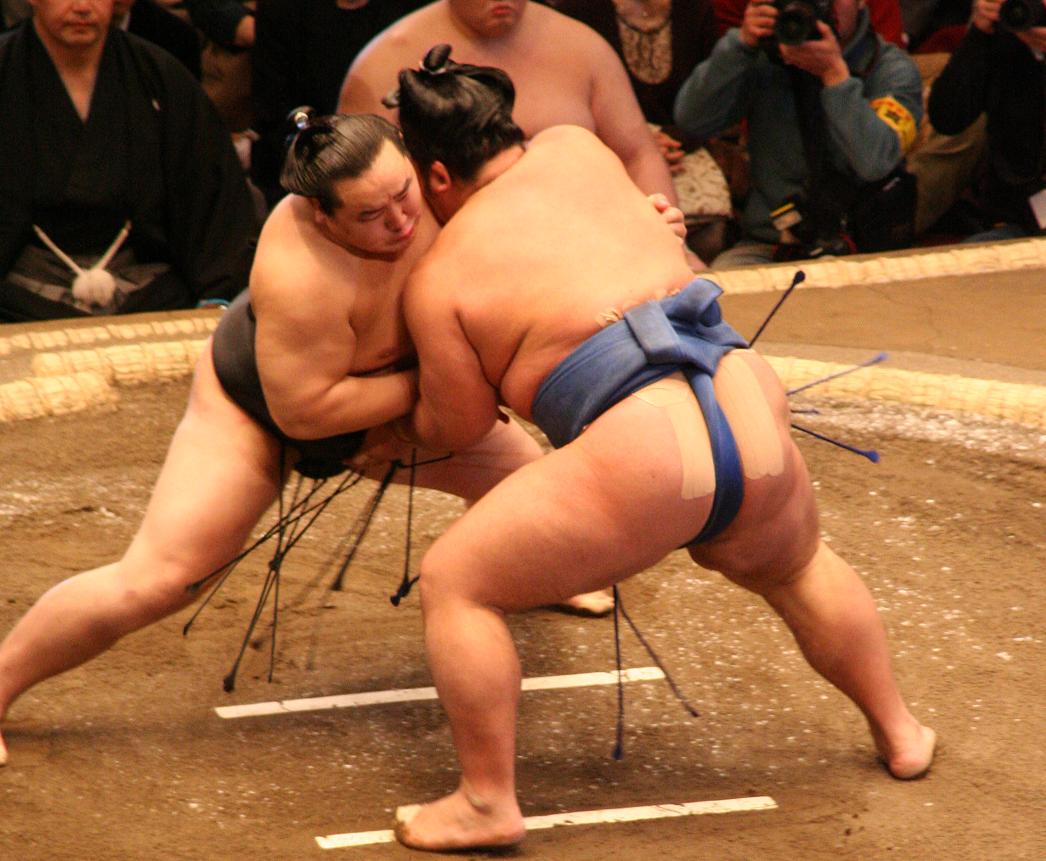


This may mean lowering your centre of gravity by bending your legs (like the sumo practitioners above). It may mean having your feet flat on the ground or it might mean making sure you have your weight directly over your feet, or one of your feet at all times. 

MOVE FROM CENTRE
This usually refers to the use of the legs and lowerback/pelvis/core to support and move the body about. To correctly move from centre the practitioner is not using extra muscles to complete the movement. I find this simple idea to be one of the most challenging to achieve in practice. Through my life I have generated certain body/movement habits. As I train myself to move from centre I am discovering these habits and am challenged to change them into new ways of moving. If you are moving from your centre correctly, your upper body is stacked on the bowl of your pelvis and will move where your centre moves. This is written too simplistically but hopefully gets my point across.

CONNECTING TO ONE'S OPPONENT
This is an extremely difficult one to explain but I will try. By making contact with another person, the practitioner can feel into their opponent's centre and take their balance. It requires a great deal of sensitivity and we spend some time every training session on this at the dojo. Ellis Amdur calls this the Listening Skill. I believe all martial arts that have elements of prolonged contact are ultimately trying to develop this. You can see this in the BJJ of the Gracies, the interplay between two fencers and the subtle Judo of Kyuzo Mifune. Once you can feel where an opponent's balance is, you can move it, take it away and ultimately control their actions.

POSTURE
Maintaining a good posture as you move is fundamental to Japanese Martial Arts. Even when a person bends at the waist they do so with a straight back. Does this mean you can't bend? No. However, where you bend from is important. Many people bend from the lower back or round their shoulders to get lower to the ground. What is better, is to bend at the hips or bend your knees. In this way you keep your centre engaged, your upper body stacked upon the pelvic bowl to tap into the power of your waist, hips and lower back. I have had both my instructor and a ballet teacher talk about 'moving around your spine'. Essentially this is the same idea. You shouldn't be twisting your spine or rounding it in a way that takes strength away from your structure. If you can spin or turn on the spot without your head moving, then you are moving around your spine and maintaining good posture. 
Throwing with good posture.
STRUCTURE
This term refers to body structure - the alignment of bones and muscle to remain stable and strong. Misalignment of the bones will cause certain muscle groups to contract to maintain stability, when this happens, an adversary can exploit this moment of increased tension. Unifying the structure of your body with sophisticated joint articulation, muscle coordination and controlled breathing leads to internal power. This is the ability to use maximum power with little effort. Threadgill sensei discusses this in depth in his book Shindo Yoshin Ryu: History and Technique. 

I believe all of the above concepts apply to good martial arts mechanics. If I see someone applying these principles, no matter what their background or training history then I know I am looking at a proficient martial artist. 

Train safe.


Saturday, 27 January 2018

Chokes and Throws.

It is very hot in New Zealand at the moment with temperatures reaching up to 30 degrees Celsius. There is something about training in the extremes of temperature that I enjoy. Stepping off the mats with skin wet with sweat is invigorating. My body feels loose and supple and I have the warm buzz of exercise flowing through my veins. 

This morning's training at the Hamilton Dojo was great. We don't officially start classes for another week so we have been working on a collection of waza from the Chuden syllabus. Today we started with chokes. We worked through ten different ways to wrap our arms around someones neck. By themselves, these chokes are just a list of possible options. But when combined with certain kata we practice, things start to make sense. One of the chokes is in fact the attack uchitachi initiates in one of the idori kata. So learning how to do this choke correctly aids shitachi in performing the correct response to escape and counter. Another one of the chokes is used part way through a different kata. Understanding what the choke is attempting to do helps shitachi perfrom it correctly. 


After swinging on each others' necks for awhile we moved to some of the chuden idori. Now, these are fun!  I can still remember when Robbie Smith sensei introduced us to these techniques. They are quite...memorable. The first technique starts in a similar way to a shoden level kata but ends, wait for it, with a choke. Being on the receiving end of this kata is not very nice. Threadgill sensei has some stories about people losing bowel control with this one as they can be choked out very quickly. The second idori kata we practiced involves someone coming up from behind to choke you but you counter and throw them. It is quite dramatic.

After idori kata we went to standing throws. The throws we were shown today work off concepts we are taught in the shoden syllabus. It was satisfying seeing the progression of techniques from the "basic" five throws we learn morphing into other variants or versions of the same concept. We are told often that the shoden mokuroku holds some of the key principles and concepts of the school and it is obvious in moments like these how true it is. An understanding of the Shoden syllabus really does make learning the Chuden stuff easier as the waza are often an extrapolation of an idea or movement learned previously. 

All in all it was a great session today. 


Sunday, 23 July 2017

Training in July (winter)

Well, it has been a very wet week here in the hills above Cambridge, NZ. The South Island has suffered severe flooding and a state of emergency has been declared in certain areas. However, training continues here.


My instructor, Chris has been overseas and left me to run the classes in his absence. The reality is that only a few of us are left to train while both Chris and Nat are gone so during the week we trained at the Hamilton Dojo and on the Saturdays we trained at the Te Miro Dojo.

I have been thinking about the way we train when Chris is away. We are left to work through our training problems and must rely on our own muscle memory and notes to do the techniques correctly. We have video footage of Threadgill sensei and notes of senior students to look at as well.

One tool we use are the key principles of the Ryu. If what we are doing is not working we return to principles. The more we train, the more we see the principles emerging in different techniques. It is empowering to solve a problem and push through our training on our own. Many times Threadgill sensei has mentioned one point or another and we think we are doing it but we are not. Then we have an epiphany during our training and realise he had been telling us that all along.

We watch our posture and structure a lot. We check the position of our shoulders compared to our hips and elbows. If our shoulders are ahead of our hips, we are often using too much arm force and not letting the lower body provide power. We watch the spine and check to see if we twisting or bending our spine in unhelpful ways. Things like this help us stay true to the training.

I have also enjoyed training over intense cold days (well as intense as it gets in our temperate climate) and very wet ones. There is something invigorating about trudging out to the cold dojo and forcing my limbs to get moving to warm up. Then afterwards feeling the warm glow that only post-training brings. Staying active in the colder months is important for health in my opinion.

The last couple of weeks has been satisfying and affirming of where we are in our training while our teacher is away.

Sunday, 27 November 2016

Theory versus Practice.

The cycle of learning is an interesting one in Martial Arts training. On the surface, an instructor explains or shows a technique and a student tries his or her best to copy. This sequence is repeated time and time again, over this time the student starts to learn these techniques and perform them without guidance.


Sometimes there is an aspect of the technique that the student simply fails to do correctly. The instructor then patiently explains what he is expecting the student to do. Maybe he uses an analogy to help describe the positioning or movement. The students attempts to do the technique again and is still stuck on the same point. 

Sometimes the student understands what is being asked of him or her but still does the technique incorrectly. They struggle to take what they know and express it with their body. 

This idea of 'knowing' but not 'doing' has occurred with me many times. Even when I am absolutely sure what I am supposed to do, I can't get my body to do it. It can be very frustrating. Eventually, at some point the transition is made where finally after many attempts, hours, days or months later I can finally do the technique the way my instructor wants it done. So what is happening?

Well to start with it could be a neuromuscular phenomenon. I might not yet have the coordination to move those particular muscles in that particular way. So I see my sensei do a technique and I monkey it. However, my version doesn't look the same. I haven't got the same coordination as my sensei so my muscles may fire in a different sequence or even the slightly wrong muscles fire to achieve a similar outcome. 

Some of the biggest changes to the neuromuscular system occur during tasks that require explosive movements or when muscles are put under high loads. This sums up a lot of budo. Neural pathways linking to target muscles become more efficient at transmitting the message. As motor units send the stimulus from nerve to muscle, more and more often, the better they get at it. Messages don't get sent to the wrong muscles en route and messages also get to their target muscles with increasing speed and less delay. 

The martial arts often talk about the mind-body connection and this is what I think they are talking about. You have in your mind the movement (theory) and you attempt to make your body do it (practice). 

The world of theory seeks understanding while the world of practice simply wants to act. If all a martial artist does is sit in his arm chair and reads all about the concepts found in budo then can he call himself a martial artist? On the other hand, if the martial artist simply starts kicking, punching, and throwing without instruction, how does he know he is even doing things correctly?  
We must try and find a balance between the two. 

Discussing these two ideas, theory and practice reminds me of something I read once. This was about the way Japanese teach and learn martial arts and how westerners teach and learn. The traditional Japanese method involves little instruction from the sensei. He will show techniques then ask the students to do them. He may say "No, not like that, like this." and repeat the movement. But no further instruction. A whole lesson may go by with the student being told, "No, not like that, like this." The student diligently repeats a movement over and over, hoping to capture the technique of their sensei. There is not a lot of talking in this kind of dojo.

A western instructor (and student for that matter), talks more. He or she will show the technique, answer questions from the students and talk abut why a technique is done a certain way. Students will try the technique and stop and ask more questions. The sensei will try different ways to explain what is happening. 

Both methods have their value. You could argue that the Western method is more theory-based while the Japanese method is more practice-based. Is one better than the other?  I don't know. I believe that we could talk less in some western dojo and perhaps Japanese instructors could take the time to explain things further. 

The danger for any martial artist is losing the balance between theory and practice. When I am on the mat I am conscious of the amount of time I spend talking about a technique rather than simply getting on and training. You can talk all day about how to place your feet or get the right positioning, but it is sometimes better to just get on with the training and work it out. One thing that can come out of the Japanese style of training is how observant the student becomes. As they cannot rely on the sensei so much for instruction they tend to look very closely at what he is doing. They pick up things that a western mindset might not. 

If you spend too much time trying to make a technique work and not listening to your sensei then you have another problem. Your training will venture off course and what you end up doing is not what your instructor asked you to do. You will lack the understanding behind why the technique is done that way and may hurt yourself or training partners accidentally. I know some stories where good martial artists are asked how they do something and they say "I don't know, I just do what my teacher did." This is no problem for that student but the martial art suffers because that person will struggle to pass on the art in any depth. 

TSYR is a funny beast as it tends to attract intellectuals. I'm not sure why, maybe its the history and culture associated with it, maybe its the complexity of the art itself. What ever the reason it is easy for some people to become too academic on the mat and try to think about the movements too much. Theory creeps in and tries to make a home. 

Even the most accomplished martial artists must continue to put theory into practice. I once asked my past sensei, Robbie Smith what was the key to ongoing training in the martial arts and he said, "Find a source." He was saying that you need a teacher to set the standard by which you can follow and keep training. This avoids your training straying. He was bothered by people who taught martial arts but never trained for themselves anymore. They would run a class, speak at length about the philosophy of the art, demonstrate the technique then let the students train. These teachers had let the balance tip heavily towards theory and had almost given up practice. 

So where do you see yourself on the continuum between theory and practice?


Monday, 3 December 2012

Idori


In TSYR idori is the practice of doing empty-hand techniques from the kneeling position. In aikido this same practice is often called suwari waza.

Why do we train in this manner? What is the point of trying to neutralise an opponent while kneeling when we would not find ourselves in this position on a day to day basis? Of course, the answer lies within the context of which we train. Aikido’s roots can be traced back to Daito Ryu, an older, more traditional martial art, TSYR is itself a koryu (old school). Both these arts trained their students based on what was required at the time. Japanese warriors would often find themselves kneeling in the house of a higher ranking lord as it was considered rude to have one’s head above a superior’s. Kneeling, instead of sitting, was common place. Therefore, it was prudent to learn how to defeat one’s opponent from this position. So what value does this type of practice present to today’s student? I believe kneeling practice has great value. First of all, leg strength and flexibility is developed. Secondly, powering techniques from the centre (hara) is developed as it is harder to ‘cheat’ with these techniques by just using arms or changing angles.

What interests me about kneeling techniques is that in both TSYR and aikido, traditionally they were taught early in a student’s training along with and often before standing techniques. However, as time as gone on this seems to have been reversed, perhaps to satisfy the western mind-set or to accommodate the westerner’s lack of flexibility, I’m not sure which. I might go even further to say that in aikido, suwari waza training is reduced as certain instructors age and find their knees are damaged and so they can no longer demonstrate the techniques. Whatever the reason, idori/suwari waza has taken a step back in the training sequence. There has been some discussion in TSYR of ensuring beginning students are exposed to idori and the headmaster of the school has allowed some instructors to teach from the chuden curriculum to ensure core skills are developed. It is my understanding that some of the kneeling techniques were originally in the shoden curriculum. Also, a few aikido instructors still incorporate suwari waza from early on in a student’s training as these instructors see the importance of the training. During demonstrations Morihei Ueshiba (founder of aikido) always started with suwari waza before moving on to standing taijutsu.
There are many things to learn in kneeling practice, just simply moving out of seiza to attack while keeping your base is a challenge, initially. This practice alone is a fundamental skill and key to hara development in my opinion. Should you rise incorrectly your attack will be weak and your balance compromised easily and quickly. Rising to receive such an attack also must come from a strong base powered by the hara otherwise the attack will succeed or even if you deflect the attack your balance is lost and you present openings to your opponent.

Kneeling practice is hard. In today’s world we do not sit in seiza very often, let alone move about on our knees. Some aikido dojos drill shikko (knee-walking) where the student s are expected to move up and down the dojo on their knees. The goal is to do this in a smooth manner where the hips do not bob up and down but move on the same horizontal plane. This is difficult but very useful for kneeling practice. I was in such a dojo and value the training greatly. It has enabled me to participate fully in TSYR idori and maintain my structure throughout the movements.

I recommend to anyone reading this to persevere with this training despite the immediate discomfort it brings. Do a little often and over time your tolerance will increase until you can practise these techniques for an hour without complaint.

Thursday, 2 August 2012

Power Not Strength


I have just finished reading a translation of Miyamoto Musashi’s, Five Rings. Something he mentions often in the book is using power not strength and quickness not speed. While training in the kenjutsu kata on Tuesday night it was becoming more and more apparent that it is easy to say, “Use power not strength, use quickness not speed.” And I can even understand it conceptually but putting into practice is a whole other thing. There is a kata in the second set called Yoko Ate. This translates roughly as Side Strike. The intention of this movement is to deflect an incoming strike with a strike of your own but at the same time clearing a line of entry to counter. I have not been able to perform this kata “with power” ever since I was taught it somewhere near the start of last year. However on Tuesday night I think I cracked it!

Of course I cannot guarantee that I will get it right every time, but at least I have an awareness of what I am supposed to feel when I get it right. You see, my understanding of the phrase “power not strength” means to move from your centre and do not rely of individual muscle groups to do the work. Not only does this generate a lot of power, it is an efficient way to move and you are less likely to have your arms or shoulders tire so easily. I knew I was doing Yoko Ate wrong because I was using my arms so much to whack the incoming strike away, due to the tension generated in my wrists I was often too slow to defend a fast, committed attack and my shoulders were getting tired. The trick is to generate tension in the hara and legs then suddenly release this in a whipping type motion to knock the attack away. I thought I was doing this but then sensei came over and specifically talked me through creating the tension in my lower body and legs. I had an ‘aha’ moment when I released this tension during the technique and it actually worked well.

This idea of generating power in the hara is not a new idea nor is it original to TSYR but it is the first time I have really got it.

Monday, 8 August 2011

Techniques and Principles

Often during my training, I find myself being caught up in the finer details of getting a technique right. At this time my sensei, whoever it may be (aikido or TSYR) will often mention a certain prinicple of the art that will correct the technique I'm struggling with. It is easy to forget that the techniques are merely a tool or medium through which to teach a principle. This has become clearer and clearer to me as I practise both arts. Principles are the underlying concepts that make an art what it is. The techniques are what we see, externally. Bend the arm this way, place your feet like this. The body moves a finite number of ways, many techniques are similar across different martial arts. However, the principle guides technique and the difference lies in how the technique feels when it is applied. Someone who is a good technician can get the same result on the surface but at a deeper level it feels hollow. Principles are applied to many techniques and a practitioner who grasps a principle will have stronger technique. Now, I often try to see the principle behind the technique that I am learning.
What is really intriguing is how many principles overlap in the two arts I study. Such things as moving from the centre, pushing (never pulling), upright posture and of course, timing and placement of one's body in relation to the opponent.