Recently training has focused on kenjutsu and battojutsu on Wednesday evenings. On Saturday mornings we have been working on taijutsu kata and idori. Things are really starting to click. I'm retaining more and more of the kata now and the new kata are easier to remember as the TSYR principles underlie all the techniques.
Recently we were split into two groups. One group worked on the Shoden kumitachi and another group worked on the first set of the Chuden kumitachi and then moved into the first few kata of the next set. There is so much to learn (I seem to be always thinking this). As always I must work on obtaining the correct mindset for TSYR sword work. The physical application of the kata is only the beginning, the intent and mental application is just as important.
As I have been training I have been delving deeper into the bits and pieces of a sword. For a while now I have been determined to remove the mekugi (bamboo pin) from the handle of my sword. Ever since I have had the sword the mekugi has been jammed in so hard I have not been able to get it out. Armed with a hammer and two blocks of wood, I took my sword outside and placed it across the blocks. Then using a modified roofing nail I hammered on the pin until it finally moved. It took many more strikes before it loosened and was knocked out. Before anyone growls at me, I didn't have a mekuginuki at the time and I was being careful.
I discovered that hole of the tang through which the pin went through had gouged into the pin jamming it in there. So I made a new mekugi out of a bamboo chopstick. I removed the handle and checked the tang. There was some corrosion where the tsuba had been rubbing against the metal so I sanded that back and put some sword oil on it. The tang is long and is almost the length of the tsuka, which is an indicator of a good sword, I believe.
I reassembled the handle and put the new pin in. Good as new!
Showing posts with label kenjutsu. Show all posts
Showing posts with label kenjutsu. Show all posts
Saturday, 19 April 2014

Thursday, 31 October 2013
The Long Slog Ahead...
I'm reflecting on the training I had last night. Sensei had me partner up with another member of the group to work through a set of kata involving the sword vs. O-tanto (large dagger). I had never done these techniques before and I'm the first to tell you my sword skills are probably the weakest of my TSYR skill sets.
Can you imagine facing a swordsman with your tanto hand outstretched as an obstacle. It sure doesn't feel safe at all. The shitachi needs very good timing and entering to make the techniques work. Add to that how tired I was last night and you get to see that the session ahead was demanding.
Its one of those moments when you tell yourself that this is what I signed up for in a koryu. Sometimes training is just hard. In that situation I was the weakest practitioner and had the most to learn. I felt incompetent and frustrated with myself at times. There is a long road ahead. Constant practice is the only thing that will allow me to progress along that road. This was only one kata set of many at this level of the curriculum. It is mind-boggling to think how we are going to practise all the different kata we know enough to progress. There doesn't seem to be enough time outside of family commitments and work. However, this is what I have signed up for.
Despite what I have written above. I count myself as lucky. Lucky to have the opportunity to study a koryu in NZ. Luck enough to have an outstanding martial practitioner as my sensei and lucky to have great training partners.
So, back to the mat and back to training.
Dean.
Can you imagine facing a swordsman with your tanto hand outstretched as an obstacle. It sure doesn't feel safe at all. The shitachi needs very good timing and entering to make the techniques work. Add to that how tired I was last night and you get to see that the session ahead was demanding.
Its one of those moments when you tell yourself that this is what I signed up for in a koryu. Sometimes training is just hard. In that situation I was the weakest practitioner and had the most to learn. I felt incompetent and frustrated with myself at times. There is a long road ahead. Constant practice is the only thing that will allow me to progress along that road. This was only one kata set of many at this level of the curriculum. It is mind-boggling to think how we are going to practise all the different kata we know enough to progress. There doesn't seem to be enough time outside of family commitments and work. However, this is what I have signed up for.
Despite what I have written above. I count myself as lucky. Lucky to have the opportunity to study a koryu in NZ. Luck enough to have an outstanding martial practitioner as my sensei and lucky to have great training partners.
So, back to the mat and back to training.
Dean.
Saturday, 4 May 2013
Getting to know your sword

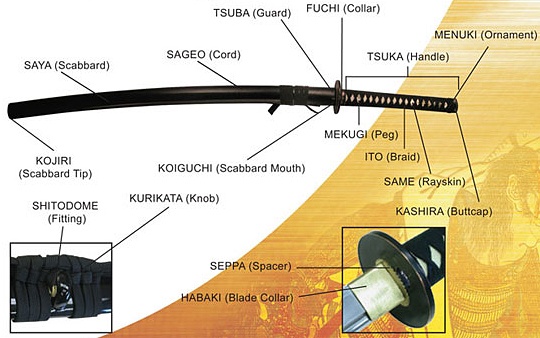
So, I now have my own, custom-made sword. It is Chinese made but was forged in the traditional manner. It is folded steel that has been differentially heated. I have made it a goal of mine to learn the Japanese terminology for the parts of the sword. I have found the whole experience fascinating. I have looked over numerous Youtube clips and other websites in my eagerness for knowledge.
So what do I know at this point (excuse the pun)?
Kissaski - the point of the sword.
Mune - the back of the blade.
Ha - the edge of the blade.
Hamon - the wavy line on the blade.
Tsuba - the guard.
Habaki - the brass piece that links blade to handle.
Seppa - the brass spacers.
Mekugi - peg that holds handle to tang.
Tsuka - the whole handle.
Same - ray skin wrap.
Saya - scabbard.
Sageo - scabbard cord.
This picture tells the story...
Of course knowing the parts of the sword allow me to look into sword disassembly and care but it is a tool for conflict and ultimately I do TSYR to learn how to use this weapon.
First there is the practise of battojutsu, or sword drawing. It is a precise discipline and there is much to be gleaned in the four kata we learn at the basic level.
However, the real challenge is simple suburi, the repetition of simple movements such as men strikes. I can swing a bokken through 100 cuts but today, I cut with my sword for 50 cuts and found that swinging a piece of steel about requires conditioning. Something I do not have as of yet. I sit writing this with aching wrists, shoulders and back muscles (also an indication that my technique is poor).
I have a long journey ahead with my sword work, it is by far the weakest part of my practice. However, having my own blade and learning its balance, weight and length is enjoyable.
Now, back to training!
Thursday, 2 August 2012
Power Not Strength
I have just finished reading a translation of Miyamoto Musashi’s,
Five Rings. Something he mentions often in the book is using power not strength
and quickness not speed. While training in the kenjutsu kata on Tuesday night
it was becoming more and more apparent that it is easy to say, “Use power not
strength, use quickness not speed.” And I can even understand it conceptually
but putting into practice is a whole other thing. There is a kata in the second
set called Yoko Ate. This translates roughly as Side Strike. The intention of
this movement is to deflect an incoming strike with a strike of your own but at
the same time clearing a line of entry to counter. I have not been able to
perform this kata “with power” ever since I was taught it somewhere near the
start of last year. However on Tuesday night I think I cracked it!
Of course I cannot guarantee that I will get it right every
time, but at least I have an awareness of what I am supposed to feel when I get
it right. You see, my understanding of the phrase “power not strength” means to
move from your centre and do not rely of individual muscle groups to do the
work. Not only does this generate a lot of power, it is an efficient way to
move and you are less likely to have your arms or shoulders tire so easily. I
knew I was doing Yoko Ate wrong because I was using my arms so much to whack
the incoming strike away, due to the tension generated in my wrists I was often
too slow to defend a fast, committed attack and my shoulders were getting
tired. The trick is to generate tension in the hara and legs then suddenly
release this in a whipping type motion to knock the attack away. I thought I
was doing this but then sensei came over and specifically talked me through
creating the tension in my lower body and legs. I had an ‘aha’ moment when I
released this tension during the technique and it actually worked well.
This idea of generating power in the hara is not a new idea
nor is it original to TSYR but it is the first time I have really got it.
Thursday, 26 July 2012
Tools of the Trade.
Most people are aware of the two swords of the samurai, the
long sword (katana) and the short sword (wakazashi). Up until now I had only
ever trained with the bokken, in other words the wooden version of the long
sword; first in aikido and now in TSYR. The way the bokken is used in my line
of aikido is to enhance taijutsu technique by applying correct body alignment
and positioning. The weapon work informs the empty hand waza. This could also
be said to be true in TSYR except the attitude behind the sword work differs
greatly. Aikido is about conflict resolution where both the attacker and
defender are given the opportunity to reconcile their differences. In TSYR the
philosophy is very basic – kill your opponent. These attitudes effect the
kenjutsu. Aikido operates in large circles and attempts to place both the
attacker and defender out of harm’s way. TSYR kenjutsu is far more direct and
quick. The emphasis is on small deflections, direct strikes and one obvious
loser. The thing is, TSYR technique is very circular or made up of spirals as
well, but the movements are small, sometimes just a matter of millimetres. Now
imagine the mental intensity this creates. After an hour of kenjutsu training
in TSYR I get a good sweat going. Not because of the physical demand but
because of the intense concentration that it requires. Attacks have to be
strong and committed, deflections and counter attacks have to be timed well and
precise.
Needless to say it has been a challenge switching mind-sets
from one art to another for the sword work. Now our sensei has been exposed to
some of the kata using other blades; the tanto (which we train with already),
the O-tanto, and the wakazashi. With the introduction of these other weapons I
get a feeling that we are really delving into an obscure, ancient tradition.
Aikido has tanto practice, but nothing like the kata I’ve experienced in TSYR.
I haven’t had the opportunity to see all the kata with these weapons but the
rationale behind them appears to be that ultimately a warrior wants to fight
with his long sword. However, there will be times when he has been disarmed or
caught without his primary weapon and needs to know how to defend himself with
the shorter blades.
The curriculum of TSYR appears to be vast, in fact it has
some 135 kata, and things get complex. It is exciting to be venturing into this unique
world where a person is assessed by their ability to maintain their posture and
composure under ever-increasing physical and mental challenge.
Good fun!
Dean.
Thursday, 19 July 2012
A slice of training life
On Tuesday my instructor had recently come back from his seminar in the USA with Toby Threadgill. There is a requirement in the ryu that the head of each study group/dojo travel to the States once a year for these seminars. So Robbie was back with renewed vigour and plenty to tell us. We spent the evening working on one of the Chuden level paired sword kata. I had only observed one of these kata before so I had plenty to see and learn. I have always used an old bokken that I bought for aikido. However the TSYR bokken are different. They are generally longer (especially the handle) and are more curved. So I am looking at getting one of these bokken as the frustration of essentially bringing a toothpick to a stick fight is starting to get to me.
I have been struggling with a knee injury for the last 6 weeks and Tuesday was the first time in that long that I could train in both aikido and TSYR without my knee giving out. The aikido club numbers have shrunk but maintains an average rank of shodan so the quality of training is good. Only two of the club members are kyu grades now. We had a great Tuesday night with good intensity and plenty of fun.
Only about a month to go before Toby Threadgill lands on our shores again and there is plenty to learn in that time. I can't seem to get enough training in at the moment. Either injury or family commitments tend to keep me away from the dojo. It might just be one of those years. I certainly haven't trained as much as I had at the same time last year. What is suffering most of all is my body conditioning due to the lack of internal strength training and in aikido, my sword work is becoming a confused mess as it seems to clash with the body habits of the TSYR sword movement. The only solution is to carefully nurse my knee back to health before the head of our school arrives and train on.
Yours on training.
Dean.
I have been struggling with a knee injury for the last 6 weeks and Tuesday was the first time in that long that I could train in both aikido and TSYR without my knee giving out. The aikido club numbers have shrunk but maintains an average rank of shodan so the quality of training is good. Only two of the club members are kyu grades now. We had a great Tuesday night with good intensity and plenty of fun.
Only about a month to go before Toby Threadgill lands on our shores again and there is plenty to learn in that time. I can't seem to get enough training in at the moment. Either injury or family commitments tend to keep me away from the dojo. It might just be one of those years. I certainly haven't trained as much as I had at the same time last year. What is suffering most of all is my body conditioning due to the lack of internal strength training and in aikido, my sword work is becoming a confused mess as it seems to clash with the body habits of the TSYR sword movement. The only solution is to carefully nurse my knee back to health before the head of our school arrives and train on.
Yours on training.
Dean.
Thursday, 10 March 2011
Sword work
I have been away from a computer for a short time so the experiences I write about today have occurred over more than one training session.
Last Saturday started with the internal strength exercises, which I am still very bad at. Then we returned to a few taijutsu techniques I had seen before and a couple of new ones. We also practised some judo-type throws. The really new stuff was the kenjutsu training. Part of the kenjutsu training is the etiquette that goes along with using a sword, it is very new and fascinating for me. I am learning the first set of kata in the shoden curriculum. They are short kata but there is plenty to learn within these seemingly simple movements. Timing, posture, breathing, grounding are all important. By the end of the Saturday training I had learned the first two kata to a rudimentary level.
I then turned up to the Tuesday training. Prior to the TSYR training is my own aikido training. Sensei was looking at initiating movement before connecting with uke. This way uke is caught up in your momentum at the moment they make contact. One of the kyu grades thanked me for my help with his Irimi Nage at the end of class. The TSYR training is giving me insights into relaxed movement and opportunities to exploit openings and this is turn is aiding my ability to teach better aikido technique. We also practised randori and I was uke for a lot of that. Good for my fitness level.
Now, onto the TSYR training for that night...
More kenjutsu. This time training along side another guy who has just started. We added a third kata to our small repertoire. I really like the third kata. It involves a block then a strike that traps the attacker's arm with your own blade. There is a feeling of winding the body tight during the block and then unwinding into the second movement. Very cool.
Tuesday night was a contrast of training experiences. The aikido training is familiar and has many teenagers training which makes it feel more casual. Compare this to the TSYR experience of every adult on the mat fully focused and more experienced than myself. Although sensei did mention that I was catching on quick. I feel I need to so I don't slow the progress of the others down.
Last Saturday started with the internal strength exercises, which I am still very bad at. Then we returned to a few taijutsu techniques I had seen before and a couple of new ones. We also practised some judo-type throws. The really new stuff was the kenjutsu training. Part of the kenjutsu training is the etiquette that goes along with using a sword, it is very new and fascinating for me. I am learning the first set of kata in the shoden curriculum. They are short kata but there is plenty to learn within these seemingly simple movements. Timing, posture, breathing, grounding are all important. By the end of the Saturday training I had learned the first two kata to a rudimentary level.
I then turned up to the Tuesday training. Prior to the TSYR training is my own aikido training. Sensei was looking at initiating movement before connecting with uke. This way uke is caught up in your momentum at the moment they make contact. One of the kyu grades thanked me for my help with his Irimi Nage at the end of class. The TSYR training is giving me insights into relaxed movement and opportunities to exploit openings and this is turn is aiding my ability to teach better aikido technique. We also practised randori and I was uke for a lot of that. Good for my fitness level.
Now, onto the TSYR training for that night...
More kenjutsu. This time training along side another guy who has just started. We added a third kata to our small repertoire. I really like the third kata. It involves a block then a strike that traps the attacker's arm with your own blade. There is a feeling of winding the body tight during the block and then unwinding into the second movement. Very cool.
Tuesday night was a contrast of training experiences. The aikido training is familiar and has many teenagers training which makes it feel more casual. Compare this to the TSYR experience of every adult on the mat fully focused and more experienced than myself. Although sensei did mention that I was catching on quick. I feel I need to so I don't slow the progress of the others down.
Subscribe to:
Posts (Atom)