A while ago (during my first year of TSYR training) I mentioned that the body conditioning exercises were changing the musculature of my back and some re-wiring of the nervous system was going on.
This is an update.
After 2 and a half years of doing these conditioning exercises this is how things have progressed...
When I work through some of the exercises and then carry this feeling of good body alignment into my techniques it feels like most of my postural muscles are engaged. So all those muscles that allow for good posture fire. For me these are the trapezius muscles, lats, some deep abdominal muscles, hamstrings, calf muscles, even muscles that pull my flat feet into better alignment. Everything feels like it gets pulled tight like a spring. Now this is not a tensing of the muscles to the point of rigidity or stiffness. The feeling is spring-like. There is stability but bounce - for want of a better word.
Other muscle groups that seem to get attention during training are the triceps. Basically every muscle group on the posterior of my body gets some sort of workout when I train. Now this intrigues me because when I think of strength I think of rock hard abs and broad pectoral muscles. However, the tone and the muscle soreness a couple of days later is almost always centred on muscles on the rear side of my body.
As some of the larger muscle groups strengthen, the conditioning exercises then seem to target smaller muscle groups to maintain correct alignment. I really do feel like I am ironing out the kinks when I perform this routine. This conditioning is having a large effect on my techniques. I move from a place of strength and balance more often. I can power the technique with a coordinated body rather than certain muscle groups trying to force it into happening. It is exciting and empowering at the same time.
I can't help thinking that Morihei Ueshiba, Sokaku Tekada and other men that influenced the creation of Aikido must have moved with this power. Aikido techniques make more sense from this viewpoint. Certainly people like Ellis Ambur and Stanley Pranin seem to suggest this.
Along with this training develops a strong awareness of your own balance and where your body is in space. This sensitivity is key to effective TSYR technique. During some of the faster, freestyle like training we do, one can start to sense when your opponent has lost their balance, or given it back to you. This can result in counters and is incredibly subtle.
Monday, 15 July 2013

Keeping the momentum
Over the last little while my TSYR group has steadily improved our knowledge of the shoden kata. We all pretty much know the basic form of each kata. Now we need to look a little deeper and start to improve on this foundation.
This got me thinking about maintaining the drive and motivation to train. In TSYR the curriculum is very large so there is always the excitement of learning a new kata. However, how do we keep the ones we have already learned fresh?
Here are some things our group has been trying:
1) deviate from the form slightly. If the kata is set using a single hand grab, how would we complete the technique from a punch? This challenges the practitioner to problem solve but stay true to the principles of that kata. We do this slowly and deliberately.
2) semi- freestyle practice. Allow the attacker to throw a punch, single-hand grab or double hand grab. The recipient must then perform one of the set kata. This can happen slow or fast. It checks how many of the kata have become internalised. If a punch is thrown or your hands are seized and you freeze...what good is your technique?
3) faster! Perform the set kata with more speed and more smoothly. Move past, the paint-by-numbers mentally that we all must start with. Trying to go faster often exposes holes in one's technique.
All of the above are only useful if the practitioners have a reasonable grasp on the basic kata. Complete novices would be confused and it would slow their progress, not improve it.
Of course, the best thing you can do to keep motivated in your training is to always self-critique. Have I got my balance? Have I taken my partner's balance? Am I keeping good body alignment/structure throughout the technique? Am I safe to move into that position? and so on and so forth.
Keep training!
This got me thinking about maintaining the drive and motivation to train. In TSYR the curriculum is very large so there is always the excitement of learning a new kata. However, how do we keep the ones we have already learned fresh?
Here are some things our group has been trying:
1) deviate from the form slightly. If the kata is set using a single hand grab, how would we complete the technique from a punch? This challenges the practitioner to problem solve but stay true to the principles of that kata. We do this slowly and deliberately.
2) semi- freestyle practice. Allow the attacker to throw a punch, single-hand grab or double hand grab. The recipient must then perform one of the set kata. This can happen slow or fast. It checks how many of the kata have become internalised. If a punch is thrown or your hands are seized and you freeze...what good is your technique?
3) faster! Perform the set kata with more speed and more smoothly. Move past, the paint-by-numbers mentally that we all must start with. Trying to go faster often exposes holes in one's technique.
All of the above are only useful if the practitioners have a reasonable grasp on the basic kata. Complete novices would be confused and it would slow their progress, not improve it.
Of course, the best thing you can do to keep motivated in your training is to always self-critique. Have I got my balance? Have I taken my partner's balance? Am I keeping good body alignment/structure throughout the technique? Am I safe to move into that position? and so on and so forth.
Keep training!
Thursday, 20 June 2013
Tetsubo, iron fans and pointy things
The samurai were a walking arsenal of weapons. Not only did they carry a long sword and a second, shorter blade (wakazashi or tanto), but they would most likely have on their person a variety of other, smaller back-up weapons.
My instructor has recently returned from Colorado where he has been taught a range of new kata. One such set of kata concentrate on the use of the tetsubo (iron bar) in combat. This bar is approximately 1 foot long and may or may not have a curved extension on it like a half sai. The kata are very direct and brutal with target areas being the neck, ankles, knees and head. In some cases I believe the iron fan can be substituted for the bar. Last night for our Wednesday training we were taught the 5 kata concerning these secondary weapons. The tetsubo/iron fan was worn on the opposite side to the swords and used used in times when the sword was not accessible for whatever reason.
Another weapon of the samurai was the metal implement tool, it basically looks like a really sharp chop stick and was used for a variety of things outside of combat. Of course, being practical types, the samurai learned how to defend themselves with such a tool. I have yet to see the kata associated with that weapon.
I am really enjoying not only seeing these techniques demonstrated but also participating in the kata. It is becoming obvious where similar body movements and principles are overlapping from earlier kata I have been taught.
This is an exciting time to be in TSYR and with the news that Toby Threadgill will be travelling to NZ in December with two senior members of the ryu it can't get any better, can it?
My instructor has recently returned from Colorado where he has been taught a range of new kata. One such set of kata concentrate on the use of the tetsubo (iron bar) in combat. This bar is approximately 1 foot long and may or may not have a curved extension on it like a half sai. The kata are very direct and brutal with target areas being the neck, ankles, knees and head. In some cases I believe the iron fan can be substituted for the bar. Last night for our Wednesday training we were taught the 5 kata concerning these secondary weapons. The tetsubo/iron fan was worn on the opposite side to the swords and used used in times when the sword was not accessible for whatever reason.
Another weapon of the samurai was the metal implement tool, it basically looks like a really sharp chop stick and was used for a variety of things outside of combat. Of course, being practical types, the samurai learned how to defend themselves with such a tool. I have yet to see the kata associated with that weapon.
I am really enjoying not only seeing these techniques demonstrated but also participating in the kata. It is becoming obvious where similar body movements and principles are overlapping from earlier kata I have been taught.
This is an exciting time to be in TSYR and with the news that Toby Threadgill will be travelling to NZ in December with two senior members of the ryu it can't get any better, can it?
Tuesday, 28 May 2013
Body dropping
The fine art of body dropping or "tai otoshi" is the ability to suddenly drop your body but keep your alignment intact as you do so. It is a crucial part of TSYR and I enjoy training this body movement. It is not as easy as it sounds. What tended to happen when I first tried this was that I would let my arms "float". Or, as I dropped my body, my hips would pop backwards and ruin my alignment. Both these things are detrimental to keeping connection to your partner and maintaining good body alignment. The idea is to drop through your spine, this requires a completely upright posture through the whole movement.
Please don't confuse what I am talking about with the tai otoshi used in judo like throws. It is not a technique in itself but a body principle. Once I had some idea how to do it, I could use the body drop to throw partners once kuzushi was made. The effect is fast and dramatic and often it occurs before your partner realises what is happening. There is no 'tell'. As body movements such as these are refined, it gets harder and harder to tell when the uke/uchitachi is about to be thrown. It comes down to complete control of your own body to control another. The more you can isolate and manipulate your own structure, the easier I is to manipulate someone else on contact.
Of course the conditioning exercises that we do to develop a budo body aid in also developing such movements as tai otoshi.
Please don't confuse what I am talking about with the tai otoshi used in judo like throws. It is not a technique in itself but a body principle. Once I had some idea how to do it, I could use the body drop to throw partners once kuzushi was made. The effect is fast and dramatic and often it occurs before your partner realises what is happening. There is no 'tell'. As body movements such as these are refined, it gets harder and harder to tell when the uke/uchitachi is about to be thrown. It comes down to complete control of your own body to control another. The more you can isolate and manipulate your own structure, the easier I is to manipulate someone else on contact.
Of course the conditioning exercises that we do to develop a budo body aid in also developing such movements as tai otoshi.
Saturday, 4 May 2013
Getting to know your sword

So, I now have my own, custom-made sword. It is Chinese made but was forged in the traditional manner. It is folded steel that has been differentially heated. I have made it a goal of mine to learn the Japanese terminology for the parts of the sword. I have found the whole experience fascinating. I have looked over numerous Youtube clips and other websites in my eagerness for knowledge.
So what do I know at this point (excuse the pun)?
Kissaski - the point of the sword.
Mune - the back of the blade.
Ha - the edge of the blade.
Hamon - the wavy line on the blade.
Tsuba - the guard.
Habaki - the brass piece that links blade to handle.
Seppa - the brass spacers.
Mekugi - peg that holds handle to tang.
Tsuka - the whole handle.
Same - ray skin wrap.
Saya - scabbard.
Sageo - scabbard cord.
This picture tells the story...
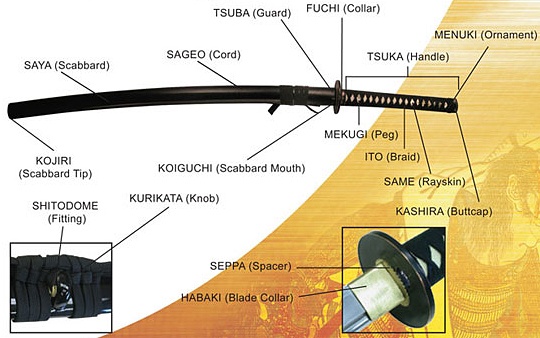
Of course knowing the parts of the sword allow me to look into sword disassembly and care but it is a tool for conflict and ultimately I do TSYR to learn how to use this weapon.
First there is the practise of battojutsu, or sword drawing. It is a precise discipline and there is much to be gleaned in the four kata we learn at the basic level.
However, the real challenge is simple suburi, the repetition of simple movements such as men strikes. I can swing a bokken through 100 cuts but today, I cut with my sword for 50 cuts and found that swinging a piece of steel about requires conditioning. Something I do not have as of yet. I sit writing this with aching wrists, shoulders and back muscles (also an indication that my technique is poor).
I have a long journey ahead with my sword work, it is by far the weakest part of my practice. However, having my own blade and learning its balance, weight and length is enjoyable.
Now, back to training!
Saturday, 13 April 2013
Kneeling, standing and swinging swords.
Training was intense today. We started with the body conditioning exercises then moved into idori kata. After this we practised a set of kata that was new for me involving the short sword versus the long sword and then we finished with some intense training moving through the various sets of taijutsu kata at pace.
I enjoy the idori as it has similarities to the suwari waza of aikido and my body responds well to it. I can keep my alignment intact and maintain my centre most of the time. My taijutsu technique is getting sharper and quicker all the time and I've had moments of disappearing into the kata to find myself at the end of it without really remembering the steps. You know, that feeling you get while driving a car and you realise you have just driven the last 10 minutes without being fully conscious of it. This is an indicator to me that my body is internalising the movements.
The short sword kata were challenging Timing is extremely important in these kata as the opponent with the longer blade has the advantage. I only worked on the first one of this set as I had not been exposed to them before and that was enough. It was tough.
As for the sword work in general? Terrible! For some reason, when I pick up a bokken my body alignment goes downhill. It is frustrating to say the least because I feel off balance or not centred and I am struggling to fix it. Of course, sensei notices as well and is constantly reminding me how I'm doing it wrong. To top it off, we train the sword work on Wednesday evenings when my brain is trying to shut down for the day. There are times I really hate that training but I continue to turn up because I know I am progressing at some level.
Now my first, new sword is arriving any day from the Kaicho and I am very excited as this will mean I can train at home and work out this issue I have with sword work. Having a blade custom made is quite humbling it makes it mine in every sense of the word. Another member of the group brought back a cheaper version from Japan and it is quite obvious how the quality differs. It is one thing to see these swords on a website but quite another to see them, hold them and inspect the quality close up.
I enjoy the idori as it has similarities to the suwari waza of aikido and my body responds well to it. I can keep my alignment intact and maintain my centre most of the time. My taijutsu technique is getting sharper and quicker all the time and I've had moments of disappearing into the kata to find myself at the end of it without really remembering the steps. You know, that feeling you get while driving a car and you realise you have just driven the last 10 minutes without being fully conscious of it. This is an indicator to me that my body is internalising the movements.
The short sword kata were challenging Timing is extremely important in these kata as the opponent with the longer blade has the advantage. I only worked on the first one of this set as I had not been exposed to them before and that was enough. It was tough.
As for the sword work in general? Terrible! For some reason, when I pick up a bokken my body alignment goes downhill. It is frustrating to say the least because I feel off balance or not centred and I am struggling to fix it. Of course, sensei notices as well and is constantly reminding me how I'm doing it wrong. To top it off, we train the sword work on Wednesday evenings when my brain is trying to shut down for the day. There are times I really hate that training but I continue to turn up because I know I am progressing at some level.
Now my first, new sword is arriving any day from the Kaicho and I am very excited as this will mean I can train at home and work out this issue I have with sword work. Having a blade custom made is quite humbling it makes it mine in every sense of the word. Another member of the group brought back a cheaper version from Japan and it is quite obvious how the quality differs. It is one thing to see these swords on a website but quite another to see them, hold them and inspect the quality close up.
Sunday, 10 March 2013
Putting Spirit in Sword Kata
 |
| Morihei Ueshiba and son. |
I'm reflecting on my Saturday training session. We covered many facets of TSYR. Ukemi practice, body throws, some very old, technical kata and finally batto (sword drawing) and sword kata. As I don't yet own my own sword, I was paired up with the only other guy there who was swordless and we practised kumitachi with bokken. We worked on the two sets from the Shoden level. We know these kata well now so we are now trying to refine them, refine them and refine them some more. One aspect we were working on is investing a stronger presence or spirit in our actions. When both people are deeply invested in the kata this creates an almost tangible tension that locks the two together. When the kata finally finishes, I feel a sense of relief or calmness as the tension falls away. It is incredibly meditative.
I recently read that the key is to ensure that our training is intense enough is to encourage enough risk that we feel challenged but not overwhelmed. By providing a strong fighting spirit for our partner to deal with we help hone their edge. The difference between someone who is just going through the motions and someone who is fully invested in each moment is marked! The idea is to consider each kata a life and death scenario where you are looking for an opening in the other person's defences. There should be a feeling of pressing your opponent at all times, even when you are taking the role of the 'loser'. In this way you both develop and become stronger budoka for the experience.
Subscribe to:
Posts (Atom)