Sunday, 14 June 2015

Back into it!

Well, its been a while, in that time I have shifted house, helped my wife through her father's death and got on with my job, my training and raising my two girls. 


Today I am writing about the tips and thoughts my sensei, Chris and another training buddy, Pete brought back from two weeks away at the TSYR instructor's seminars in Colorado, USA. They attended the Shoden Instructor's seminar and Chuden Instructor's seminar over this time.  

First and foremost, they are both happy with where our dojo is in regards to the quality of our practice and technique. This is important as New Zealand is a long way from other dojo, in particular hombu, so knowing we are on the right path is good. 

Secondly, Threadgill sensei has decided to rearrange some of the kata in the syllabus. This appears to make a lot of sense and I don't want to go into too much detail here but Takamura sensei did move some of the kata around due to the type of students he had when he began in the United States. Threadgill sensei thinks the time is right to move some of these kata back to where they were. Ultimately, this means that the order that the kata are learned will change slightly. This does not affect our group very much as we have practised most of the kata involved at one time or another anyway.
What is exciting is that there are three throws being introduced back into the shoden curriculum which I have not practised before. However, due to the principles that we adhere to I was amazed to find how easy it was for the group to learn these throws quickly. They are in fact, easier than the throws we had been doing but we can see how they give a foundation for more advanced throws later on. 

Finally, sensei talked about some points to our practice that we need to refine or tweak. It is always exciting to hear and see what these points are so we can continue to refine and perfect our martial art. 
It is moments like these that I appreciate how both my past sensei, Robbie Smith and my current sensei, Chris can see the principle behind a technique and distill it down and teach it back to us. It is this type of instruction that makes us as good as we are, in my opinion. As a group we are moving past needing to know where to place our feet and hands for a technique and are seeing more of the greater whole of the TSYR curriculum, We are seeing how each part fits together like a puzzle. 

It was great to have these guys back and just to show you how crazy these two are with their training. They came along to the Saturday morning training which starts at 9am having arrived back in the country at 5am that same morning!

Now that is dedication.


Sunday, 22 March 2015

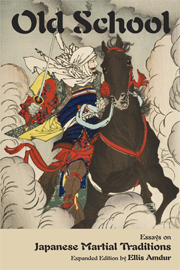
A Review of 'Old School' by Ellis Amdur.

I have recently finished reading Old School: Essays on Japanese Martial Traditions the expanded edition by Ellis Amdur.


First of all let me say that I have always enjoyed reading anything written by Ellis. He has a way of taking dry history and weaving it into a dramatic story that sometimes has a no-holds-barred feel about it. So I was very keen to start reading this book.

The structure of the book is divided up into five sections.
Part One: Something Once New
Part Two: Essays on Japanese Weaponry
Part Three: History and Tradition
Part Four: Nothing Stays the Same: Martial Traditions from the Edo Period.
Part Five: The Sinew of Classical Martial Traditions.

I will review the book by taking my favourite pieces from each of the five parts and highlight some things that stood out for me as a practitioner of a classical Japanese martial art.

Part One introduces the reader to some of the oldest koryu (old schools) still being practised today. The most famous perhaps being Tenshinsho-den Katori Shinto-ryu. The other two I had never read about before, Maniwa Nen-ryu and Higo Ko-ryu. Reading about these other two ryu encouraged me to have a look on Youtube and I found a nice clip of Nen Ryu and it was just like Ellis had described.
It is here if you are interested. Nen Ryu
Also found Higo Ko Ryu, keep in mind that Amdur's description of the ryu helps immensely in understanding the movements on the clip.

Ellis gives the reader plenty of information on the three ryu, including samples of the syllabus and key features of each ryu and the context in which these ryu were established.

The most outstanding passage from this first section of the book is how Ellis writes with such reverence about Kino Shizue, 14th generation headmaster of Higo Ko Ryu. Kino Sensei had just finished a shiai but one more opponent waited to one side to compete with her. The announcer had decided that enough time had been spent on 'old folks' matches and wanted to move things along. Kino sensei refused to move from the floor despite the pleas from the announcer and officials. She stood there silently.

Eventually Kino Sensei got her way and Abe Toyoko of Tendo-ryu walked out to challenge her.

The fight between these two ladies was not typical of shiai. They did not need judges to tell them if a hit had been scored. Every strike was considered a killing blow and each woman knew it. The two ladies stalked each other around the hall with few attacks made and fewer landing. When a strike did hit home a loud crack was heard around an otherwise silent hall. At some point they both decided the match was over and walked off. It is an amazing story and shows the character of these stoic, honest women. If this character can be imbued into current practitioners of koryu it would be a good thing indeed. It was a great way to end Part One.

Part Two was probably my least favourite part of the book. It discusses the evolution and development of three of Japan's classic weapons. The naginata (halberd), kusarigama (chain and sickle) and chigiriki (flail). Ellis studies ryuha which incorporate the use of naginata and this is apparent in his knowledge and obvious interest in this weapon. He tells us how the romantic ideal of warrior monks turns out to be nothing more than mercenaries hired by religious sects. He also investigates how the naginata evolved from a foot soldier's weapon to one associated with women samurai. 
He debunks myths around the origins of the kusarigama and discusses how three versions of the weapon are still used. He holds no punches in critiquing these weapons and the kata they are used in.
The Chigiriki is an odd weapon I had not even heard of before reading this book. It is a strange weapon that stands out among the other Japanese weapons. Again, Ellis can speak with authority over this weapon as it is utilised in one of the ryu he studies. 

Although this section is packed with information, I struggled to relate to some of the material as I have never trained with any of the weapons mentioned or studied the ryuha mentioned. I diligently read it for completeness but was not as inspired or interested in the text compared to the other chapters. 

Part Three felt the most typical of historical text. This did not make it less interesting for me as Ellis keeps it 'alive' by his writing style and he reveals a lesson to the reader by telling the tale. What this section showed clearly to me was that the ryuha are often complex, political and have much more in common with each other than some people may think. All it takes is a particular person in history to use his knowledge of previously learned martial schools and then combine certain elements from all schools to create their own style. Through generations schools may split into factions but key elements can be identified as belonging to such-and-such ryu and despite the two schools having nothing to do with each other for generations, the key elements still exist. 

This section also discusses the role of women warriors in Japan. Again, the reader can tell Ellis has a soft spot for this topic and one can't help thinking that the fact one of his teachers was a woman that he has a great respect and reverence for these ladies that follow martial pursuits. He also returns to the topic of the naginata as predominantly the weapon of the female budoka in the current age. 

Part Four was truly a highlight for me. First let me explain that this section discusses at length how these old Japanese traditions have moved into the 21st Century. Ellis discusses Tenshinsho-den Katori Shinto-ryu, Honma Nen-ryu and Yoshin-ryu specifically as examples on how this has occurred. Of course this discussion cannot occur without mentioning World War Two and what that meant for the traditional martial arts. In fact, the end of this war would spell the end of some of the schools as its practitioners were either killed in the war or left with old men with no students due to the stigma that had been associated with the old ways of thinking. Competitive fencing and Kano's Judo must be discussed here as well. Both influenced the classical Japanese martial arts and how they changed or adapted to survive. 
Ellis takes each ryu and writes about how they continued to be sustained at different points in their history. He highlights the importance of certain men and decisions that allowed the ryu to stay at least slightly relevant in its time to ensure it continued on.  
I must mention how excited I was to read the chapter on Yoshin-ryu, obviously important in my understanding of Takamura-ha Shindo Yoshin Ryu, the art in which I train. There was nothing more satisfying than understanding the roots of one's own school and the events and people that allowed this ryu to survive. When I read a family tree of TSYR what I miss are the human elements and interactions that help me better understand how the school came about. Ellis provided some of this for me. Ellis writes about a foreigner called Erwin Baelz who was pivotal in getting Japanese interested in classical martial arts again around the 1870s (just after the modernisation of Japan) and he may have been the catalyst that enabled the koryu to continue when Japanese minds had their thoughts on Western ideas and values.
Of course, I once again got to read about Matsuoka Katsunosuke the founder of Shindo Yoshin Ryu, merely 28 years old when he announced his new style. After him came many other important names that I recognized such as Obata Shigeta and Takamura Yukiyoshi to name a few. It was nice to read about Takamura sensei from an outsider's point of view. 

Part Five was a short section that touches on important aspects of any koryu. That of the more esoteric religious and philosophical viewpoints that are woven into the fabric of each ryu. Ellis briefly discusses Shinto, Taosim, Neo-Confucianism, Mikkyo, and Shugendo. He also dedicates a chapter to Keppan (blood oaths) and what they mean to the modern practitioner. 

At the very end of the book is a glossary to help the reader define the many Japanese terms found within the text.

Overall I found Ellis to write respectfully about people and their martial schools but gave honest critique when he felt he had the authority to do so. He added splashes of colour to historical events that helped me stay engaged with the passages of text. Occasionally he added subtle humour that had me chuckling to myself. I believe this book has relevance to anyone who is practising koryu whether your specific school is mentioned in the book or not. 

I must thank my friend, Jules, for acquiring a copy for me. I am very grateful.  


Tuesday, 20 January 2015

Aiki in Aikido

I do not actively practise aikido right now. However, it is still in my heart and I wish to return to it in the near future. Circumstances may allow this to happen soon.


I left aikido to pursue TSYR. I had to decide between the two martial arts as my time was at a premium with a young family. Now, with my girls getting older, very soon, hopefully I will return to aikido training once more.

So I find it timely that I stumbled upon this article by Ellis Amdur.

This article resonated with me for a couple of reasons. First and foremost, I have always believed the founder of Aikido was a man of remarkable skill and ability as a martial artist. Like many founders of martial arts he had a certain presence and the backing of important people that allowed him to be successful but ultimately it was his martial prowess that won many people over. However, over the generations, we are not seeing students of aikido emerging with similar skills. Why not? In my opinion, Morihei Ueshiba had developed a different way of powering his techniques that most of his students simply didn't pick up. Ellis Amdur states this much more eloquently in his book, "Hidden in Plain Sight" so I won't even attempt to articulate further.

So it was that I went on the search for a martial art that could teach me how to develop internal strength. I found TSYR.

Secondly, the article talks about incorporating internal strength into aikido practice and this is something I have been thinking about for some time. I am very interested in studying this further and I have dabbled with moving with a connected body using the shapes of aikido techniques. It will take some time but inspired by the article I think there is value in pursuing it. 

So the irony is, my TSYR training may end up informing my aikido practice. Isn't that interesting?


Wednesday, 17 December 2014

Enter the Kaicho, yet again.

Toby Threadgill.
Takamura Ha Shindo Yoshin Ryu.

TSYR Kaicho, Toby Threadgill was back in NZ for about 6 days. He arrived on a Thursday and had a day's rest before we started our closed seminar on Friday.

Friday training started with kuzushi no kata. These are a set of verbally transitted kata that teach important balance breaking principles. Sensei decided to take it up 'a notch' and made them more challenging as we refined them and performed them with a higher level of connection and alertness.
After lunch we practised battojutsu (sword drawing). This is always challenging and I had an argument with my sword. It was refusing to do as it was told resulting in jerky movements and ugly cuts. I find this a demanding practice that requires precision and patience. Both of which I lack at times.

Saturday training started with chuden hand escapes which are done from idori (kneeling). I find these kata fascinating. Lots of good internal principles can be learned and applied in these kata. Lots of tips about moving tension around the body and correct use of the hara to develop power.
After lunch was batto torikaeshi which is how to protect yourself against someone attempting to take your sword. Again, sensei refined what we were doing and added another layer. He was teaching us how to make our technique softer and lighter. This of course makes it more powerful in the long term. Many of these techniques make the uchitachi believe he has control of the sword but he never does. He does not realise this until he finds himself in a compromised position and often with the blade of the sword coming at him! We looked into mental disruption as well by using our swords instead of bokken to get a better understanding of the dynamics between ken and saya. Something that cannot be achieved with bokken alone.
Sensei showed some henka. I had the privilege to be on the end of one of these versions and it was exciting!

Saturday night was the official social gathering where we go to a restaurant and eat and be merry. One of our members always brings a good supply of sake.

Sunday was an open seminar in Auckland. I did not attend this but it was very positive by all accounts.

Then sensei was back at the Hamilton dojo for the TSYR members to work through their training Monday Tuesday and Wednesday. I had a day with my two daughters on Monday but was able to get to the morning sessions on Tuesday and Wednesday.

Tuesday morning focused on the kumitanto. I enjoyed these very much and once again Sensei Threadgill was in top form as he showed us how to refine these movements and I felt, once more just how powerful his connected strikes can be. For the first time in my life I had both my feet lifted from the ground as I was struck. I have witnessed such feets on video and often think the person receiving the strike is taking a fall. But to actually have my own centre taken so strongly was amazing.

Wednesday morning saw us take a look at the tanto disarms. This is a set of kata I struggle with to some degree. Again Sensei was on hand to make corrections and also took us through some sensitivity drills to try and get us to make our techniques lighter.

Its always great to see those who travel to Hamilton to train with us as well. It is quite a commitment to make every seminar and it is a credit to those members.

It was a great experience and I learned many things. I now have plenty to think about in the coming months before Sensei Threadgill's next visit in 2015.


Monday, 8 December 2014

Socialising off the mat.

The budo world is a weird place. People from different races, religions and professions don traditional Japanese clothing and walk onto a matted space to practice antiquated martial techniques. We put our safety into each others' hands and then we bow, walk off the mat and continue with our lives as normal.

What happens when training is over?


At times I find it a surreal experience. We leave behind our contemporary world and enter one of etiquette, respect and controlled violence. What are we thinking?

In some dojo this is the extent of the relationship between the practitioners. However, another part of the culture can be the socialising that occurs between members at other times.

There are the seminar get-togethers. Usually a high ranking guest is in town and effort is put into booking a venue to gather after a day's training. This is often a restaurant close to the training venue. People get to talk to sensei off the mat, hear the budo stories and get to know one another a little better. It is an atmosphere that appears informal but due to the number of people quite often people are still reserved and respectful, despite the jokes being thrown around.

Then there are the talks after class. These often involve discussing organisational issues and making plans for upcoming events at the dojo. "We need to get that leak fixed." or "How do you think that new guy went today?" I will include in this events where members get together to clean the dojo or repair a part of the building. The relationships between people are more authentic than the seminar events. Usually everyone knows everyone else, at least by name and there is a feeling of camaraderie as the members work towards a common goal.

In some cases, the relationship with other members of the dojo become true friendships. They become people you can hang out with any time. The dojo may still be the focal point for many of your meetings and get-togethers but it is much more likely that you might go around to each other's house or end up getting to know each others children.

I have trained and been a member of dojo that had people mostly interact on the mat then leave. I have also been part of a dojo where each member will look out for you and catch up off the mat as well. Both were/are filled with good people.

People come to train at a dojo for many reasons. Some for fitness, some for self-defence and so on. They get out of it as much as they put in, including the relationships they form with other members. The three situations I described above allow different people to interact with others at different levels and in my opinion, that is a good thing.


Thursday, 14 August 2014

Polishing the Mirror.

When polishing the mirror, one is refining technique. You have the big dots connected. You know the basic look and shape of the kata. Now it is time to dig deeper, study further.


Recently our new sensei (Chris) came back with another member of the club from a two week intensive training session with Toby Threadgill. What he brought back were subtle tips and pointers to further our understanding of each of the kata in the Shoden Mokuroku (first level of the curriculum). Each time we get together for training, sensei is going over some of these tips.

I am finding these training sessions very enlightening and exciting. We remarked with one another how we had been over-thinking some of the techniques. Now they seemed simpler but more effective. However, these tips would be meaningless to someone new to the martial art. There is assumed knowledge in these new pointers. It is refinement of our current technique. Someone completely new would take the advice in the wrong way or simply not know what it meant.

Bits of the puzzle are starting to fit together for me now. Certain principles keep appearing throughout the different sets of kata. Some movements are similar. Others that appeared similar are now obviously different and teaching a different lesson within the same set. This seems logical. Why have two kata teaching the same thing in the same set?

As a group we are entering an interesting crossroads where we have the step by step instructions for beginning students but we are moving forward with our own training and Toby is refining what we do. Sometimes Chris would ask Toby which the right way for doing a technique was? This or that? Toby would say both. One is how it is done for beginners, the other a more advanced version.

Chris was able to go through the entire Shoden syllabus while away, refining, questioning and adapting. So far we have looked at the first kumitachi set, the sword disarms and defence against sword disarms. I had to miss one other session due to family commitments.

I look forward to the next training session as he goes over more of his notes from Hombu.

Wednesday, 6 August 2014

Training the Right Way

I walked away from training today thinking about the experiences I had on the mat that day. Then I stumbled upon a blog by Budo Bum and he was speaking about training right. He speaks about training hard but only as hard as your technique can handle. The balance between training with intensity and training slow enough to keep the technique correct is difficult to achieve.

Too much intensity can turn to thuggery.

If you train with high intensity too often your technique can get sloppy. In TSYR, ideally techniques are done in a relaxed manner so not to telegraph your intentions. If you try to force techniques and tense up in the process this is counterproductive to what you are trying to achieve. The end result is that your opponent notices or feels this tension and responds accordingly. At greater speed and with stronger intention both from the attacker and the defender's viewpoint, these subtleties can be lost. In extreme situations it begins to look like thuggery as one or both training partner's lose their centre and overbalance at certain times through the kata or technique. Techniques get cranked on without awareness of body structure and the lesson is lost and increases the chance of serious injury in the dojo.

However, doing the kata slowly and deliberately all the time can have its down side. People start to get a false sense of their abilities. Yes, you maintain structure, yes you move from your centre, yes you create kuzushi but always when things are moving slowly. If the situation is hyped up this can all fall apart very quickly. In this situation people who think they are competent suddenly get a wake up call when someone comes charging at them REALLY trying to strike them. Often people freeze up or find their technique too weak or they switch gears to "force mode" and try to muscle the technique on.

So my point is to try a graduated approach to training. Both styles of training have their purpose but the middle ground must be obtained. A good sensei is one who can see where a student needs to be to be challenged enough for growth but not so much to push them over the edge and allow them to fall back on bad habits.

In our dojo after practising some kata for a while, slowly and deliberately, we do a more free style form of practise. We decide on three to five responses we will use against certain attacks and then have the partner attack quicker and harder than usual. We do not stop to correct mistakes or spend time discussing points. We receive five and then give five attacks. After that set we might stop to discuss points but only then. This allows us to see the holes in our techniques and truely see what parts of the kata have been internalised.
It is important that both partners know what is going on here. Uchitachi should be relaxed and pliable during this process but at the same time, if kuzushi isn't made, then uchitachi will not fall. This is not the time for uchitachi to become wooden and resist every movement as this is unnatural and relies on a certain amount of anticipation of what technique is coming. This will not teach shitachi anything. This relates of course to the idea of uchitachi being in a teaching role.

After this exchange we may change partners and do it again. Different body types add another dimension. After doing these sets a few more times we have now given ourselves plenty to work on when we go back to slow and steady next time in class.

The idea is that over time it will take faster and harder attacks to undermine our technique.

Yours in training,
Dean.