The fine art of body dropping or "tai otoshi" is the ability to suddenly drop your body but keep your alignment intact as you do so. It is a crucial part of TSYR and I enjoy training this body movement. It is not as easy as it sounds. What tended to happen when I first tried this was that I would let my arms "float". Or, as I dropped my body, my hips would pop backwards and ruin my alignment. Both these things are detrimental to keeping connection to your partner and maintaining good body alignment. The idea is to drop through your spine, this requires a completely upright posture through the whole movement.
Please don't confuse what I am talking about with the tai otoshi used in judo like throws. It is not a technique in itself but a body principle. Once I had some idea how to do it, I could use the body drop to throw partners once kuzushi was made. The effect is fast and dramatic and often it occurs before your partner realises what is happening. There is no 'tell'. As body movements such as these are refined, it gets harder and harder to tell when the uke/uchitachi is about to be thrown. It comes down to complete control of your own body to control another. The more you can isolate and manipulate your own structure, the easier I is to manipulate someone else on contact.
Of course the conditioning exercises that we do to develop a budo body aid in also developing such movements as tai otoshi.
Tuesday, 28 May 2013

Saturday, 4 May 2013
Getting to know your sword

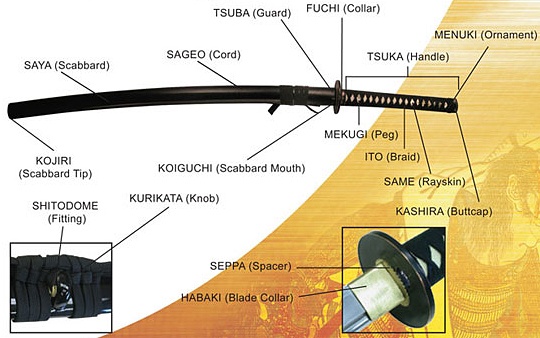
So, I now have my own, custom-made sword. It is Chinese made but was forged in the traditional manner. It is folded steel that has been differentially heated. I have made it a goal of mine to learn the Japanese terminology for the parts of the sword. I have found the whole experience fascinating. I have looked over numerous Youtube clips and other websites in my eagerness for knowledge.
So what do I know at this point (excuse the pun)?
Kissaski - the point of the sword.
Mune - the back of the blade.
Ha - the edge of the blade.
Hamon - the wavy line on the blade.
Tsuba - the guard.
Habaki - the brass piece that links blade to handle.
Seppa - the brass spacers.
Mekugi - peg that holds handle to tang.
Tsuka - the whole handle.
Same - ray skin wrap.
Saya - scabbard.
Sageo - scabbard cord.
This picture tells the story...
Of course knowing the parts of the sword allow me to look into sword disassembly and care but it is a tool for conflict and ultimately I do TSYR to learn how to use this weapon.
First there is the practise of battojutsu, or sword drawing. It is a precise discipline and there is much to be gleaned in the four kata we learn at the basic level.
However, the real challenge is simple suburi, the repetition of simple movements such as men strikes. I can swing a bokken through 100 cuts but today, I cut with my sword for 50 cuts and found that swinging a piece of steel about requires conditioning. Something I do not have as of yet. I sit writing this with aching wrists, shoulders and back muscles (also an indication that my technique is poor).
I have a long journey ahead with my sword work, it is by far the weakest part of my practice. However, having my own blade and learning its balance, weight and length is enjoyable.
Now, back to training!
Saturday, 13 April 2013
Kneeling, standing and swinging swords.
Training was intense today. We started with the body conditioning exercises then moved into idori kata. After this we practised a set of kata that was new for me involving the short sword versus the long sword and then we finished with some intense training moving through the various sets of taijutsu kata at pace.
I enjoy the idori as it has similarities to the suwari waza of aikido and my body responds well to it. I can keep my alignment intact and maintain my centre most of the time. My taijutsu technique is getting sharper and quicker all the time and I've had moments of disappearing into the kata to find myself at the end of it without really remembering the steps. You know, that feeling you get while driving a car and you realise you have just driven the last 10 minutes without being fully conscious of it. This is an indicator to me that my body is internalising the movements.
The short sword kata were challenging Timing is extremely important in these kata as the opponent with the longer blade has the advantage. I only worked on the first one of this set as I had not been exposed to them before and that was enough. It was tough.
As for the sword work in general? Terrible! For some reason, when I pick up a bokken my body alignment goes downhill. It is frustrating to say the least because I feel off balance or not centred and I am struggling to fix it. Of course, sensei notices as well and is constantly reminding me how I'm doing it wrong. To top it off, we train the sword work on Wednesday evenings when my brain is trying to shut down for the day. There are times I really hate that training but I continue to turn up because I know I am progressing at some level.
Now my first, new sword is arriving any day from the Kaicho and I am very excited as this will mean I can train at home and work out this issue I have with sword work. Having a blade custom made is quite humbling it makes it mine in every sense of the word. Another member of the group brought back a cheaper version from Japan and it is quite obvious how the quality differs. It is one thing to see these swords on a website but quite another to see them, hold them and inspect the quality close up.
I enjoy the idori as it has similarities to the suwari waza of aikido and my body responds well to it. I can keep my alignment intact and maintain my centre most of the time. My taijutsu technique is getting sharper and quicker all the time and I've had moments of disappearing into the kata to find myself at the end of it without really remembering the steps. You know, that feeling you get while driving a car and you realise you have just driven the last 10 minutes without being fully conscious of it. This is an indicator to me that my body is internalising the movements.
The short sword kata were challenging Timing is extremely important in these kata as the opponent with the longer blade has the advantage. I only worked on the first one of this set as I had not been exposed to them before and that was enough. It was tough.
As for the sword work in general? Terrible! For some reason, when I pick up a bokken my body alignment goes downhill. It is frustrating to say the least because I feel off balance or not centred and I am struggling to fix it. Of course, sensei notices as well and is constantly reminding me how I'm doing it wrong. To top it off, we train the sword work on Wednesday evenings when my brain is trying to shut down for the day. There are times I really hate that training but I continue to turn up because I know I am progressing at some level.
Now my first, new sword is arriving any day from the Kaicho and I am very excited as this will mean I can train at home and work out this issue I have with sword work. Having a blade custom made is quite humbling it makes it mine in every sense of the word. Another member of the group brought back a cheaper version from Japan and it is quite obvious how the quality differs. It is one thing to see these swords on a website but quite another to see them, hold them and inspect the quality close up.
Sunday, 10 March 2013
Putting Spirit in Sword Kata
 |
| Morihei Ueshiba and son. |
I'm reflecting on my Saturday training session. We covered many facets of TSYR. Ukemi practice, body throws, some very old, technical kata and finally batto (sword drawing) and sword kata. As I don't yet own my own sword, I was paired up with the only other guy there who was swordless and we practised kumitachi with bokken. We worked on the two sets from the Shoden level. We know these kata well now so we are now trying to refine them, refine them and refine them some more. One aspect we were working on is investing a stronger presence or spirit in our actions. When both people are deeply invested in the kata this creates an almost tangible tension that locks the two together. When the kata finally finishes, I feel a sense of relief or calmness as the tension falls away. It is incredibly meditative.
I recently read that the key is to ensure that our training is intense enough is to encourage enough risk that we feel challenged but not overwhelmed. By providing a strong fighting spirit for our partner to deal with we help hone their edge. The difference between someone who is just going through the motions and someone who is fully invested in each moment is marked! The idea is to consider each kata a life and death scenario where you are looking for an opening in the other person's defences. There should be a feeling of pressing your opponent at all times, even when you are taking the role of the 'loser'. In this way you both develop and become stronger budoka for the experience.
Thursday, 14 February 2013
Comparisons
Comparisons - I wrote this near the end of the 2012 year and forgot to post it earlier. My apologies. It is not a positive post and I wasn't going to place it here, but it is what I felt at the time and therefore my historical point of view. I don't name anyone or any club so take it how you like.
It is nearing the end of the year and tomorrow will be my
last training session of TSYR for 2012. I happened to attend the last training
session of my aikido club as well, earlier in the week. The teenage daughter of
an old work colleague of mine was grading to 4th kyu and I was interested in
seeing her progress and seeing what I could still remember of aikido. All
people on the mat participate in a grading at this dojo. So even though I was
not grading I was pairing up with people and doing the techniques asked by the
grading panel just like everyone else there. As it turns out the young woman
had a solid grading and I hadn't forgotten any of the kihon waza asked at this
level. I discussed this with my aikido sensei afterwards. How is it that I
could still perform the techniques crisply and without hesitation after being
away from training for many months? Well, the first thing that happens to any
athlete that ceases training is that their body loses condition. Of course this
is not the case with me because I am still in fact training in the martial
arts, just not aikido. I know of many examples where people have ceased
training and then returned to find that their mind is willing but their body is
not. After nine years of aikido, the techniques were still locked away ready to
be used and the fact that I was in the familiar setting of the dojo I learnt
the art in and going through the rituals of a formal grading, it was easy to
fit right in. Also of importance was the calibre of the grading, it was 4th
kyu, not very high up the ranks and the test was pretty limited as to what was
asked. However, at that level all techniques that I consider kihon were asked
for. From katatetor; ikkyo through to yonkyo and shihonage. From shomenuchi; iriminage, ikkyo and nikkyo and from yokomenuchi, any two techniques. There
were other combinations as well as the grading panel pushed the young girl to
her limits. Kotegaeshi from munetsuki, tenchinage from a two handed grab,
sumi otoshi from katate tori and so on.
As a nidan in aikido none of those techniques posed a
problem for me. But here’s the snag. I like the people I train with at aikido,
they are genuinely, nice people. However, after training elsewhere in what I
consider a potentially more dangerous art, I had concerns for my safety at the
grading. Why? The emphasis appears to be on making the technique work, come
what may. As I have trained in TSYR and my body alignment and structure has
improved, I don’t lose my centre as easily and I have become more sensitive to
the balance of my training partner. Most of the people at TSYR are even better
at this than me so when a technique doesn't work, they don’t think “push
harder” they think “what have I done wrong, where have I lost the connection?”
So they stop adjust and dump me cleanly on my backside. I had one experience during
the aikido grading where my partner was attempting ikkyo on me and he swung my
arm in the appropriate manner but simply didn't move me from my base at all, I wasn't resisting, in fact I was quite relaxed (thank goodness) and because I didn't move as expected he proceeded to try and force me down by putting his
knee into my arm as well. Now, I still didn't move as the pressure was still
being applied in the same way, but now with his knee. However, seeing where it
was going I moved appropriately and he pinned me. As I got up he said “Man,
that didn't really work, even when I put my knee in.” I'm thinking, what is
wrong with the training methodology here that an aikido practitioner of a
reasonable rank would think like that? Of course I am/was a product of the very
same dojo and I know my TSYR instructor has ironed out a few kinks in my
thinking since then. Another incident occurred when we were asked to perform
any techniques we wished from yokomenuchi. At one point I looked across to the
pair training next to me and my partner. A young black belt had a complete
novice in a dangerous technique that included a head lock with the uke’s back
arched. The poor girl didn't realise she needed to tap her leg to signal submission
and she was going red in the face while this young show-off applied the lock.
Needless to say I quietly but very firmly told him to let go and to take into
account the abilities of the training partner.
I had mixed emotions about the night. I was happy for the
girl grading as she had done a great job. I was happy that I slotted back into
the aikido dojo without any of my techniques showing any ‘rust’ and I enjoyed
catching up with people I hadn't trained with for a while. However, I was
disappointed at how no one I trained with that night showed any evidence of
good internal body structure, and during a formal occasion when things are
often at their safest, I saw/experienced some practises that were very
dangerous.
This leaves me thinking. Was the dojo always like that when
I was a consistent practitioner? I certainly know that my posture and general
body alignment was rubbish before I trained in TSYR. The grading was set up so
that only dan grades trained with kyu grades to allow most experienced to work
with least experienced. So I never got my hands on the other black belts that
night. However, all but three were my junior so I have a good idea of what they
are capable of. I honestly believe I can now see a contrast in the training
methodology of each of the two dojos I have trained in. It was not as apparent
while I was still training in both vigorously. Now that I have been away from
the aikido dojo for a while, my eyes have been opened to the differences.
A part of me wants to be involved in changing things at the
aikido dojo but it is not my place. It is my sensei’s dojo, not mine. I can
simply choose to train elsewhere and go back from time to time to keep the
bonds of friendship with the people in aikido, ignoring the aspects of training
that bother me. As the saying goes, when in Rome…
Monday, 21 January 2013
Wednesday, 5 December 2012
Solo Practice
What makes a martial artist good? Look at your fellow students in your dojo, which of them would you consider to be fine examples of your martial art? I don't just mean the black belts or senior members. Looking as objectively as you can, which individuals stand out, no matter what the experience?
I can remember a particular black belt that got me into aikido, he had been practising something like eight years before I joined. Even though there were other black belts around, he stood out for me. His posture was always good, his technical ability was sharp and he would not let me slack off on naming the techniques in Japanese or on poor form, he always strived for perfection. On top of all that he was a humble, gentle guy.
In my current training in TSYR obviously my instructor stands out. He has many of the same attributes as the person I mentioned above. Our headmaster of the school has even called him a 'freak', but in a good way, he learns new things, fast.
Why do these guys appear to be a step above the others, even of equivalent rank?
First and foremost, they are talented, there is no question. They learn by doing (kinaesthetic learners). The teaching of martial arts happens to coincide with the best way that they learn, by repeating movements of the body over and over again. They can watch someone else do the movement and pick it up very quickly.
However, there are plenty of talented people in the world. The one factor that I think sets them apart is how and when they train. They train earnestly when they are in the dojo, they use every moment to progress while on the mat. They always believe they can do better. But this is the big thing...they train outside of the dojo, often by themselves - solo work.
The aikidoka I mentioned often practised his weapon work at home by himself, going over the kata, refining each one. He would come to the dojo with questions about his training for the sensei. I asked my current instructor what he valued most in his training and he showed me a series of exercises he uses to maintain mobility and keep a strong centre. He has been doing them for years and learnt them from a guy in Thailand.
You are your best teacher. You know yourself best. Solo training, in my opinion, is key to progressing towards excellence in your chosen martial art.
The challenge of course is finding time. Once you take into account work, family and your normal dojo hours, where do you find the time (or energy) to do solo work. I have set myself a goal. To do the conditioning exercises of my art at least three times a week. One of those times will be in the dojo, so I need to find about 15 minute blocks outside of the dojo in the rest of the week to do this. Incorporated into my own training are the other exercises sensei showed me. I use these as a warm up before the conditioning exercises. I find after 15 minutes that I have quite a sweat up. As time allows, I'll move into doing these exercises every day. Some days this won't happen but that is OK, provided I achieve my three times a week.
Subscribe to:
Posts (Atom)